
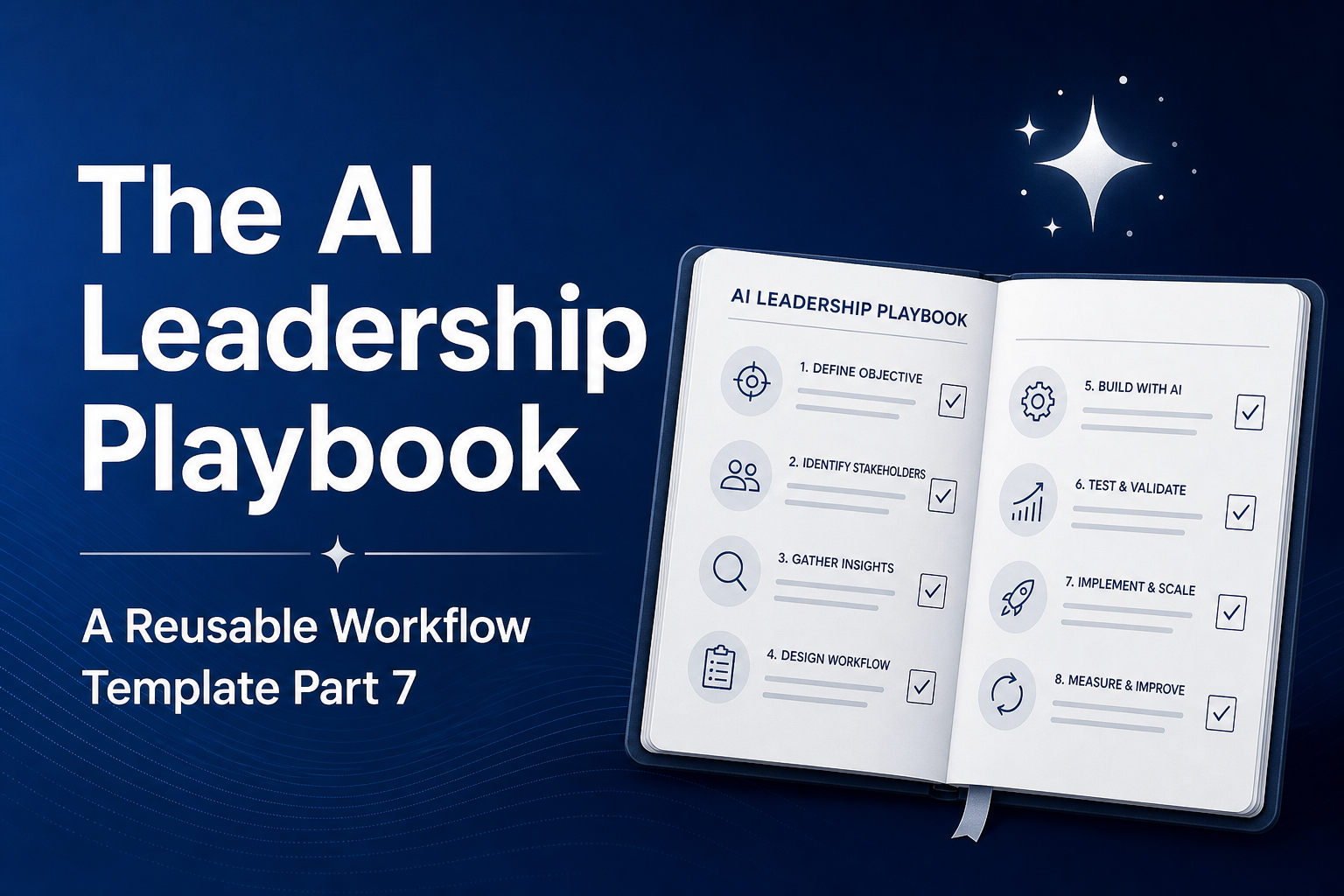
The AI Leadership Playbook: A Reusable Workflow Template#
Part 7 of the Human Skills, AI-Expanded series (capstone)
This is the last post in a seven-part series. The earlier articles gave role scenarios and prompts. This one gives you a single page you can reuse for any task: what you own, what AI may help with, which pattern fits, and how you will know it worked.
If you are new here, start with the frame: Leaders, Human Skills, and AI: What Stays Yours. For model limits, see LLM Skills and Human Skills.
Full series index#
| Part | Focus | Article |
|---|---|---|
| 1 | Frame: human vs AI accountability | Leaders, Human Skills, and AI: What Stays Yours |
| 2 | Project and program leaders | AI for project and program leaders |
| 3 | HR and people leaders | AI for HR and people leaders |
| 4 | General managers | AI for general managers and senior leaders |
| 5 | Technology executives | AI for technology executives |
| 6 | Agentic patterns | Agentic AI for business leaders |
| 7 | This playbook | You are here |
How to use this playbook#
- Copy the blank table into your notes (Notion, OneNote, or a doc).
- Fill one row for one real task this week—not ten hypotheticals.
- Run the meta-prompt at the end if you want a 5-step workflow draft.
- After you try it, answer the journal questions—honestly.
- Repeat monthly; compare rows to see what improved.
One row = one experiment. Do not boil the ocean.
Blank playbook table#
| Field | Your answer |
|---|---|
| Role | (e.g. program director, HRBP, CTO) |
| Task | (one sentence: what you must deliver) |
| Human accountability | (what you own if AI is wrong) |
| AI may help with | (repeatable core work only) |
| Pattern | Research / Draft / Monitor / Workflow (Part 6) |
| Prompt skeleton | (paste or link your prompt) |
| Approval gate | (who signs off before external use) |
| Data rules | (redaction, tool, no-go data) |
| Success metric | (how you know this helped in 2 weeks) |
| Risk | (what could go wrong) |
Three filled examples (from this series)#
Example A — Program leader (from Part 2)#
| Field | Answer |
|---|---|
| Role | Program director |
| Task | Prepare steering committee pack in 48 hours |
| Human accountability | Decisions requested, tone with sponsors, accuracy of commitments |
| AI may help with | Slide outline from status + RAID; Q&A prep |
| Pattern | Draft |
| Prompt skeleton | See steering prompt in Part 2 |
| Approval gate | I review every slide before send |
| Data rules | Redact customer names; enterprise chat only |
| Success metric | Steering finishes in 20 min with 3 clear decisions logged |
| Risk | AI invents green status; I verify against PMO data |
Example B — HR leader (from Part 3)#
| Field | Answer |
|---|---|
| Role | HRBP |
| Task | Calibration themes from anonymized comments |
| Human accountability | Fairness in room; no individual quotes; ratings unchanged by AI |
| AI may help with | Theme clusters and calibration questions |
| Pattern | Draft (one-shot, not autonomous) |
| Prompt skeleton | See performance themes prompt in Part 3 |
| Approval gate | HR director reviews themes before calibration |
| Data rules | No names in prompt; policy-approved tool |
| Success metric | Calibration agenda covers top 5 themes with evidence counts |
| Risk | Bias from past comment tone; spot-check by demographic slice |
Example C — Technology executive (from Part 5)#
| Field | Answer |
|---|---|
| Role | CTO |
| Task | One-page board brief on AI risk |
| Human accountability | What I attest is true; regulatory alignment |
| AI may help with | Risk list, control mapping draft, metric suggestions |
| Pattern | Draft |
| Prompt skeleton | See board AI risk prompt in Part 5 |
| Approval gate | Security + legal review before board |
| Data rules | Use case list only; no customer PII |
| Success metric | Board asks follow-ups we can answer with owned metrics |
| Risk | Overstated controls; legal flags gaps before meeting |
Meta-prompt: design your workflow#
Use when you want a 5-step flow with gates—not only a one-shot chat.
I am a [role] working on [task].

Human accountability: [what I must own].

AI may help with: [repeatable core work].

Constraints: [privacy, regulation, tone].

Produce a 5-step workflow with approval gates and a one-paragraph success metric.
Personal learning journal (after each experiment)#
Answer in five lines—save with the date:
- What did I ask AI to do? (one sentence)
- What was useful? (fact, speed, or option I had not seen)
- What was wrong or missing? (hallucination, tone, bias, gap)
- What did I change before using it? (edits, cuts, verification)
- Will I run this again? Yes / No / Yes with changes: ___
Over time, your “Yes with changes” list is your personal playbook.
Principles (carry everywhere)#
From Part 1:
- Core work can be accelerated; core accountability stays human.
- More autonomy → more approval gates and audit.
- If you would not send it unsigned, do not automate the send.
From Part 6:
- Pick one pattern per task: research, draft, monitor, or workflow.
- Name a human owner for every agent or recurring prompt.
Try this week (close the series)#
- Fill one blank row for your real role.
- Run it once; complete the journal five questions.
- Share the row (redacted) with one peer—compare what they would own differently.
- Bookmark this post and Part 1; skip the rest until you need that role.
- Revisit in 90 days: which experiments are still running?
Related reading#
- Leaders, Human Skills, and AI: What Stays Yours — Part 1
- AI for project and program leaders — Part 2
- AI for HR and people leaders — Part 3
- AI for general managers and senior leaders — Part 4
- AI for technology executives — Part 5
- Agentic AI for business leaders — Part 6
- LLM Skills and Human Skills — technical companion
This series ends here. Try one playbook row this week. Write down what was useful and what was wrong—both are worth keeping for your next role change or your next tool.

Comments: