
Anatomy of a Circle#
Every named part, formula, and diagram — strictly in two dimensions#
Part 16 of the Learning Quantum Physics series.
A circle is every point in the plane at one distance from a center. These names are different objects.
| Name | What it is | Formula |
|---|---|---|
| Radius | Center to the boundary | \(r\) |
| Diameter | A chord through the center | \(d = 2r\) |
| Circumference | Length of the boundary | \(C = 2\pi r\) |
| Area | The filled disk | \(A = \pi r^2\) |
| Arc | A piece of the boundary | \(s = r\theta\), \(\theta\) in radians |
| Sector | Two radii plus the arc | \(\tfrac{1}{2} r^2 \theta\) |
| Segment | The cap between a chord and an arc | \(\tfrac{1}{2} r^2(\theta - \sin\theta)\) |
A circle looks simple: all points the same distance from a center. Yet the vocabulary around it is rich — radius, chord, arc, sector, segment, radian, π, and more. Each name marks a different geometric object or measurement, and each has its own formula.
This article is a 2D reference guide. For every concept you get a short definition, the standard formula, and a labeled diagram. We stay in the plane throughout. When you need the six trigonometric functions as line lengths on the unit circle, see Six Trigonometric Functions — One Diagram. When you want to rotate or extrude a circle into a sphere or cylinder, see Conic Sections and Their 3D Shapes.
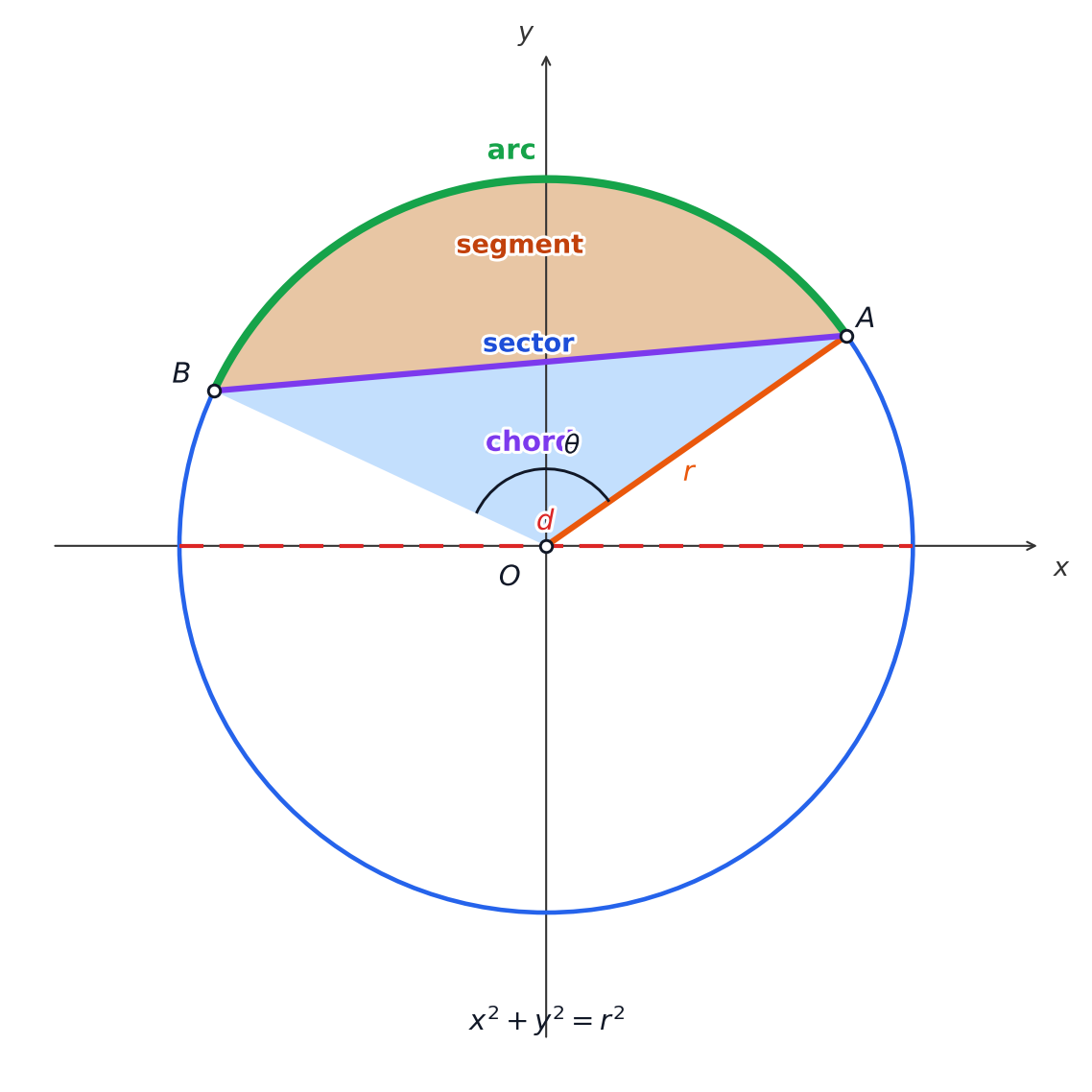
The hero figure above labels the parts that share one construction; later sections zoom in on measurements and formulas.
1. Circle and center#
A circle is the set of all points in the plane at fixed distance \(r\) from a point called the center \(O\).
\[ \boxed{x^2 + y^2 = r^2} \]More generally, a circle with center \((h,k)\) satisfies \((x-h)^2 + (y-k)^2 = r^2\). Parametrically: \(x = r\cos\theta,\ y = r\sin\theta\).
- Center \(O\) — the unique point equidistant from every point on the boundary.
- Boundary — the curve itself (the circumference); the interior is the filled disk.
The overview diagram marks \(O\) and the equation. Everything else in this article is built from center, radius, and points on that boundary.
2. Radius#
The radius \(r\) is the distance from the center to any point on the circle.
\[ \boxed{r = \text{distance}(O,\,P) \quad \text{for any boundary point } P} \]All radii of one circle are equal. In the overview figure, the orange segment \(OA\) is a radius.
3. Diameter#
A diameter is a chord that passes through the center. Its length is twice the radius:
\[ \boxed{d = 2r} \]The red dashed segment through \(O\) in the overview is a diameter. The diameter is the longest possible chord of a circle.
4. Circumference (perimeter)#
The circumference \(C\) is the length of the boundary — the 1D “perimeter” of the 2D disk.
\[ \boxed{C = 2\pi r = \pi d} \]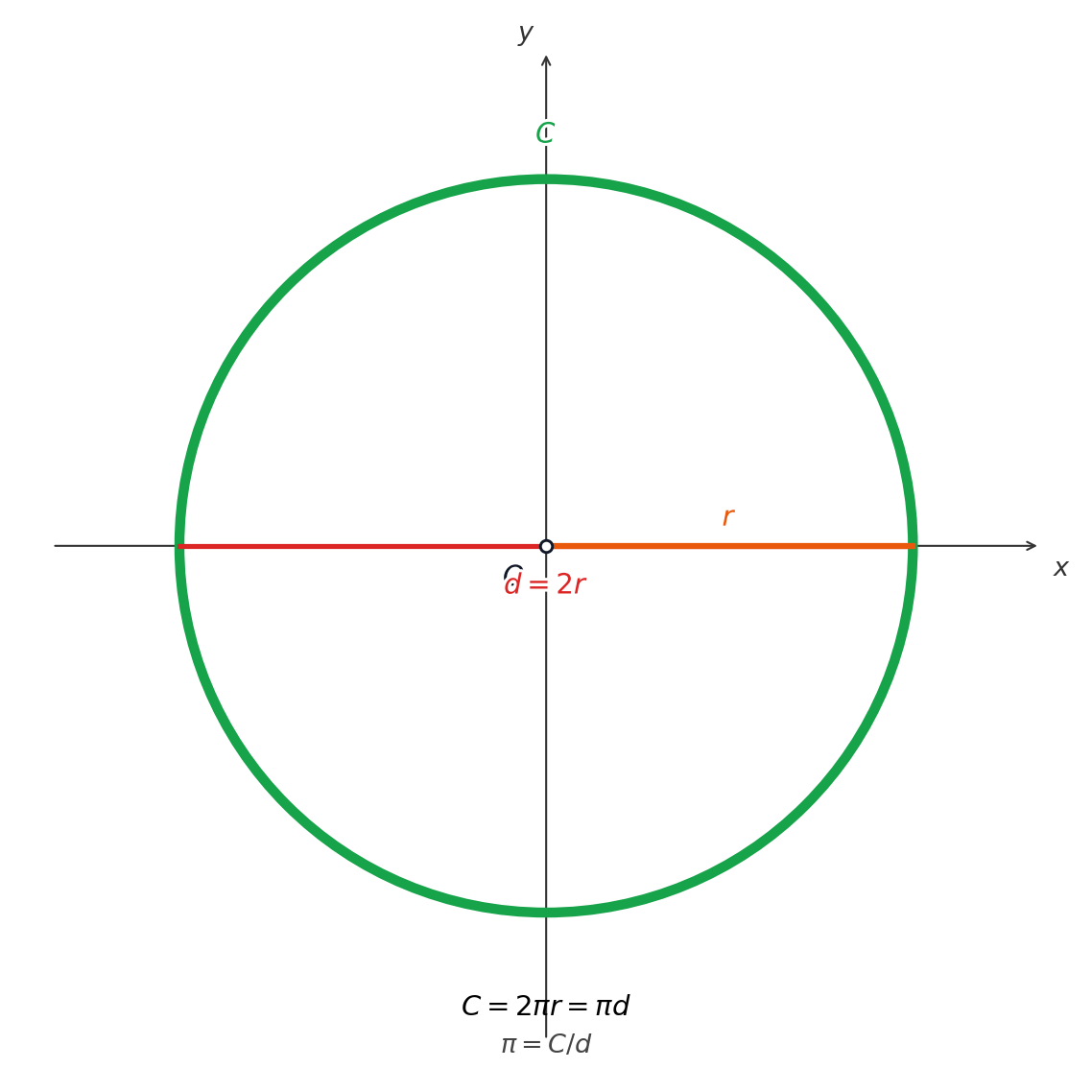
Walk once around the rim and you trace length \(C\). The green highlight in the figure is that full boundary curve.
5. Area#
The area \(A\) is the measure of the filled region inside the circle.
\[ \boxed{A = \pi r^2} \]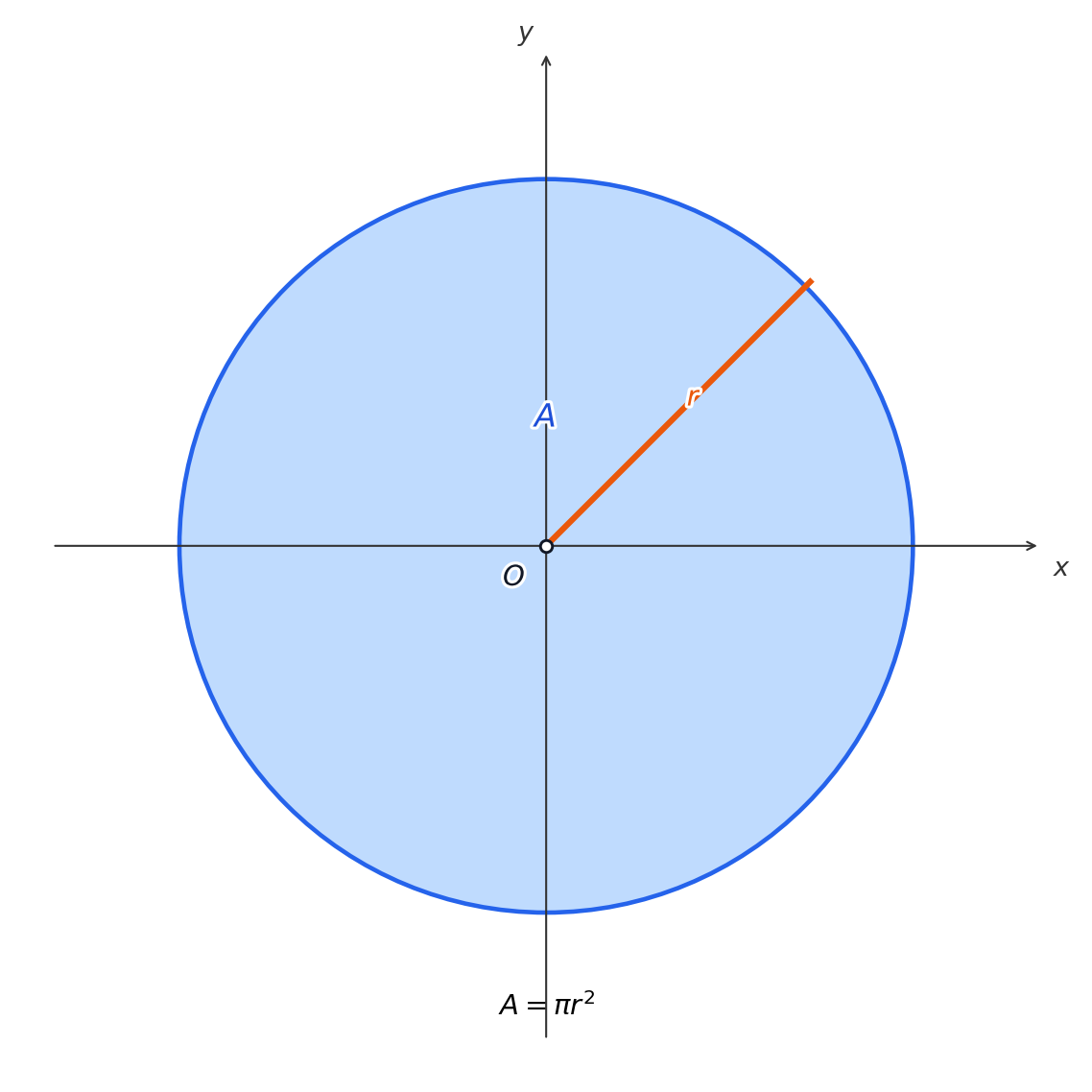
Area grows with the square of the radius: double \(r\) and the disk becomes four times as large.
6. π (pi)#
π is the ratio of circumference to diameter — the same for every circle:
\[ \boxed{\pi = \frac{C}{d} = \frac{C}{2r}} \]Equivalently, \(C = \pi d\) and \(A = \pi r^2\). The symbol \(\pi\) appears because circumference and area both involve this fixed ratio for circular shapes. It is irrational (\(\pi \approx 3.14159\ldots\)) and cannot be written as a finite decimal or fraction — so \(3.14\) is an approximation, not \(\pi\) itself (see §12 for why that distinction matters when converting radians and degrees).
The circumference diagram shows \(C\) and \(d\) on the same figure so the ratio is visible.
7. Chord#
A chord is a line segment whose both endpoints lie on the circle.
\[ \boxed{\text{chord } AB \text{ with } A,B \text{ on the circle}} \]The purple segment \(AB\) in the overview is a chord. A diameter is a special chord (through \(O\)). The shortest chord is a degenerate point; the longest is the diameter.
8. Arc#
An arc is a connected portion of the circumference between two boundary points.
- Minor arc — the shorter route along the circle from \(A\) to \(B\).
- Major arc — the longer route (the rest of the circumference).
The bold green curve from \(A\) to \(B\) in the overview is the minor arc. An arc is one-dimensional (a curve); do not confuse it with a sector or segment, which are two-dimensional regions (§14, §15).
9. Semicircle#
A semicircle is the arc together with its diameter — half the boundary plus the closing diameter segment.
\[ \boxed{\text{Area of semicircle} = \frac{1}{2}\pi r^2} \]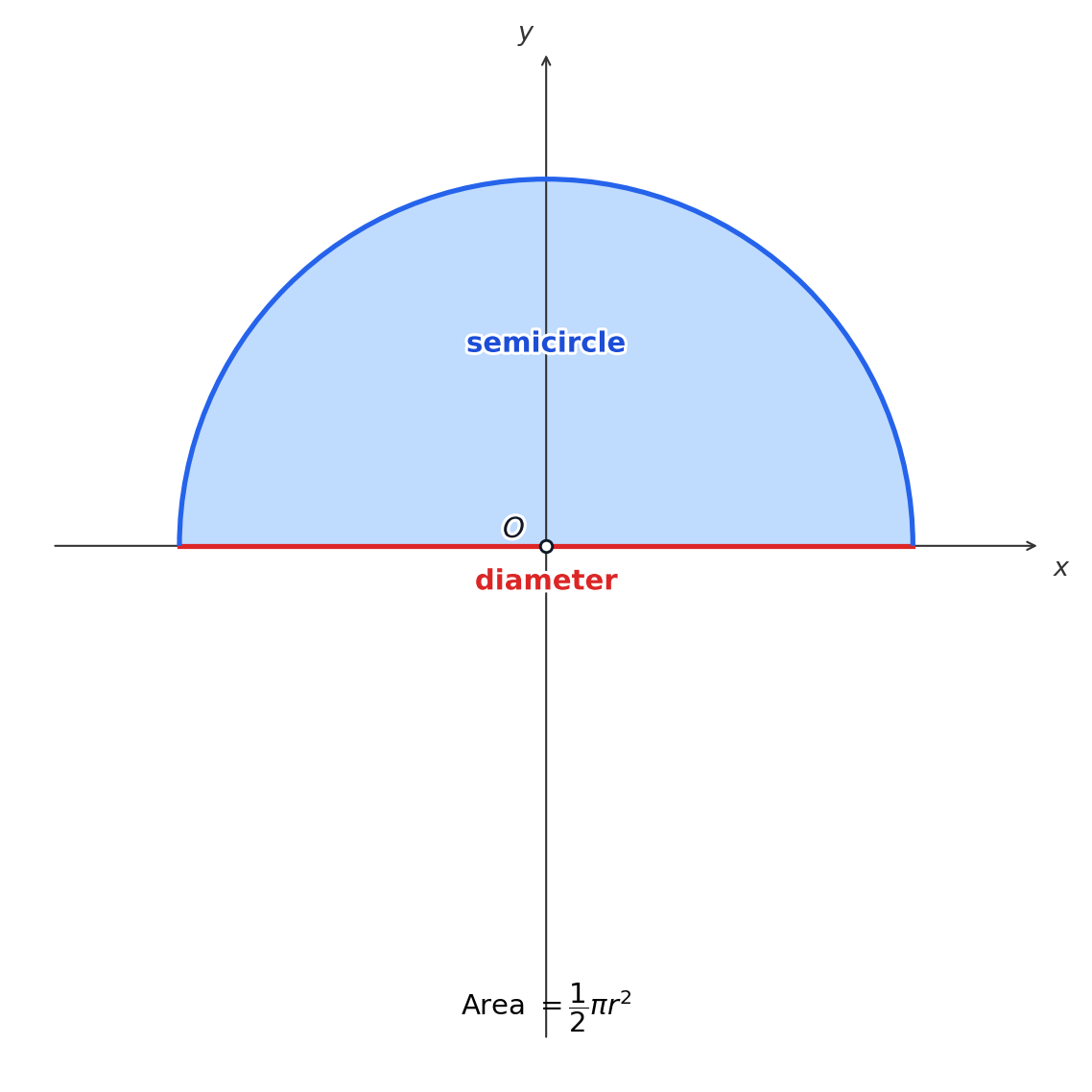
The curved part alone has arc length \(\pi r\) (half the full circumference). Any angle inscribed in a semicircle is a right angle — a classic theorem we omit here to stay focused on measurements.
10. Central angle#
A central angle has its vertex at the center \(O\) and its sides along two radii.
\[ \boxed{\text{Central angle } \angle AOB} \]In the overview, \(\theta = \angle AOB\) opens the sector and subtends the minor arc \(AB\). Central angles are the link between angular measure (§11, §12) and arc length (§13).
11. Degrees#
In the degree system, one full turn around the center is \(360^\circ\).
\[ \boxed{360^\circ = \text{one complete revolution}} \]A right angle is \(90^\circ\); a straight angle is \(180^\circ\). Degrees are convenient for everyday angles (clock faces, compass bearings) but arc-length formulas require radians (§13).
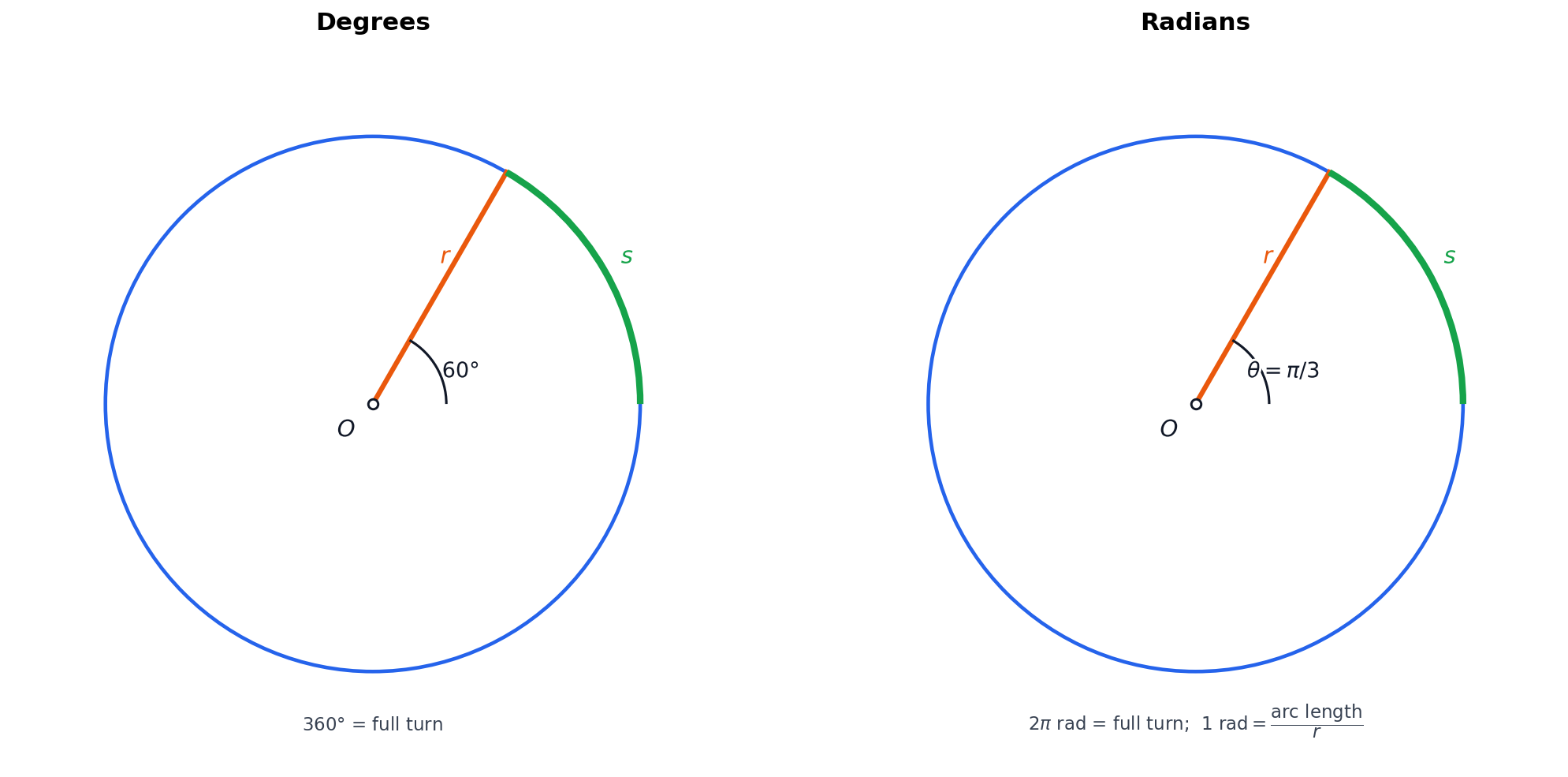
The left panel shows a \(60^\circ\) central angle. The same geometric angle can be expressed in degrees or radians — the next section defines radians.
12. Radians#
A radian is the angle that subtends an arc of length equal to the radius:
\[ \boxed{1\ \text{rad} = \frac{\text{arc length}}{r} \quad \text{(when arc length } = r\text{)}} \]One full turn is \(2\pi\) radians:
\[ \boxed{360^\circ = 2\pi\ \text{rad} \qquad \Rightarrow \qquad 180^\circ = \pi\ \text{rad}} \]That last line is a hard mathematical identity, not an approximation. A full circle is \(2\pi\) radians by the radian definition (arc length \(2\pi r\) when \(r=1\)) and also \(360^\circ\) by the degree definition, so half a circle is exactly \(\pi\) radians and exactly \(180^\circ\):
\[ \boxed{\pi\ \text{rad} = 180^\circ \quad \text{(exact, always)}} \]To convert any angle: \(\text{radians} = \text{degrees} \times \dfrac{\pi}{180}\) and \(\text{degrees} = \text{radians} \times \dfrac{180}{\pi}\). The right panel of the radians figure shows \(\theta = \pi/3\) rad (\(60^\circ\)) with arc length \(s = r\theta\).
π versus “3.14”#
The decimal \(3.14\) is a rounded approximation of \(\pi\), not \(\pi\) itself. As noted in §6, \(\pi\) is irrational — its digits continue forever without repeating (\(3.14159265\ldots\)). So these two statements are not the same:
| Statement | True? |
|---|---|
| \(\pi\ \text{rad} = 180^\circ\) | Yes — exact identity |
| \(3.14\ \text{rad} = 180^\circ\) | No — \(3.14 \neq \pi\) |
If you plug \(3.14\) into the conversion formula:
\[ 3.14\ \text{rad} \times \frac{180^\circ}{\pi} \approx 179.9^\circ \]The gap is about \(0.006^\circ\) — tiny for sketch diagrams and everyday work, but real. Using more decimal places (\(3.14159\ldots\)) closes the gap as far as you need. In formulas and proofs, keep the symbol \(\pi\); use decimals only when you are ready to accept a numerical error bar.
Radians are the natural unit in calculus, physics, and machine learning (rotations, Fourier analysis, periodic activations) because they make linear formulas work without extra factors of \(\pi/180\).
13. Arc length#
For a central angle \(\theta\) measured in radians, arc length \(s\) on a circle of radius \(r\) is:
\[ \boxed{s = r\theta} \]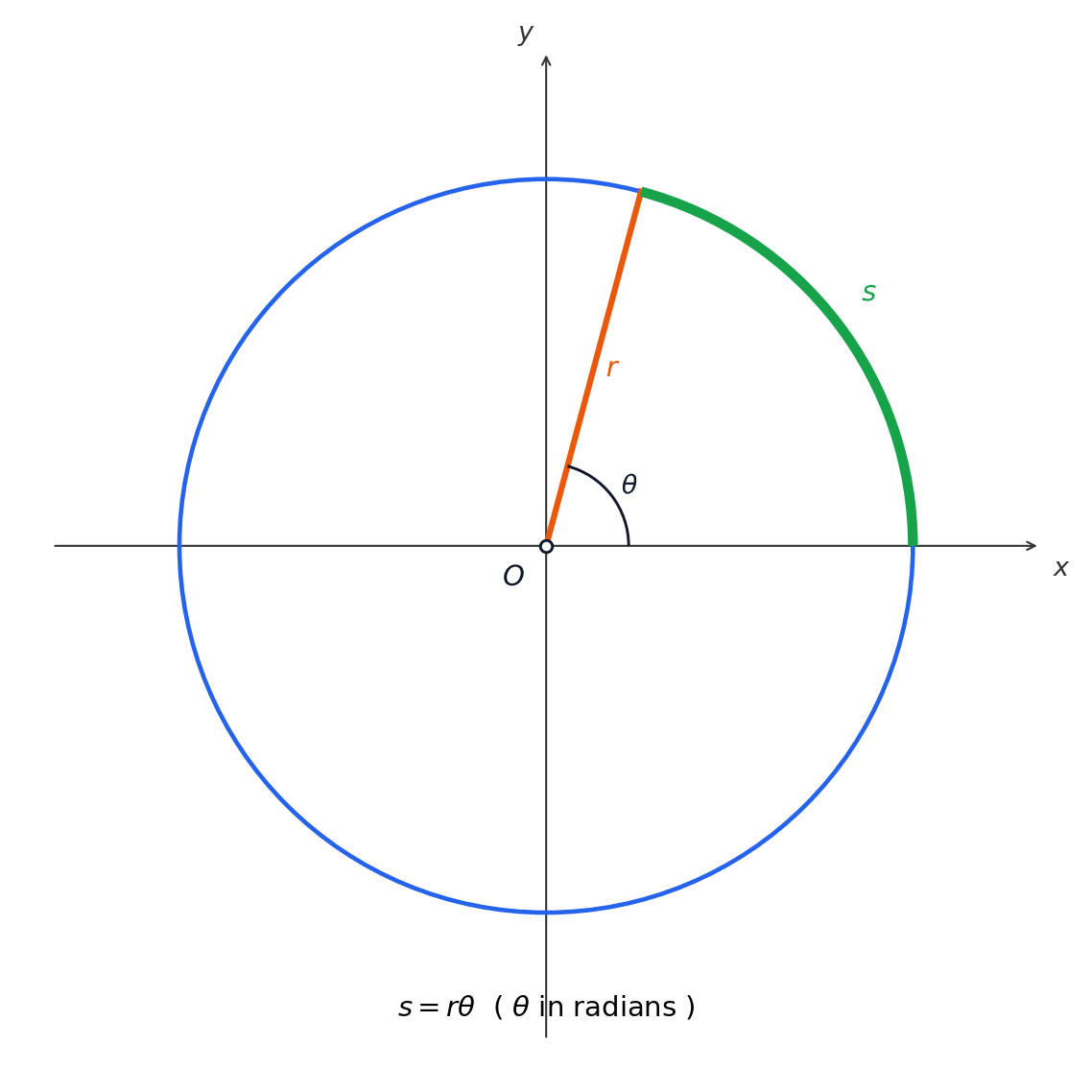
Example: \(r = 5\) cm and \(\theta = \pi/3\) rad gives \(s = 5 \times \pi/3 \approx 5.24\) cm. If \(\theta\) is in degrees, convert to radians first — there is no simple “arc length = r × degrees” formula.
14. Sector#
A sector is the 2D region bounded by two radii and the arc between them — a “pie slice” with vertex at \(O\).
The blue shaded region in the overview is a sector. Its central angle is \(\theta\).
15. Segment#
A segment (more precisely, a circular segment) is the 2D region between a chord and the arc above it — the “cap” cut off by the chord.
The orange shaded cap in the overview is a segment. Sector and segment are often confused:
| Region | Bounded by |
|---|---|
| Sector | two radii + arc (includes center) |
| Segment | one chord + arc (does not include center unless the chord is a diameter) |
16. Sector area#
For central angle \(\theta\) in radians:
\[ \boxed{A_{\text{sector}} = \frac{1}{2} r^2 \theta} \]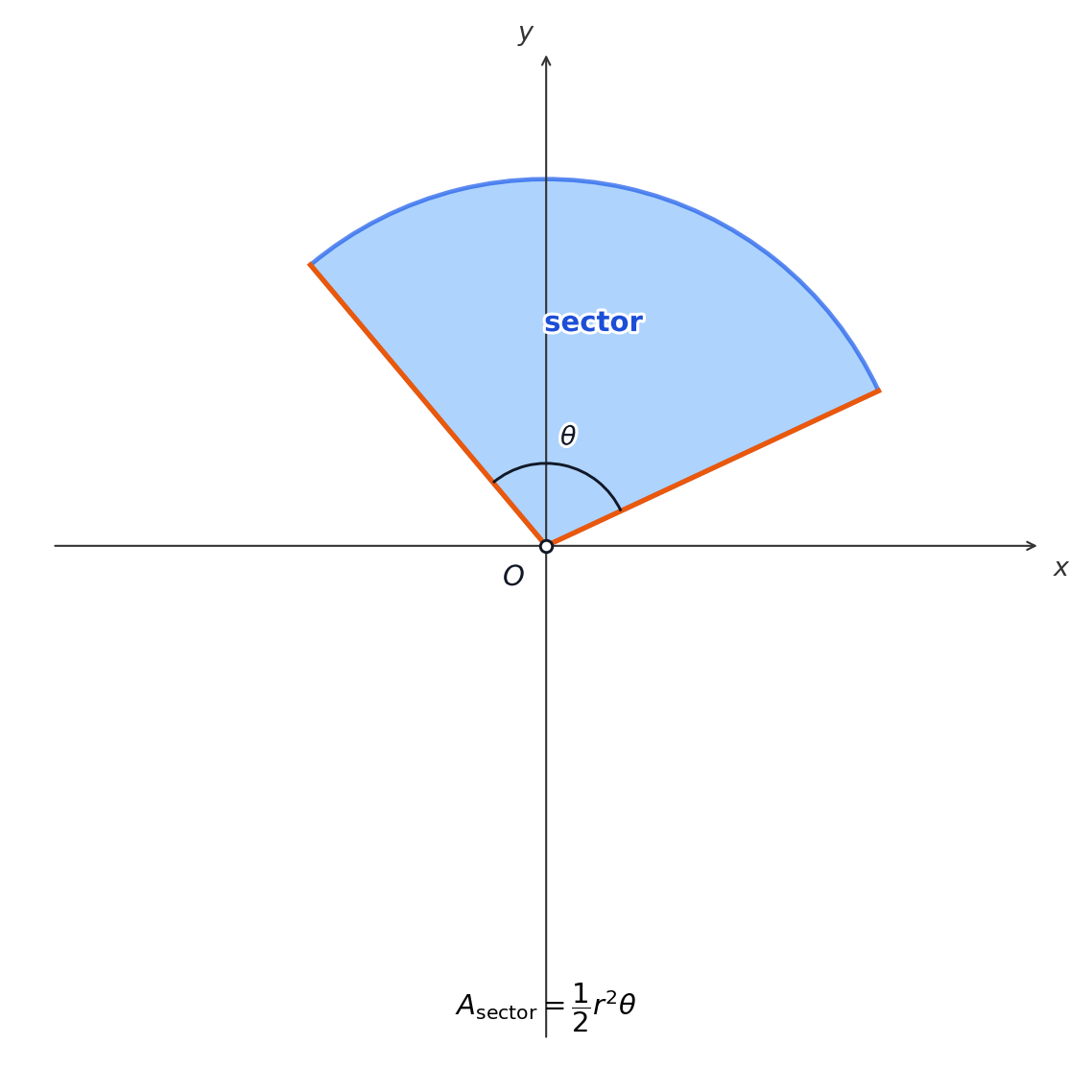
This is exactly half the product of \(r^2\) and the angle in radians. For degrees, use \(\theta_{\text{rad}} = \theta_{\text{deg}} \cdot \pi/180\). A full disk (\(\theta = 2\pi\)) gives \(\tfrac{1}{2} r^2 \cdot 2\pi = \pi r^2\) — consistent with §5.
17. Segment area#
For a segment subtending central angle \(\theta\) (radians):
\[ \boxed{A_{\text{segment}} = \frac{1}{2} r^2 (\theta - \sin\theta)} \]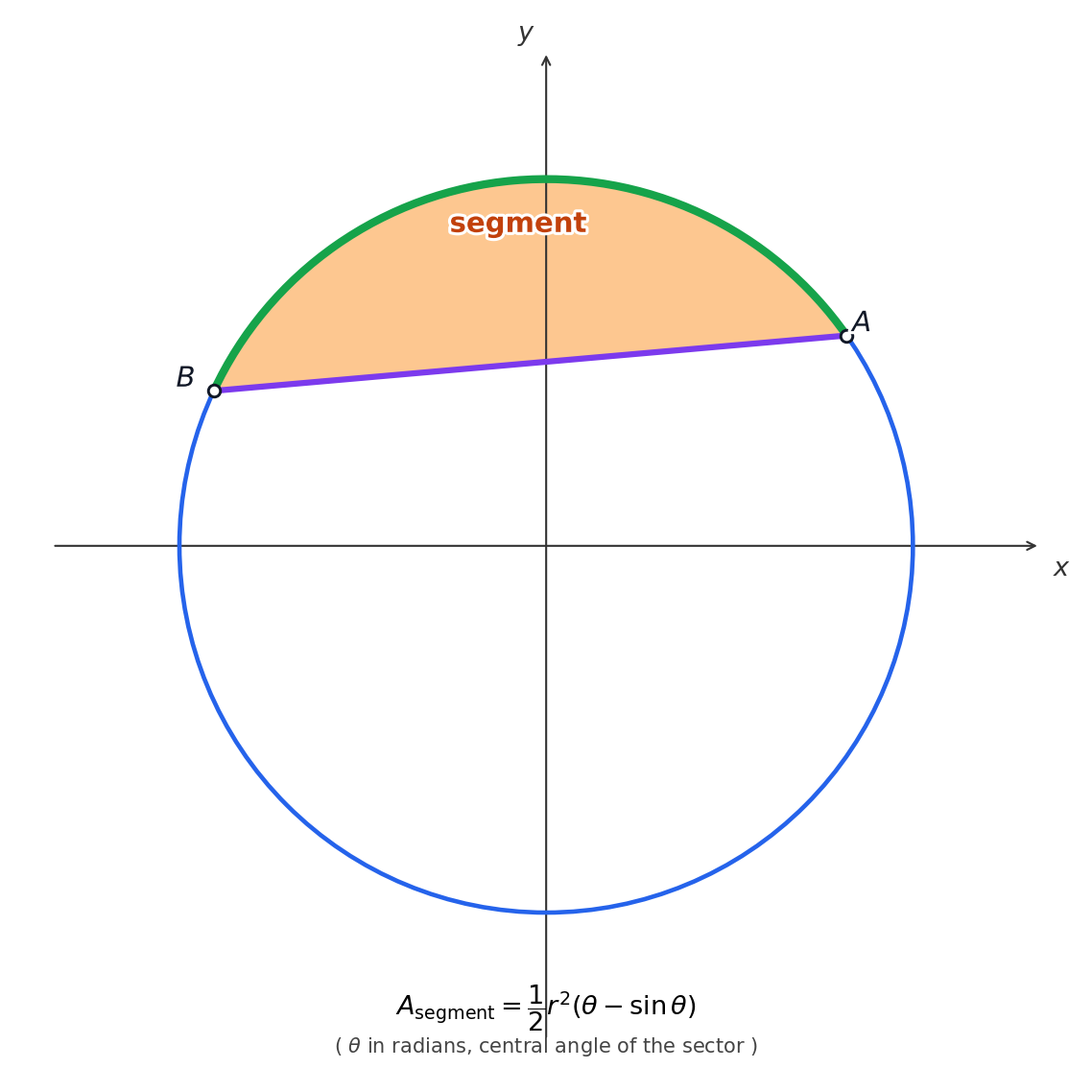
Derivation sketch: area of sector (§16) minus area of triangle \(OAB\):
\[ A_{\triangle} = \frac{1}{2} r^2 \sin\theta \quad\Rightarrow\quad A_{\text{segment}} = \frac{1}{2} r^2 \theta - \frac{1}{2} r^2 \sin\theta. \]When \(\theta = \pi\) (semicircle), \(\sin\pi = 0\) and the formula gives \(\tfrac{1}{2}\pi r^2\) — matching §9.
Radians throughout: In \(\theta - \sin\theta\), both terms use the same central angle in radians. Writing \(\theta = 1\) means 1 radian; \(\theta = \pi/2\) means \(\pi/2\) radians (90°). Do not plug in \(90\) for a 90° angle — use \(\theta = \pi/2\) instead. Example at \(r=1\): for \(\theta = 1\) rad, \(\theta - \sin\theta \approx 1 - 0.841 = 0.159\); for \(\theta = \pi/2\) rad, \(\theta - \sin\theta = \pi/2 - 1 \approx 0.571\).
18. Tangent and secant#
A tangent line touches the circle at exactly one point. A secant line cuts through the circle at two points.
\[ \boxed{\text{Tangent} \perp \text{ radius at the point of contact}} \]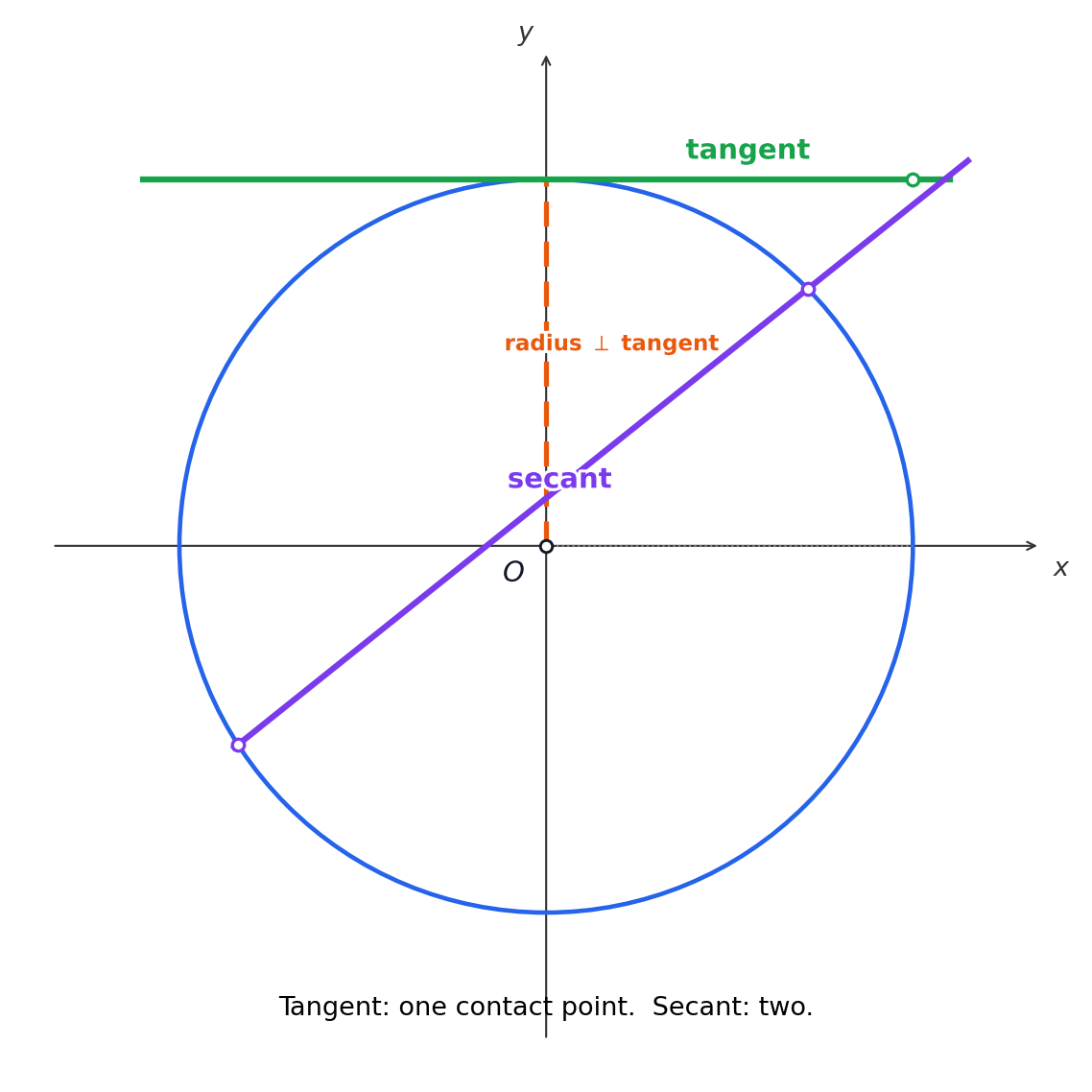
The green horizontal line is tangent at the top of the circle; the dashed orange radius to that point is perpendicular to it. The purple line is a secant — it intersects the boundary twice. (Do not confuse secant lines here with the trigonometric secant function \(\sec\theta\) in Six Trigonometric Functions — One Diagram; the words share Latin roots but name different objects.)
19. Formula cheat sheet#
| Concept | Symbol / name | Formula |
|---|---|---|
| Equation (center at origin) | circle | \(x^2 + y^2 = r^2\) |
| Radius | \(r\) | center to boundary |
| Diameter | \(d\) | \(d = 2r\) |
| Circumference | \(C\) | \(C = 2\pi r = \pi d\) |
| Area | \(A\) | \(A = \pi r^2\) |
| Pi | \(\pi\) | \(\pi = C/d\) |
| Arc length | \(s\) | \(s = r\theta\) (\(\theta\) in rad) |
| Sector area | \(A_{\text{sector}}\) | \(\tfrac{1}{2} r^2 \theta\) |
| Segment area | \(A_{\text{segment}}\) | \(\tfrac{1}{2} r^2(\theta - \sin\theta)\) |
| Semicircle area | — | \(\tfrac{1}{2}\pi r^2\) |
| Full turn | — | \(360^\circ = 2\pi\) rad |
| Half turn (exact) | — | \(\pi\ \text{rad} = 180^\circ\) |
20. Where to go next#
- Trigonometry on the unit circle — Six Trigonometric Functions — One Diagram: \(\sin\), \(\cos\), \(\tan\), and reciprocals as visible segment lengths when \(r=1\).
- Trigonometric identities as operations — Trigonometric Identities as Operations on Ratios: why \(\sin^2\theta+\cos^2\theta=1\), angle addition, graphs, the Laws of Sines and Cosines, and Euler are measurements on those same ratios — not strings to memorize.
- 3D shapes from circles — Conic Sections and Their 3D Shapes: rotate a circle to get a sphere; extrude it to get a cylinder.
- Broader conics — same article covers ellipses, parabolas, and hyperbolas and their 3D surfaces.
Once the vocabulary in this article is fixed, the unit-circle and 3D articles read as natural extensions — not separate subjects.
Hashtags#
#CircleGeometry #Radius #Circumference #Pi #Radians #ArcLength #Sector #Segment #Mathematics #Geometry #MathForML #Visualization #AppliedMathematics

Comments: