The Atomic Nucleus: Twelve Models, One Unfinished Story#
Scientists use twelve models of the atomic nucleus. Each model answers a different question, from binding energy and magic numbers to quarks and QCD.
Why did scientists need so many explanations for something so small?
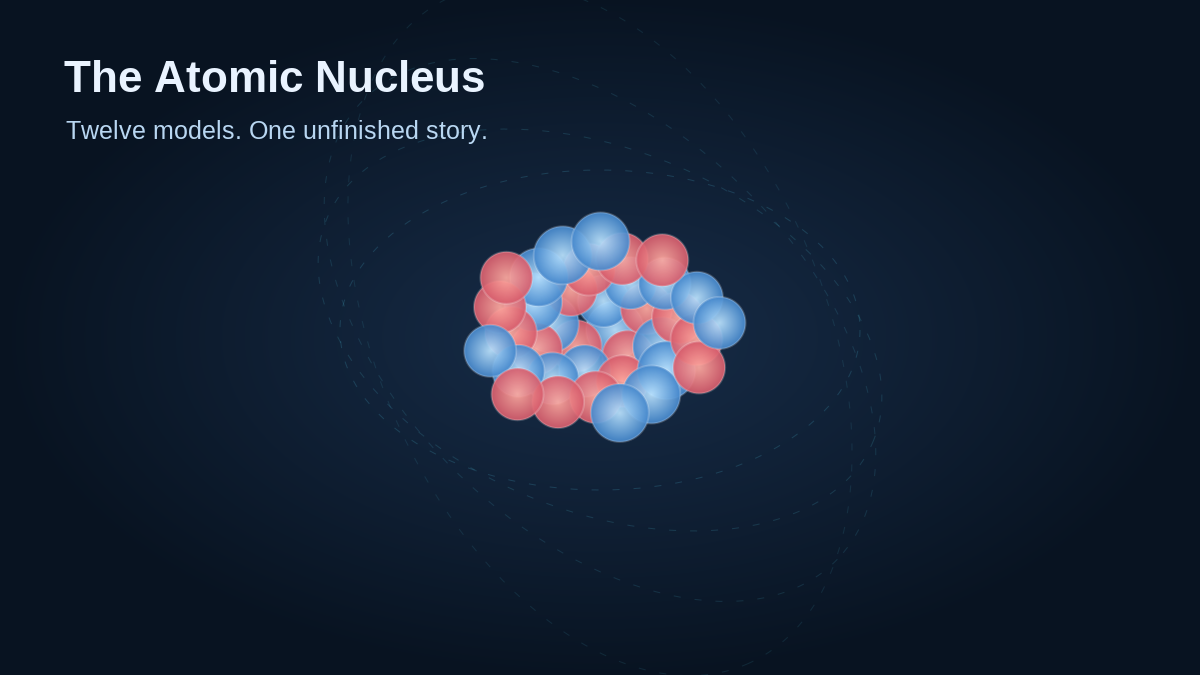
What holds a nucleus together when its positively charged protons repel one another? Why does adding a single neutron sometimes change a nucleus dramatically? Why do some nuclei behave like liquid drops, others like shells, and still others like tiny vibrating or rotating systems?
And if protons and neutrons are not hard little balls, what exactly is being held together?
For more than a century, nuclear physics has advanced through a recurring pattern: an observation challenged an explanation; scientists invented or improved a model; a new observation exposed its limits. The result is not twelve mutually exclusive truths, but different descriptions suited to different scales and questions.
1. The first challenge: How does a nucleus behave?#
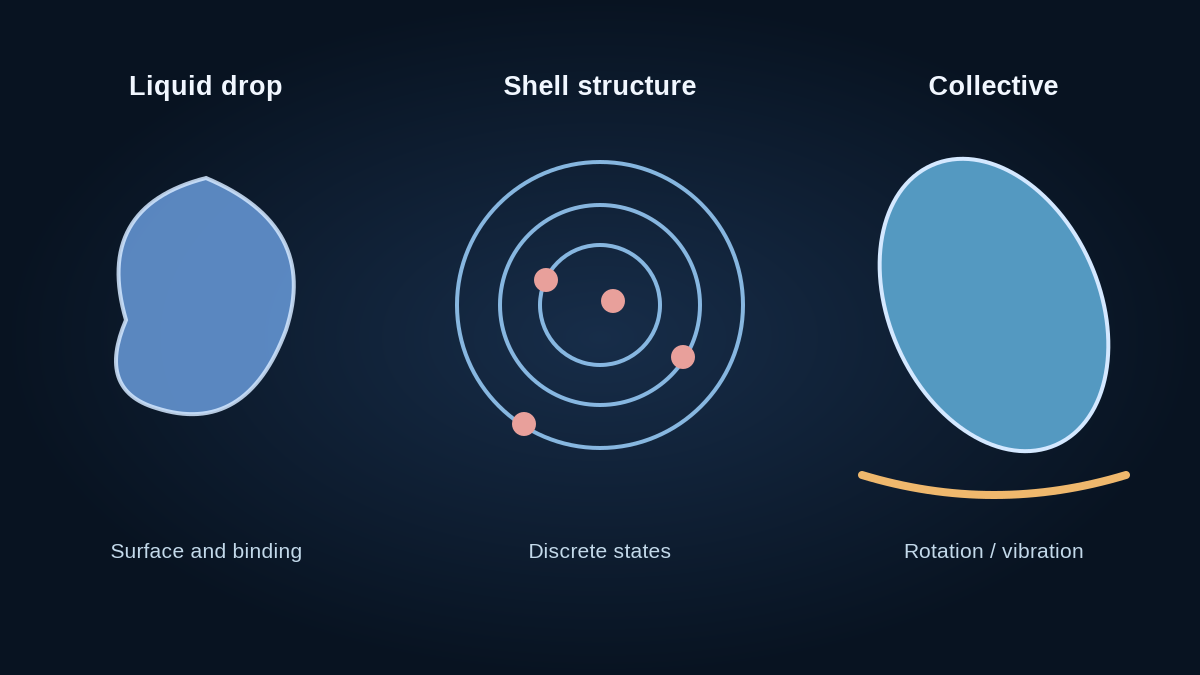
Liquid Drop Model. Why do nuclei show smooth trends in binding energy, and why can heavy nuclei undergo fission? The liquid-drop analogy captures bulk energy, surface effects and electrostatic repulsion. But it misses why certain proton and neutron numbers produce exceptional stability.
Nuclear Shell Model. Why are the numbers 2, 8, 20, 28, 50, 82 and 126 special as shell closures? Quantum states of nucleons, including spin-orbit effects, account for these so-called magic numbers. However, the simplest shell picture does not capture every cooperative motion.
Collective Model. Why do entire nuclei vibrate, rotate and deform? Collective descriptions join many-particle motion to individual nuclear structure. These are not three competing explanations: each can be effective for a different observable.
Cluster Model. Why do some light nuclei, and some specific excited states, exhibit alpha-particle-like correlations? Treating groups of nucleons as clusters can reveal patterns hidden in a purely single-particle picture.
Nuclear Mean-Field / Density Functional Models. How can we predict properties across thousands of nuclei? Self-consistent effective fields make large-scale surveys practical, though uncertainties increase in less-tested regions.
Ab Initio Nuclear Many-Body Methods. Can we calculate nuclear states from specified interactions among nucleons? These methods try to solve the many-body quantum problem systematically, but the computations—and uncertainties in the interactions—are challenging.
2. The second challenge: What force holds nucleons together?#
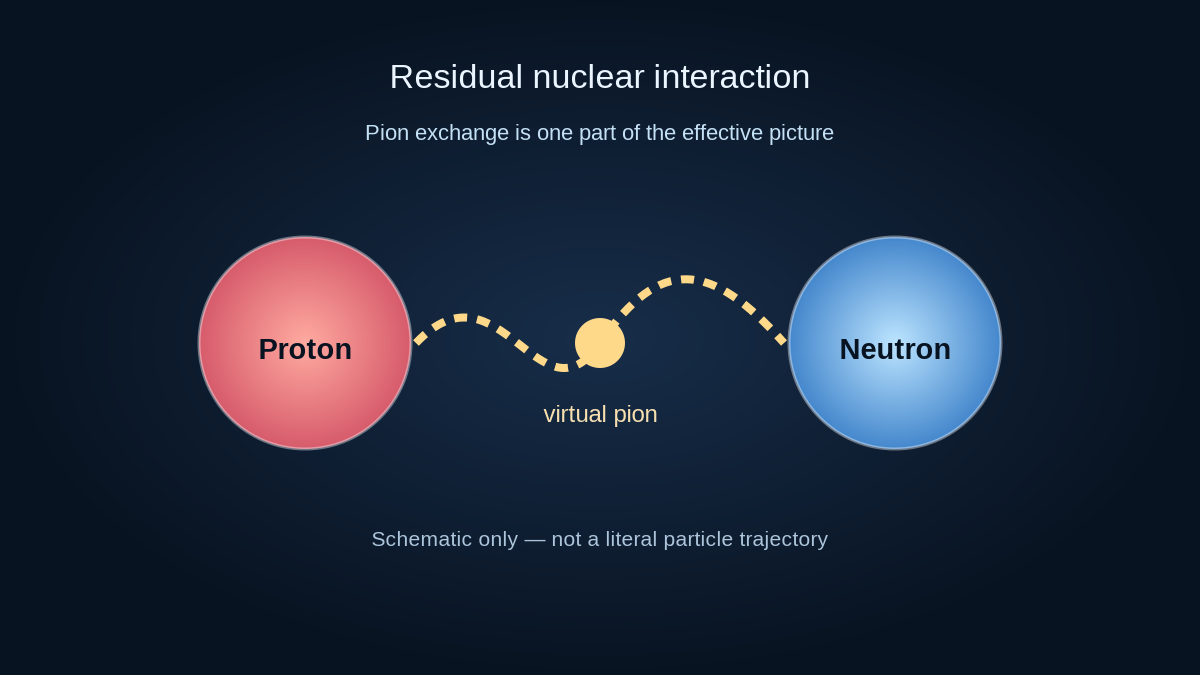
Protons repel through electromagnetism. At very short nuclear distances, however, the residual strong interaction can bind nucleons. Understanding that force produced another family of explanations.
Yukawa Meson Exchange. The exchange of virtual pions provides a vital part of the long-range nuclear interaction. It helped make sense of the force’s short range, but pion exchange alone is not the whole story.
Phenomenological Nuclear Potentials. If the fundamental dynamics are too difficult to solve, can a carefully fitted effective potential reproduce scattering and binding measurements? Often yes—but fitting the data does not itself establish a fundamental derivation.
Chiral Effective Field Theory (EFT). Can low-energy nuclear forces be organized systematically using the symmetries of QCD? Chiral EFT connects pion physics, short-range terms and two- and three-nucleon interactions, with uncertainties that researchers work to quantify.
3. The third challenge: What is a proton made of?#
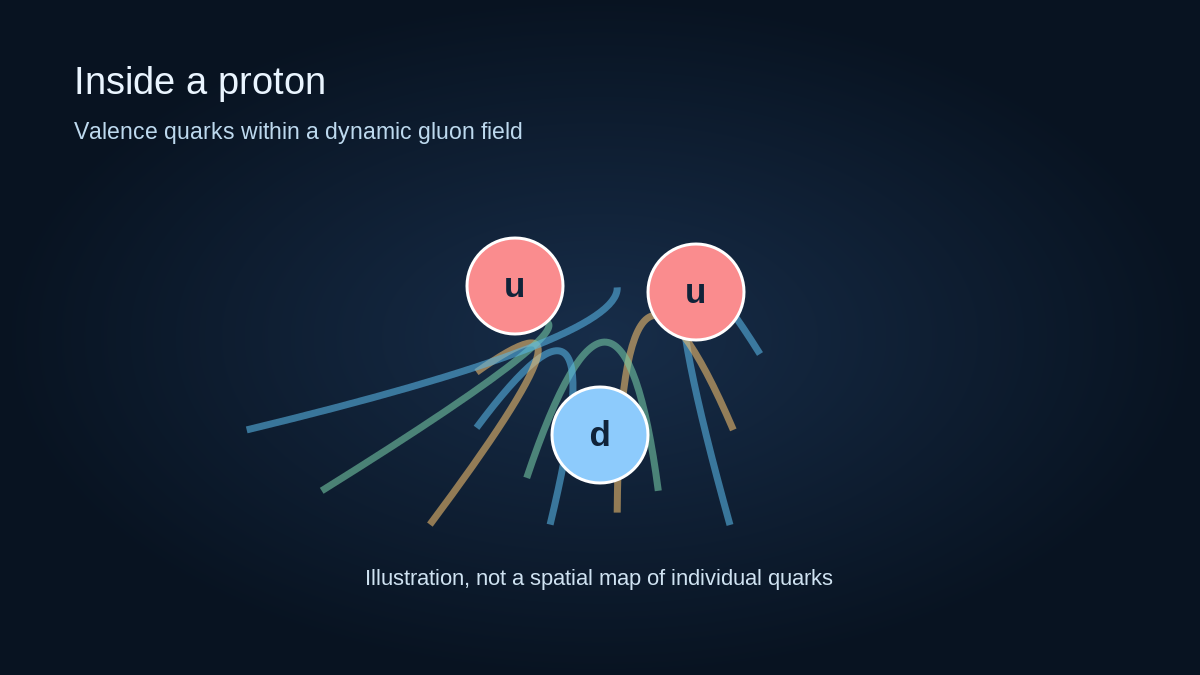
A proton has a mass of about \(938\,\mathrm{MeV}/c^{2}\). The bare masses of its three valence quarks account for only a small part of that mass. This raises a remarkable question: Where does most of its mass come from?
Constituent Quark Model. Three effective constituent quarks give a useful description of many hadron properties. But the model does not depict all the sea-quark and gluon dynamics inside a proton.
Quantum Chromodynamics (QCD). This is the fundamental theory of the strong interaction. Its quark and gluon fields explain why the proton’s mass is overwhelmingly associated with strong-interaction dynamics, not merely the sum of the bare valence-quark masses. The equations are known; solving the strongly coupled low-energy system is difficult.
Lattice QCD. By putting QCD onto a computational spacetime lattice, physicists can calculate aspects of hadron structure from first principles. Accurate calculations for increasingly complicated nuclei remain an important frontier.
4. Quick reference: All twelve in one table#
| # | Model / approach | The question it addresses | A central limitation |
|---|---|---|---|
| 1 | Liquid Drop | Why do binding energies follow smooth trends, and why does fission occur? | Misses detailed shell closures and many individual energy levels. |
| 2 | Nuclear Shell | Why do certain proton/neutron counts show extra stability? | Simple versions do not fully describe collective correlations. |
| 3 | Collective | Why do nuclei rotate, vibrate and deform? | Effective collective parameters need microscopic explanation. |
| 4 | Cluster | Why do some nuclei contain strongly correlated alpha-like groups? | Not a universal picture for all nuclei. |
| 5 | Mean-Field / Nuclear DFT | How can we survey properties of many nuclei efficiently? | Functionals remain approximate, particularly far from known nuclei. |
| 6 | Ab Initio Many-Body | Can nuclear observables be calculated from specified few-nucleon interactions? | Cost grows sharply with complexity; input-force uncertainties persist. |
| 7 | Yukawa Meson Exchange | Why is the attraction between nucleons short-ranged? | Pion exchange by itself is not a complete force law. |
| 8 | Phenomenological Potentials | Can one reproduce scattering and bound-state data accurately? | Fits alone do not derive interactions from QCD. |
| 9 | Chiral Effective Field Theory | How can low-energy nuclear interactions reflect QCD symmetries? | Has truncation, fitting and regulator uncertainties. |
| 10 | Constituent Quark Model | Why do hadrons show recognizable families and quantum numbers? | A simplified effective picture of a dynamic quark-gluon system. |
| 11 | Quantum Chromodynamics | What fundamental theory governs strong interactions? | Solving low-energy strongly coupled systems is difficult. |
| 12 | Lattice QCD | Can the QCD equations yield quantitative numerical predictions? | Precise physical-mass, multi-nucleon calculations remain resource intensive. |
These twelve are a teaching classification—not a complete census. They mix phenomenological models, fundamental theory, effective field theory and computational approaches.
5. What connects them?#
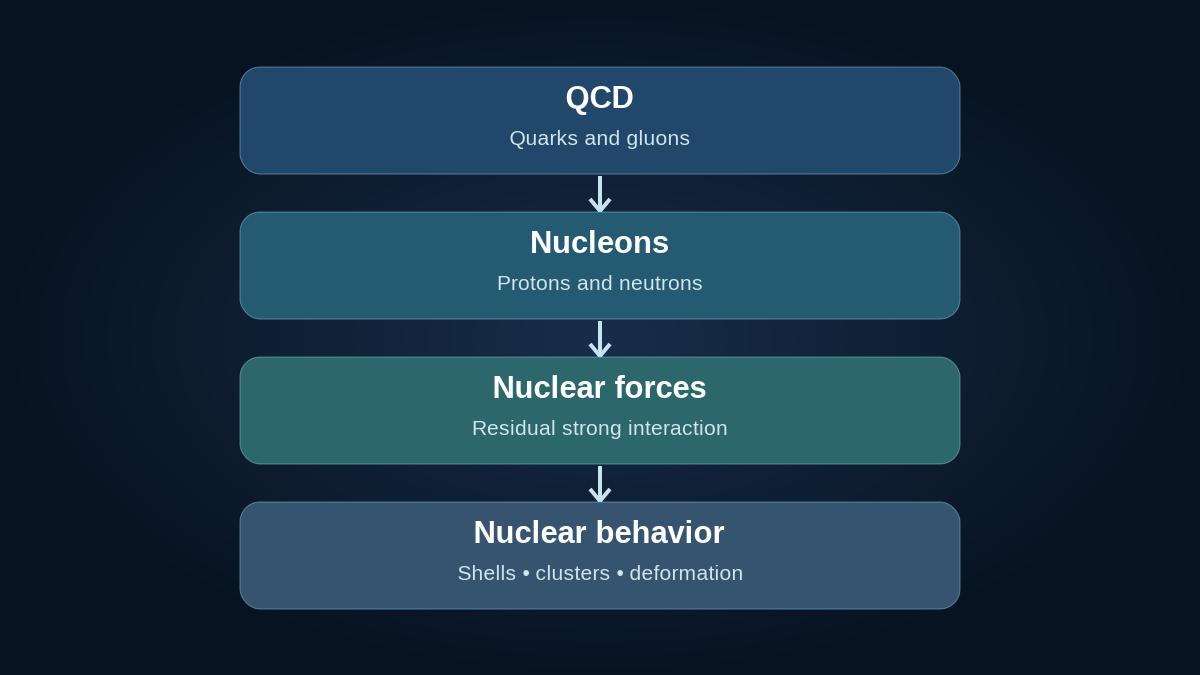
There is a hierarchy of descriptions:
Quarks and gluons → nucleons → residual nuclear forces → the behavior of whole nuclei.
But each arrow hides a difficult many-body calculation. Knowing the fundamental equations is not the same as being able to derive every useful larger-scale description from them.
There is also a crucial mass versus binding distinction. Strong-interaction dynamics account for most of the mass of a proton or neutron. Binding nucleons together, by contrast, releases energy and makes the bound nucleus lighter than the corresponding separated nucleons:
\[ \text{Mass of nucleus} \times c^{2} = Z \times \text{proton mass} \times c^{2} + N \times \text{neutron mass} \times c^{2} - \text{binding energy}. \]These are related consequences of the strong interaction, but not the same phenomenon.
6. A thought experiment: where is the Earth’s mass?#
A proton has a mass of about \(938\,\mathrm{MeV}/c^{2}\). The Higgs field gives the up-quark and the down-quark their masses. The proton’s three valence quarks are two up-quarks and one down-quark. Add those three masses and the sum is about \(9\,\mathrm{MeV}/c^{2}\), about 1% of the proton. A neutron, with one up-quark and two down-quarks, is close to the same fraction.
That 1% is only the bare masses of the three valence quarks. A fuller count includes the sea of quark–antiquark pairs. A lattice QCD decomposition of the proton finds that this quark-mass piece is about 9% of the proton’s mass. It is the piece tied directly to the Higgs field: if the up-quark, the down-quark, and the strange quark were massless, that piece would be gone, and more than 90% of the proton’s mass would remain. The remaining part is the energy of the strong interaction. In that lattice split, roughly a third is quark motion, roughly a third is the gluon field, and about a quarter is a quantum correction called the trace anomaly. Lattice QCD can reach the proton’s measured mass from these pieces. It does not yet give a short derivation that starts from the QCD equations and lands on every nucleus in the chart.
Volume is a different fact from mass. A light atom is about \(10^{-10}\) meters across. Its nucleus is about \(10^{-15}\) meters across. The length ratio is about \(10^{5}\). Volume grows with the cube of length, so the nucleus is about \(1/10^{15}\) of that atom’s volume. The electron cloud fills the rest of the volume. Almost all of the mass stays in the nucleus.
The nucleus of a light atom is about \(1/10^{15}\) of the atom’s volume. Use that same fraction for the whole planet. Divide the Earth’s volume by \(10^{15}\). The result is a cube about 100 meters on a side. The planet itself is about 12,700 kilometers across.
Rock is heavier than a pile of light atoms. Each nucleus in rock holds many nucleons, and the atoms already sit against one another. Count the volume from the density inside a nucleus instead. About 0.15 nucleons sit in each cubic femtometer. That density is about \(2.5 \times 10^{17}\) kilograms per cubic meter.
The Earth’s mass is \(5.97 \times 10^{24}\) kilograms. That is the whole mass a scale would report. Nearly all of it sits in nucleons. Divide that mass by the density:
\[ 5.97 \times 10^{24} / 2.5 \times 10^{17} \approx 2.4 \times 10^{7}. \]The unit is cubic meters. This pile is the whole measured mass, with the nucleons packed and no gaps between them. It fills a cube about 290 meters on a side, or a ball about 360 meters across.
Only a small share of that measured mass comes from the Higgs field.
The small share has two counts. The first count adds only the three valence quarks. The Higgs field gives them their bare masses, and those masses are about 1% of a nucleon. One percent of the Earth’s mass is about \(6 \times 10^{22}\) kilograms. Divide that mass by the same density. The cube is about 60 meters on a side.
The second count is still the Higgs piece. It adds the sea of quark pairs as well as the three valence quarks. That quark-mass term is about 9% of a nucleon, about \(5 \times 10^{23}\) kilograms for the whole Earth. The same division gives a cube about 130 meters on a side.
The other 90% or so of the measured mass is the energy of the strong interaction. That energy is already inside the 290-meter cube. It does not get a cube of its own, and it does not come from the Higgs field.
The ground pushes back on your feet because the electron clouds of neighboring atoms repel. That push is electromagnetic. The whole measured mass would fit in the ball about 360 meters across. Almost all of the planet’s volume is the electron clouds around that mass.
7. What are we still unable to answer completely?#
- From QCD to a complex nucleus: Can we reliably derive nuclear energies, shapes and reactions from the underlying quark-and-gluon theory across the nuclear chart?
- Many-body interactions: How can we determine and control two-, three- and higher-nucleon effects with precision?
- The limits of stability: Exactly where do bound nuclei cease to exist as we add protons or neutrons?
- Extreme matter: What happens to the nuclear equation of state deep inside neutron stars?
- Emergence: Why do simple collective patterns—shells, clusters, rotations and vibrations—arise from enormous quantum complexity?
These are not claims that nuclear physics lacks predictive success. They describe the boundary between powerful present-day methods and a fully unified, accurate and tractable calculation.
8. What are we waiting for?#
More revealing experiments. Rare-isotope studies probe unstable nuclei. The planned Electron-Ion Collider aims to clarify the quark-and-gluon structure of nucleons and nuclei. Astronomical observations constrain extreme nuclear matter.
More powerful computation. Better many-body algorithms, high-performance computers and lattice methods continue to narrow the distance between fundamental equations and observables. Quantum computing may eventually contribute, but it is not currently a general replacement for classical nuclear calculations.
Better connections between scales. The goal is not necessarily a thirteenth model. It is an increasingly reliable explanation of why the existing models work, when they fail, and how they emerge from deeper principles.
9. A final reflection: Is matter a thing—or an organized interaction?#
The nucleus challenges a familiar picture of matter as a pile of solid objects. Protons and neutrons are quantum systems, and many of their properties emerge from interacting fields. In nuclei, those systems acquire new collective behavior.
The liquid-drop model does not mean a nucleus is literally water. The shell model does not mean nucleons trace classical planetary orbits. Each is a carefully chosen language for an aspect of nature.
The deepest unfinished question is not only “What is matter made of?” It is “How does nature turn fundamental interactions into the mass, stability, structure and apparently solid world we experience?”
References and further reading#
- Lawrence Berkeley National Laboratory — Theoretical Models
- Lawrence Berkeley National Laboratory — The Collective Model
- U.S. Department of Energy — Nuclear Physics
- 2023 Long Range Plan for Nuclear Science (DOE PDF)
- Chiral EFT nuclear interaction review — Frontiers in Physics
- Brookhaven — Electron-Ion Collider Science
- APS Physics — Dissecting the Mass of the Proton (summary of Yang et al., Physical Review Letters 121, 212001, 2018)
- NASA — Earth Fact Sheet
Illustrations are original conceptual schematics; they are not experimental images or literal visualizations of quantum trajectories.
Hashtags#
#NuclearPhysics #AtomicNucleus #LiquidDropModel #NuclearShellModel #QuantumChromodynamics #LatticeQCD #NuclearModels #ParticlePhysics #StrongInteraction #QuarkGluon #HiggsField #ProtonMass

Comments: