Seeing Three Dimensions: Colors, Planes, a Sphere and the Meaning of Rotation#
Part 24 of the Learning Quantum Physics series.
X, Y, and Z are easy to draw. They are harder to hold in mind together when a plane, a turn, and a qubit all refer to them.
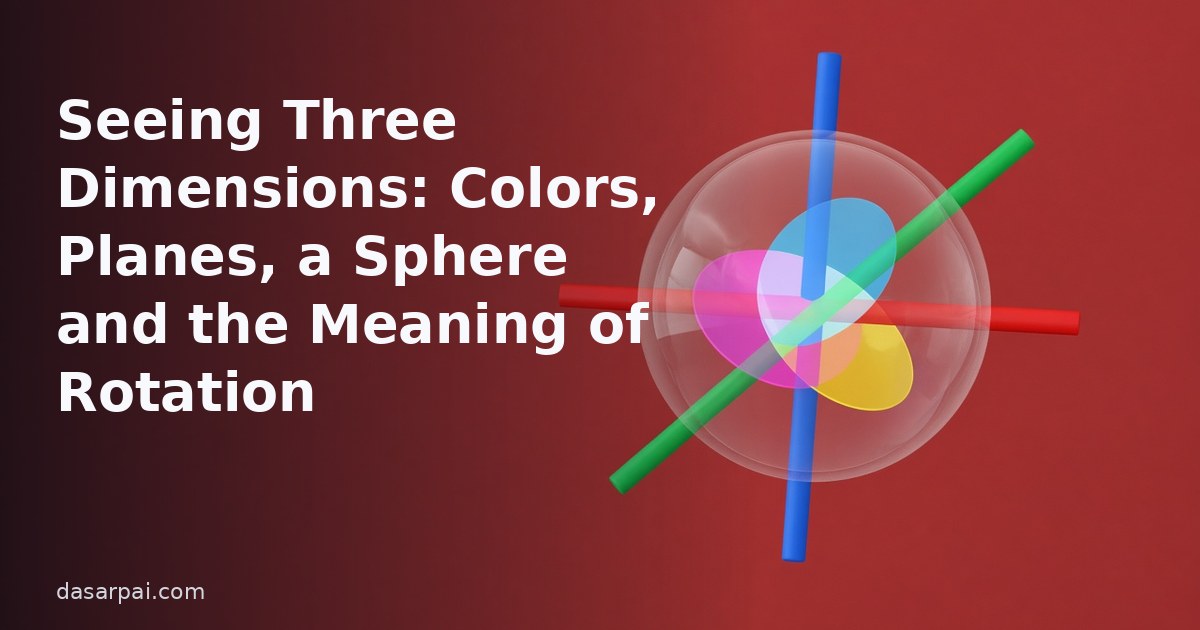
This article gives each axis a color and passes three colored planes through a sphere. The colors keep the axes distinct. The sphere shows what a turn does. The same six directions then name the states of one qubit.
Begin with three directions#
Imagine standing at the center of a transparent ball. Three straight lines pass through you, each perpendicular to the other two. These are our coordinate axes.
Let us assign their colors:
| Axis | Color |
|---|---|
| X | Red |
| Y | Blue |
| Z | Green |
The colors are our labels. Space itself does not have red, blue, and green directions.
An axis also has two sides. To discuss them consistently, we need to decide which side is positive.
For our right-handed coordinate system, picture these directions in front of you:
| Axis | Positive direction | Negative direction |
|---|---|---|
| X | Right | Left |
| Y | Back (away from you) | Front (toward you) |
| Z | Up | Down |
Right, Front, and Up look natural. That set is left-handed if Front means toward you. The usual right-handed convention in physics keeps Right and Up, and puts +Y at the back: +Y = Back, −Y = Front.
These labels describe the starting arrangement. When we rotate our view, +X may no longer appear on the right of the screen. It remains +X because it belongs to the coordinate system.
From axes to planes#
One axis gives us a line. Two distinct perpendicular axes define a plane.
Imagine three transparent sheets passing through the ball’s center:
| Plane | Axes it contains | Coordinate that is zero | Assigned color |
|---|---|---|---|
| XY | X and Y | Z = 0 | Magenta |
| YZ | Y and Z | X = 0 | Cyan |
| ZX | Z and X | Y = 0 | Yellow |
Why these colors? In additive mixing of light, red and blue give magenta; blue and green give cyan; green and red give yellow.
This is light mixing, rather than mixing paints. We use the resulting colors to remember which axes belong to each plane. The transparent overlaps in the diagram are illustrative; they do not simulate an optical experiment.
The XY sheet contains every point whose Z coordinate is zero. Moving anywhere along this sheet changes X, Y, or both, while Z remains zero. The same reasoning applies to the other two sheets.
Explore the sphere#
Drag with a mouse, or use the Turn and Tilt sliders. Switch off two planes and inspect the remaining one. Then bring the other planes back.
The sliders change the viewing orientation. They are camera-style controls, not an axis-and-angle rotation experiment.
Why are the planes drawn as discs?#
A mathematical plane extends without limit. Our diagram shows only the portion inside the ball, so each central plane appears as a filled circular disc.
Its rim is the circle where the plane meets the sphere’s surface. Because the plane passes through the center, this is a great circle: a circle with the same radius as the sphere.
Strictly speaking, the sphere is the surface; the ball includes its interior. The colored discs lie inside the ball, while their rims lie on the sphere.
Each pair of planes shares an axis:
| Pair of planes | Shared line |
|---|---|
| XY and YZ | Y axis |
| YZ and ZX | Z axis |
| ZX and XY | X axis |
All three planes meet at the center. We now have a connected picture: axes are shared lines, planes are central slices, and circles are the boundaries of those slices on the sphere.
What does “turn around an axis” mean?#
Imagine a skewer passing through a ball. Hold the skewer still and turn the ball around it.
The skewer represents the rotation axis. Points on that axis stay where they are. Other points move along circles around it.
For a rotation around X, the X coordinate stays constant while Y and Z generally change. Likewise:
| Rotation around | Coordinate unchanged | Coordinates that generally change |
|---|---|---|
| X | X | Y and Z |
| Y | Y | Z and X |
| Z | Z | X and Y |
The point’s distance from the center also stays unchanged. A point on the sphere remains on the sphere.
A useful way to specify one rotation is therefore axis + angle. For example, “rotate around X by +30°.”
“Rotation angle” is a better general label than “Tilt.” Tilt usually suggests a particular viewing movement, whereas an angle can describe rotation around any chosen axis.
Does positive mean counterclockwise?#
Yes, in the usual right-handed rotation convention—but we must say where we are looking from.
Look from the positive end of the chosen axis toward the center. From that viewpoint, positive rotation is counterclockwise and negative rotation is clockwise.
| Chosen axis | Viewpoint | Positive angle | Negative angle |
|---|---|---|---|
| X | From +X toward the center | Counterclockwise | Clockwise |
| Y | From +Y toward the center | Counterclockwise | Clockwise |
| Z | From +Z toward the center | Counterclockwise | Clockwise |
Think of a clock viewed through its transparent back. The same hand movement appears reversed. Nothing changed about the clock; your viewpoint changed.
That is why “positive means counterclockwise” is incomplete without the viewing convention.
The right-hand rule packages the same idea into a gesture. Point your right thumb along the positive rotation axis. Your curled fingers indicate the positive rotation direction.
Follow a quarter-turn#
A positive quarter-turn is +90°. With fixed axes, rotate a vector around the selected axis:
| Rotation | Starting direction | Ending direction |
|---|---|---|
| Around X by +90° | +Y | +Z |
| Around Y by +90° | +Z | +X |
| Around Z by +90° | +X | +Y |
Negative quarter-turns reverse these movements.
| Rotation | Starting direction | Ending direction |
|---|---|---|
| Around X by −90° | +Z | +Y |
| Around Y by −90° | +X | +Z |
| Around Z by −90° | +Y | +X |
Read either table around the circle X, Y, Z. The turn is about the axis that stays still. A +90° step goes to the next name. A −90° step goes to the previous name.
For +90°, follow the arrows.
%%{init: {"flowchart": {"rankSpacing": 18, "wrappingWidth": 480}}}%%
flowchart LR
    X(("+X")) -->|"around Z"| Y(("+Y"))
    Y -->|"around X"| Z(("+Z"))
    Z -->|"around Y"| X
For −90°, follow the arrows the other way.
%%{init: {"flowchart": {"rankSpacing": 18, "wrappingWidth": 480}}}%%
flowchart LR
    X(("+X")) -->|"around Y"| Z(("+Z"))
    Z -->|"around X"| Y(("+Y"))
    Y -->|"around Z"| X
Notice that “+X” and “+90°” describe different things. The first identifies a direction along an axis. The second gives the direction and amount of a rotation.
Also, rotating a vector and rotating the coordinate frame are different operations. Here we keep the axes fixed and rotate the vector. Changing coordinates by rotating the frame uses the inverse transformation.
Where the Bloch sphere enters#
This geometry is useful when learning about a single qubit.
On a Bloch sphere, the six axis directions correspond to familiar states:
| Direction | Qubit state |
|---|---|
| +Z | |0⟩ |
| −Z | |1⟩ |
| +X | (|0⟩ + |1⟩) / √2 |
| −X | (|0⟩ − |1⟩) / √2 |
| +Y | (|0⟩ + i|1⟩) / √2 |
| −Y | (|0⟩ − i|1⟩) / √2 |
The position represents the qubit’s state. It does not show a photon traveling inside a physical ball. The axis colors remain visual labels, not the color of the photon or qubit.
Pure single-qubit states lie on the surface. Mixed single-qubit states lie inside the Bloch ball. The colored interior discs are coordinate slices; they are not themselves individual quantum states.
The standard X, Y, and Z Pauli gates rotate the Bloch vector by 180° around their corresponding axes. For the quantum state, this correspondence is understood up to an overall phase. At 180°, positive and negative rotations give the same final Bloch-vector direction; smaller rotations make their difference easier to see.
The numbers (1, 0) do not mean the same thing in the plane and for a qubit.
| Where | (1, 0) means | 180° about a perpendicular axis |
|---|---|---|
| Plane | the +X direction | (−1, 0), the −X direction |
| Qubit amplitudes | |0⟩, the +Z point | (0, 1), which is |1⟩, the −Z point |
The arrow drawn for |0⟩ has coordinates (0, 0, 1). The list (1, 0) is not that arrow. It says the whole weight sits on |0⟩.
(−1, 0) as a list of amplitudes is −|0⟩. That is the same point on the sphere as |0⟩. The opposite pole is |1⟩. A 360° turn brings the arrow back to +Z and changes the amplitudes from (1, 0) to (−1, 0). The drawn point looks the same. The amplitudes need another full turn, 720° in all, to come back to (1, 0).
A single Bloch sphere describes one qubit. It cannot represent every possible state of a multi-qubit system.
A practical way to think about it#
Before describing any rotation, settle three things: the axis, the angle, and the viewing convention.
The colors help us recognize the axes and planes. The sphere helps us see their relationships. The right-hand rule helps us describe motion consistently.
Once those conventions are clear, “rotate around X by +30°” becomes a precise instruction we can picture, calculate, and implement.
Related reading#
Hashtags#
#CoordinateGeometry #BlochSphere #QuantumComputing #RightHandRule #Rotation #ThreeDimensions #Visualization #LinearAlgebra #Qubit #GreatCircle

Comments: