
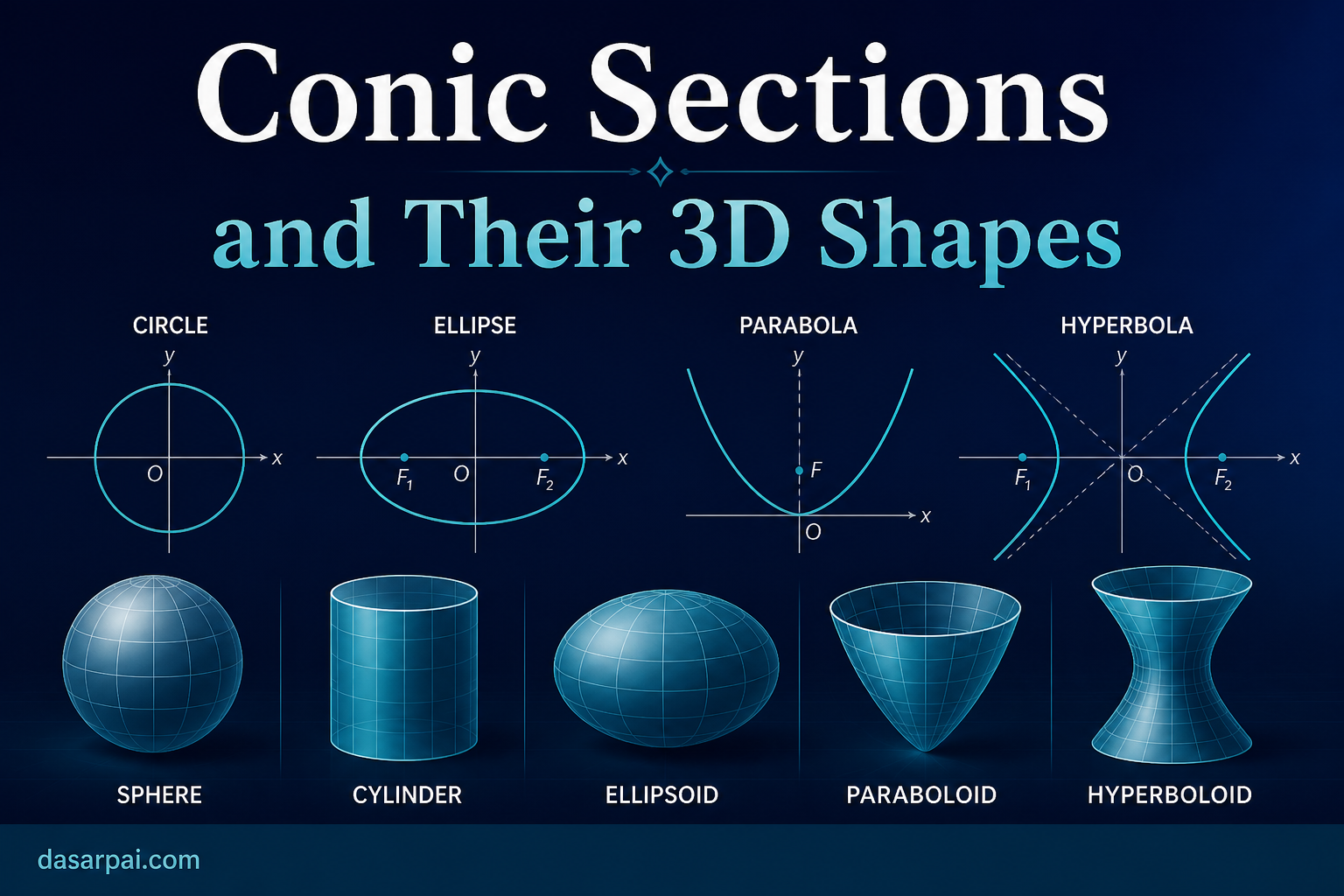
Conic Sections and Their 3D Shapes#
Circles, ellipses, parabolas, and hyperbolas in two and three dimensions#
Part 12 of the Learning Quantum Physics series.
A circle is not an isolated shape. It is the simplest member of a family: rotate it around an axis and you get a sphere; slide the same cross-section along a straight line and you get a cylinder. The same pattern repeats for ellipses, parabolas, and hyperbolas — each 2D curve has a natural 3D surface of revolution and a natural cylindrical extrusion.
This article is a shape-and-formula guide. For each family you get:
- the standard equation in the plane,
- the 3D surface you obtain by rotation,
- the 3D surface you obtain by extrusion along the \(z\)-axis,
- everyday names so you can connect the formula to objects you already know,
- a labeled illustration to fix the picture in memory.
We work in Cartesian coordinates \((x,y)\) in the plane and \((x,y,z)\) in space. Parameters \(a,b,c,p,r>0\) unless noted otherwise.
1. How the four families fit together#
All four curves arise when a plane cuts a double cone (hence conic sections). In analytic form they are the quadratic curves — curves whose defining equation is degree 2 in \(x\) and \(y\).
| Family | Sign pattern in standard form | 2D curve | Rotate → 3D | Extrude along \(z\) → 3D |
|---|---|---|---|---|
| Circle | both terms plus | circle | sphere | right circular cylinder |
| Ellipse | both terms plus (unequal weights) | ellipse | ellipsoid | elliptic cylinder |
| Parabola | one squared, one linear | parabola | paraboloid | parabolic cylinder |
| Hyperbola | one plus, one minus | hyperbola | hyperboloid | hyperbolic cylinder |
Rotation means: take the curve in the \(xy\)-plane and spin it about the \(z\)-axis (or an equivalent axis). Every point at radius \(r=\sqrt{x^2+y^2}\) from the axis traces a circle, so squared \(x\) and \(y\) terms often collapse to \(r^2\).
Extrusion means: keep the same equation in \(x\) and \(y\) and allow \(z\) to be any real number. Geometrically, you stack identical cross-sections along the \(z\)-axis — a cylinder in the broad sense (not necessarily circular).
The sections below follow the same order: circle family, then ellipse, parabola, hyperbola.
2. Circle family#
2.1 Circle (2D)#
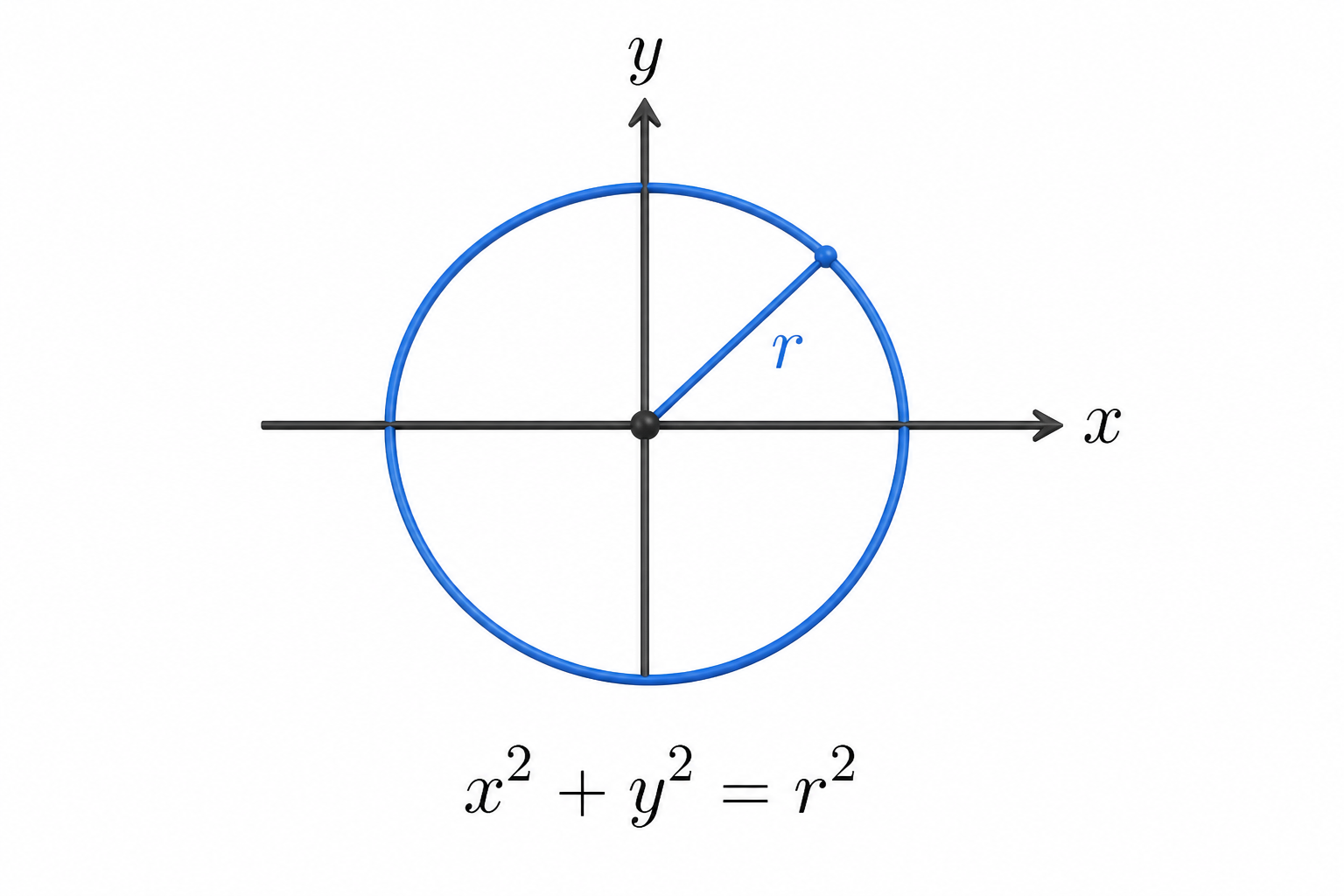
A circle is the set of points at fixed distance \(r\) from the center (placed at the origin here).
\[ \boxed{x^2 + y^2 = r^2} \]Equivalent forms: \((x-h)^2+(y-k)^2=r^2\) for center \((h,k)\); parametric form \(x=r\cos\theta,\ y=r\sin\theta\).
- Shape: closed curve, constant curvature.
- Key numbers: radius \(r\); diameter \(2r\); circumference \(2\pi r\); area \(\pi r^2\).
- Everyday names: a wheel seen from the front, a coin face-on, a clock face, or the rim of a hula hoop when you look straight at it.
2.2 Sphere (3D — rotate the circle)#
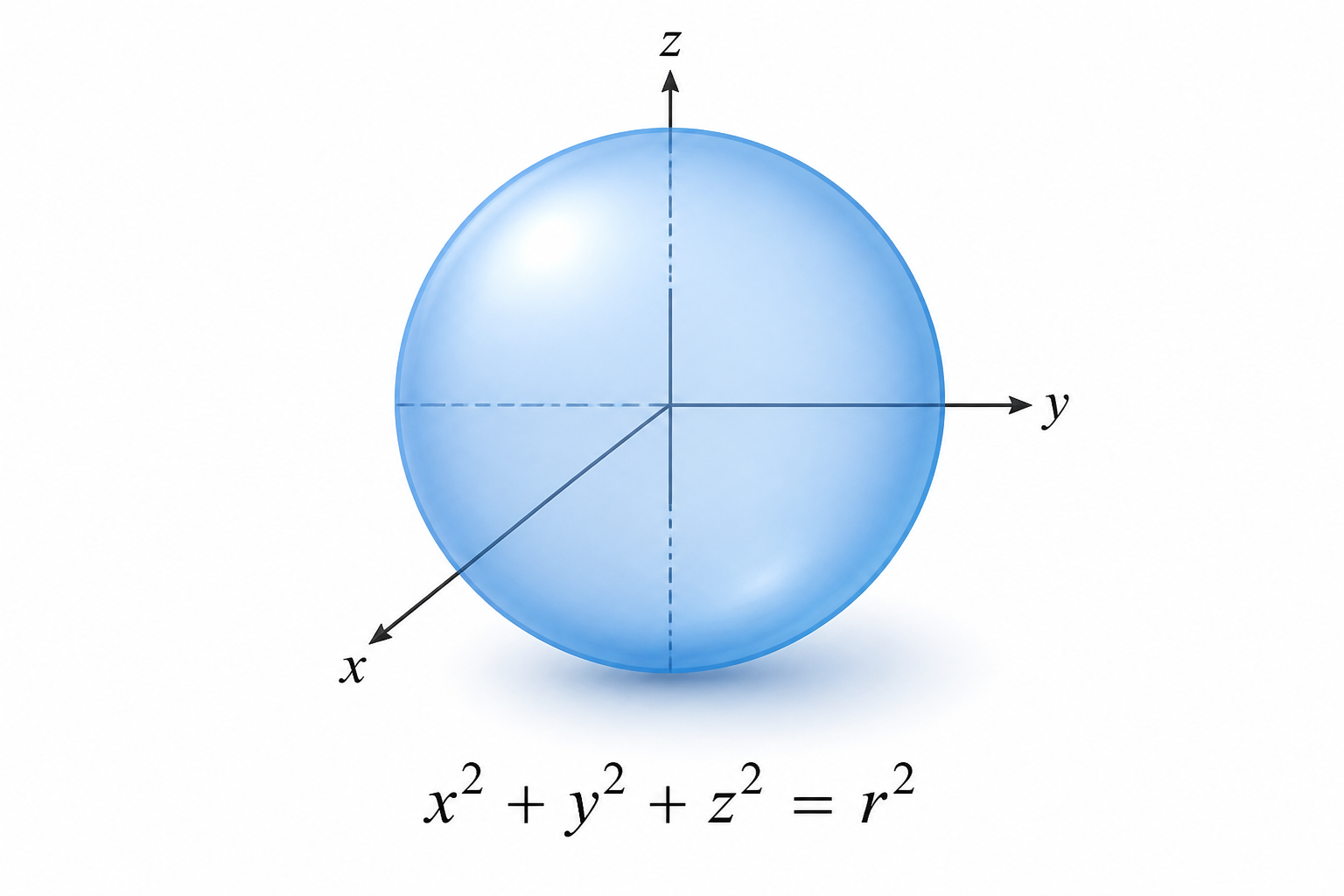
Rotate the circle about the \(z\)-axis (equivalently, about any diameter through the center). Every point on the circle sweeps out a sphere — the 3D locus of points at distance \(r\) from the center.
\[ \boxed{x^2 + y^2 + z^2 = r^2} \]- Shape: closed surface, every cross-section through the center is a circle.
- Volume: \(\dfrac{4}{3}\pi r^3\). Surface area: \(4\pi r^2\).
- Everyday names: a basketball, baseball, marble, orange, globe, or soap bubble — anything round in every direction.
2.3 Right circular cylinder (3D — extrude the circle)#
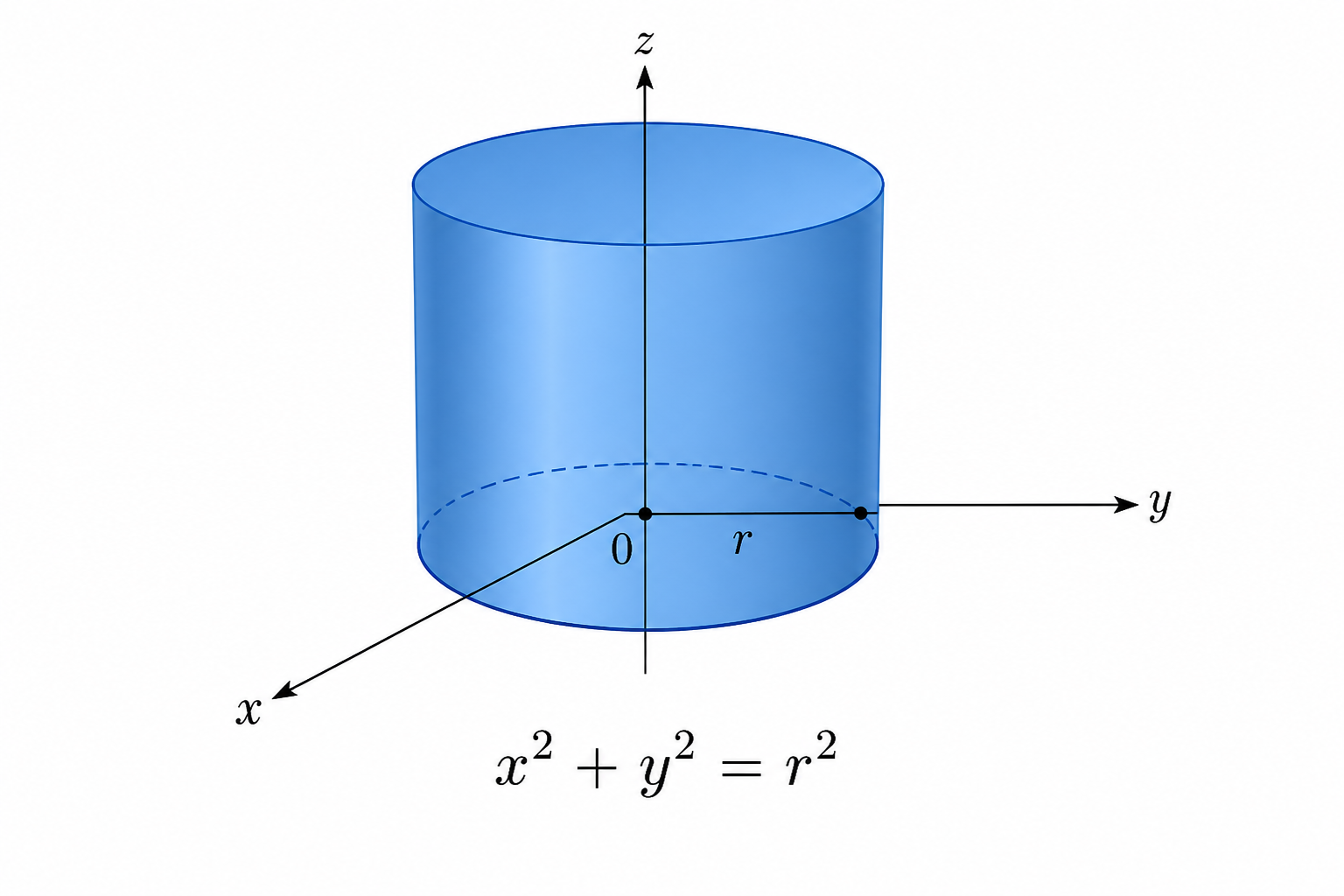
Hold the circle in the \(xy\)-plane and allow \(z\) to vary freely. The result is a right circular cylinder — the shape of a tin can (ignoring top and bottom caps).
\[ \boxed{x^2 + y^2 = r^2} \]Here the same equation appears as for the circle, but now \((x,y,z)\) ranges over all \(z\in\mathbb{R}\). The surface is the side wall; if you include the interior at fixed height, each horizontal slice is a filled disk.
- Shape: straight vertical (or horizontal) tube with circular cross-section.
- Volume (between \(z=0\) and \(z=h\)): \(\pi r^2 h\).
- Everyday names: a soda can, tin can, water pipe, drum, or a roll of paper towels — same circular slice repeated along the length.
3. Ellipse family#
When the two squared terms have different positive coefficients, the circle stretches into an ellipse. The same stretch-and-rotate logic lifts to an ellipsoid or an elliptic cylinder.
3.1 Ellipse (2D)#
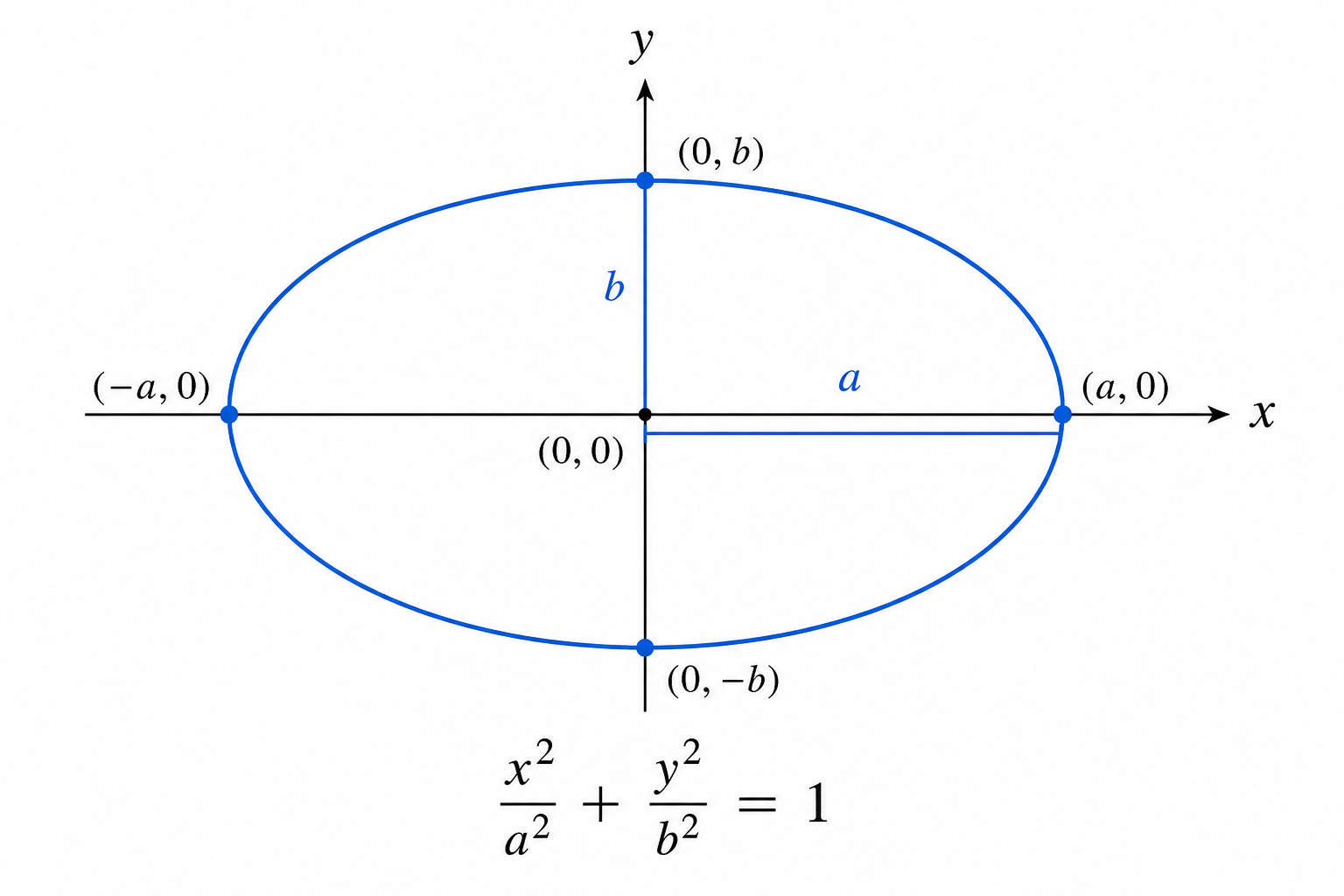
\[ \boxed{\frac{x^2}{a^2} + \frac{y^2}{b^2} = 1} \]with \(a\ge b>0\).
- Shape: closed oval; major semi-axis \(a\), minor semi-axis \(b\).
- Foci at \((\pm c,0)\) where \(c^2=a^2-b^2\) when the major axis lies on \(x\).
- Area: \(\pi ab\).
- Special case: \(a=b=r\) recovers the circle from §2.1.
- Everyday names: a running track oval, a planetary orbit (Kepler’s ellipse), the outline of an egg viewed from the side, or the elongated loop of a racetrack.
3.2 Ellipsoid (3D — rotate the ellipse)#
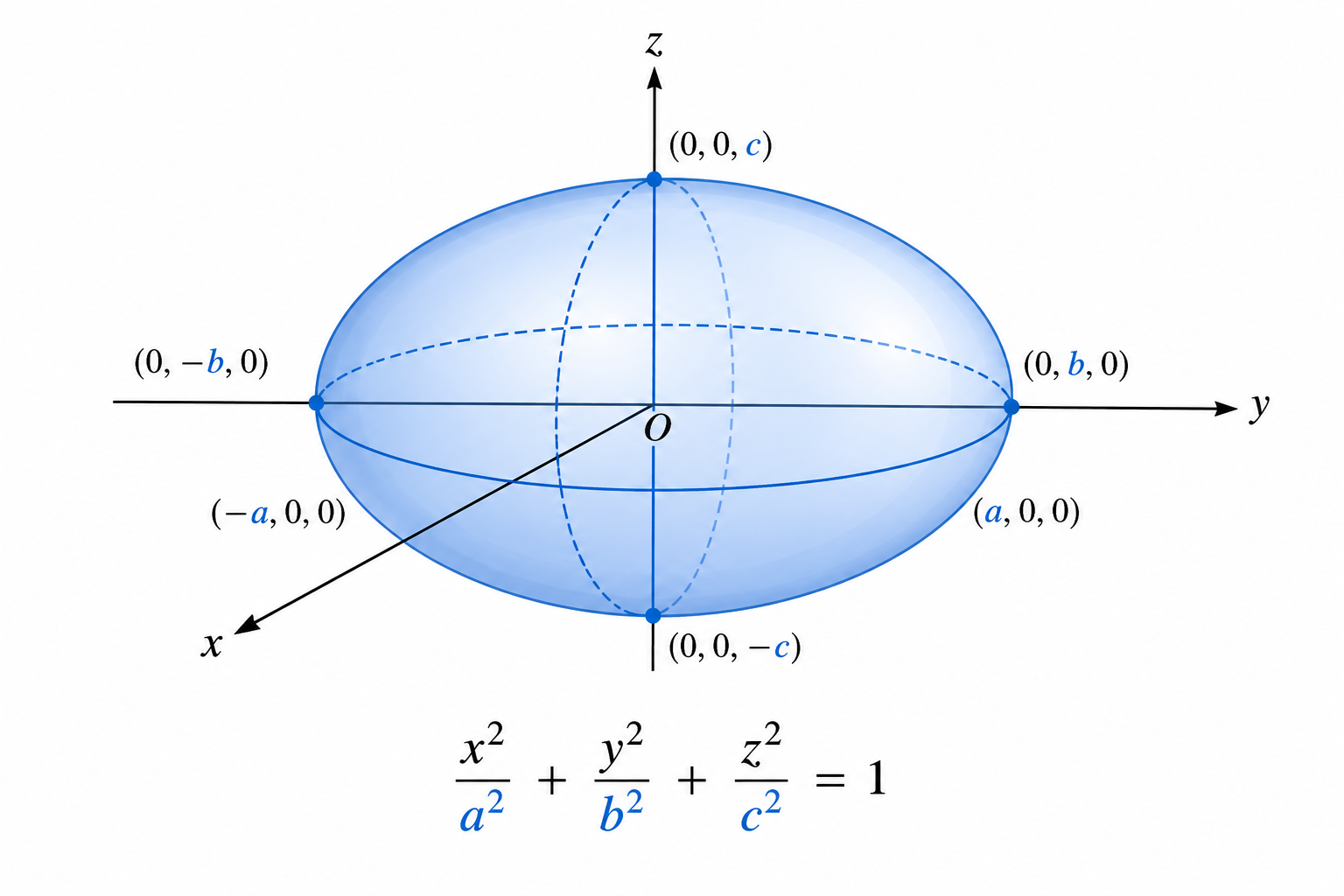
Rotate an ellipse about its major or minor axis, or more generally solve the triaxial equation:
\[ \boxed{\frac{x^2}{a^2} + \frac{y^2}{b^2} + \frac{z^2}{c^2} = 1} \]- Shape: closed egg-like or football-like surface when \(a,b,c\) are all different; every cross-section is an ellipse (or a circle when two semi-axes match).
- Volume: \(\dfrac{4}{3}\pi abc\).
- Special case: \(a=b=c=r\) gives the sphere from §2.2.
- Everyday names: an American football, a rugby ball, an egg, an avocado, or planet Earth (slightly squashed at the poles — an oblate spheroid, a special ellipsoid).
3.3 Elliptic cylinder (3D — extrude the ellipse)#
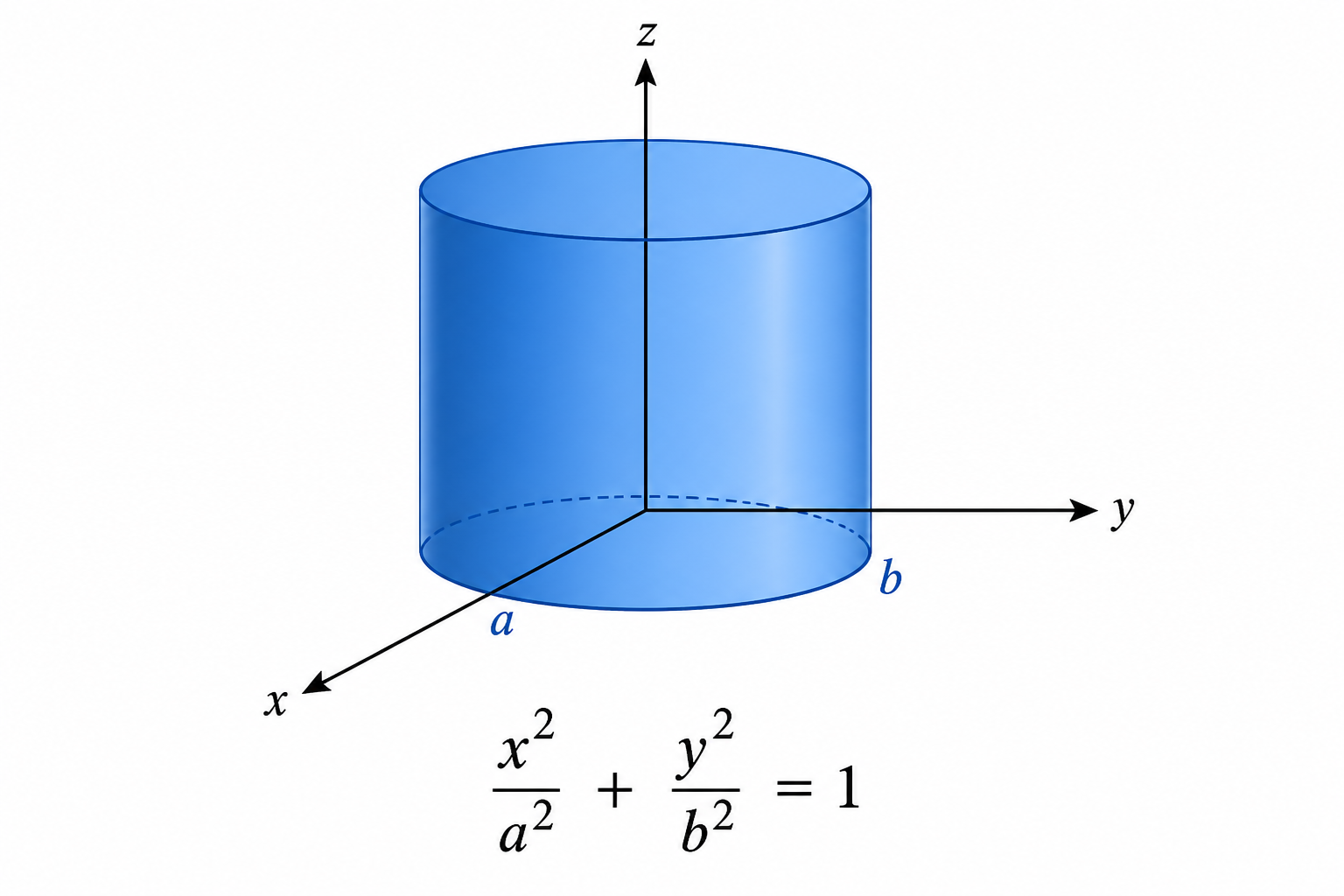
\[ \boxed{\frac{x^2}{a^2} + \frac{y^2}{b^2} = 1} \]with \(z\) free. Each horizontal slice is the same ellipse.
- Shape: an oval tube — like a cylinder, but the cross-section is elliptical rather than circular.
- Volume (between \(z=0\) and \(z=h\)): \(\pi ab\,h\).
- Everyday names: an oval duct or HVAC pipe, some architectural columns with an elliptical profile, or a toilet-paper roll that has been gently squeezed oval (approximate).
4. Parabola family#
A parabola has one squared variable and one linear variable. It is the trajectory of a thrown ball in idealized gravity, and the cross-section of a satellite dish. In 3D, rotation yields a paraboloid; extrusion yields a parabolic cylinder.
4.1 Parabola (2D)#
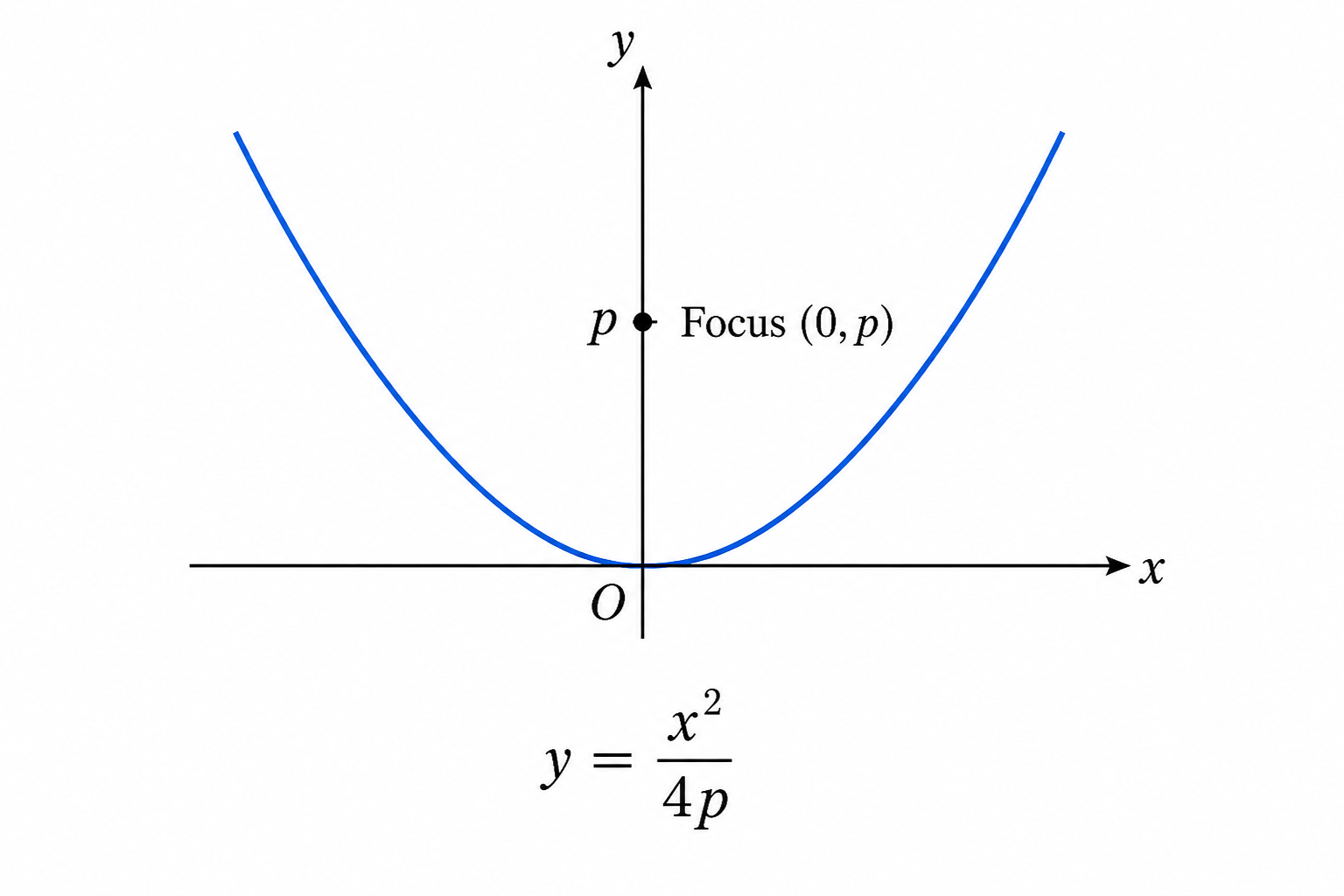
Standard form (vertex at origin, axis along \(y\)):
\[ \boxed{y = \frac{x^2}{4p}} \quad\text{equivalently}\quad \boxed{x^2 = 4py} \]where \(p>0\) is the focal parameter — distance from vertex to focus.
- Shape: open U-curve, symmetric about the \(y\)-axis.
- Focus: \((0,p)\). Directrix: line \(y=-p\).
- Reflective property: rays parallel to the axis reflect through the focus (used in mirrors and antennas).
- Everyday names: the arc of a thrown ball in idealized gravity, the curve of water in a fountain, or the cross-section of a satellite dish cut vertically through its center.
Horizontal-axis form: \(x = \dfrac{y^2}{4p}\).
4.2 Paraboloid (3D — rotate the parabola)#
Rotate \(y=\dfrac{x^2}{4p}\) about the \(y\)-axis, or write the elliptic paraboloid:
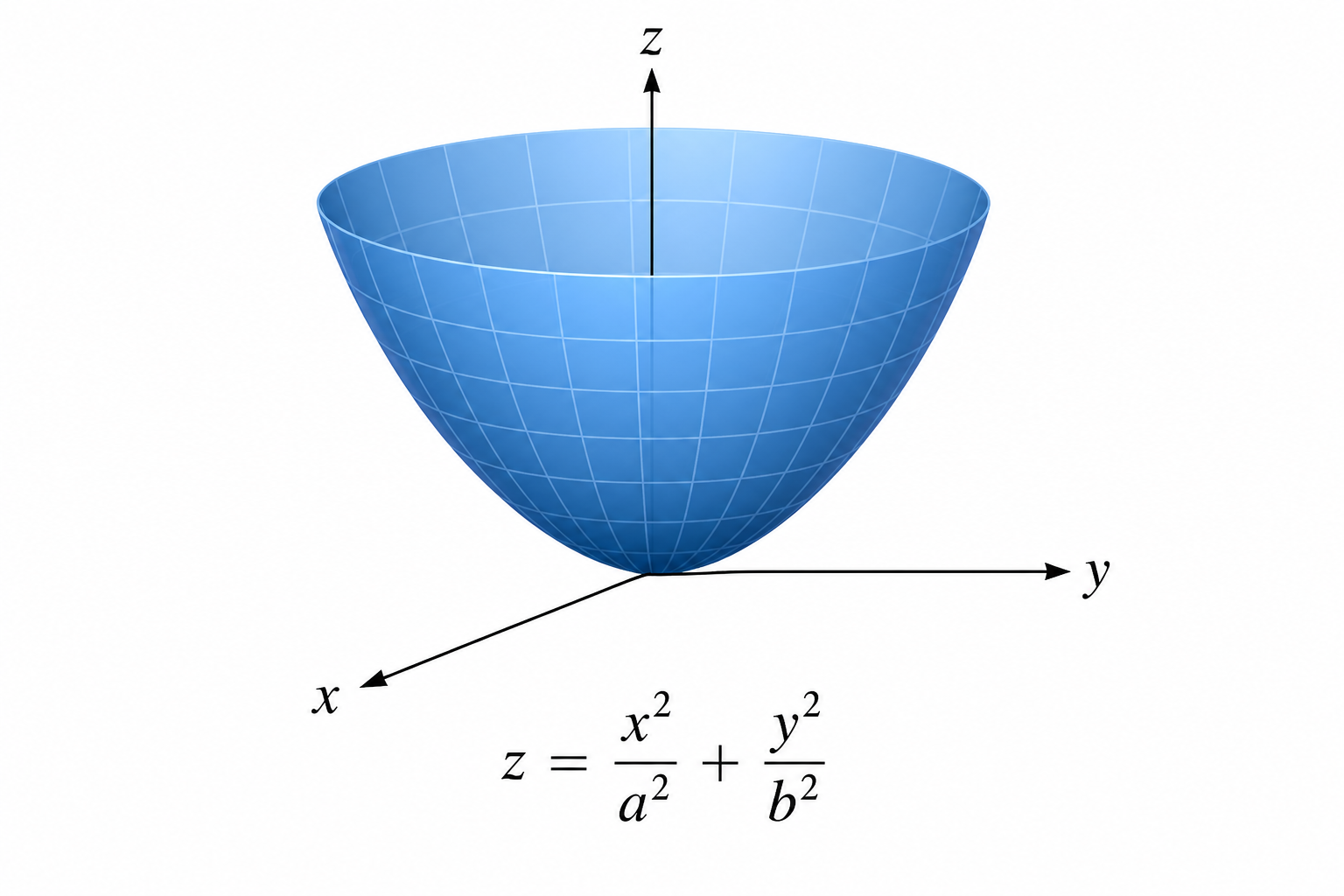
\[ \boxed{z = \frac{x^2}{a^2} + \frac{y^2}{b^2}} \]When \(a=b\), this is a circular paraboloid (satellite-dish shape opening along \(z\)).
- Shape: bowl opening upward (or downward if you flip the sign); level sets \(z=\text{const}\) are ellipses.
- Everyday names: a mixing bowl, satellite dish, headlight reflector, wok, or the surface of coffee spinning in a cup (approximate) — anything bowl-shaped that curves upward or downward smoothly.
4.3 Parabolic cylinder (3D — extrude the parabola)#
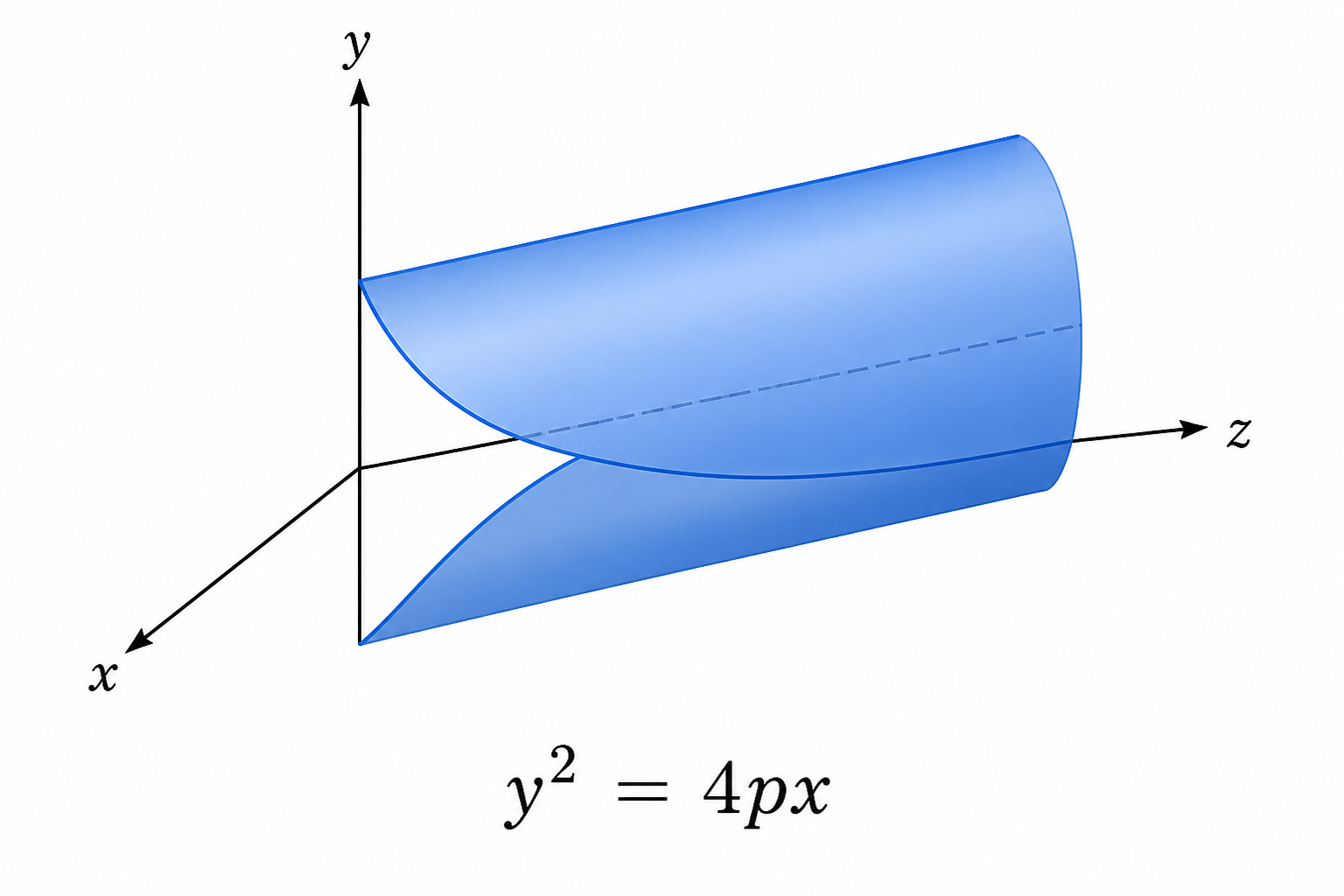
\[ \boxed{y = \frac{x^2}{4p}} \quad\text{or}\quad \boxed{y^2 = 4px} \]with \(z\) free — a parabolic cross-section copied along the \(z\)-axis.
- Shape: a curved trough running infinitely in the \(z\)-direction.
- Everyday names: a roof gutter profile extruded along a roofline, a ski-jump ramp cross-section stretched along the slope, or a corrugated sheet with a parabolic wave profile.
- Note: unlike the closed surfaces above, a parabolic cylinder is unbounded in the direction the parabola opens.
5. Hyperbola family#
A hyperbola has one squared term minus another. Its branches open along one axis, with asymptotes guiding the long-range shape. In 3D: rotation gives a hyperboloid; extrusion gives a hyperbolic cylinder.
5.1 Hyperbola (2D)#
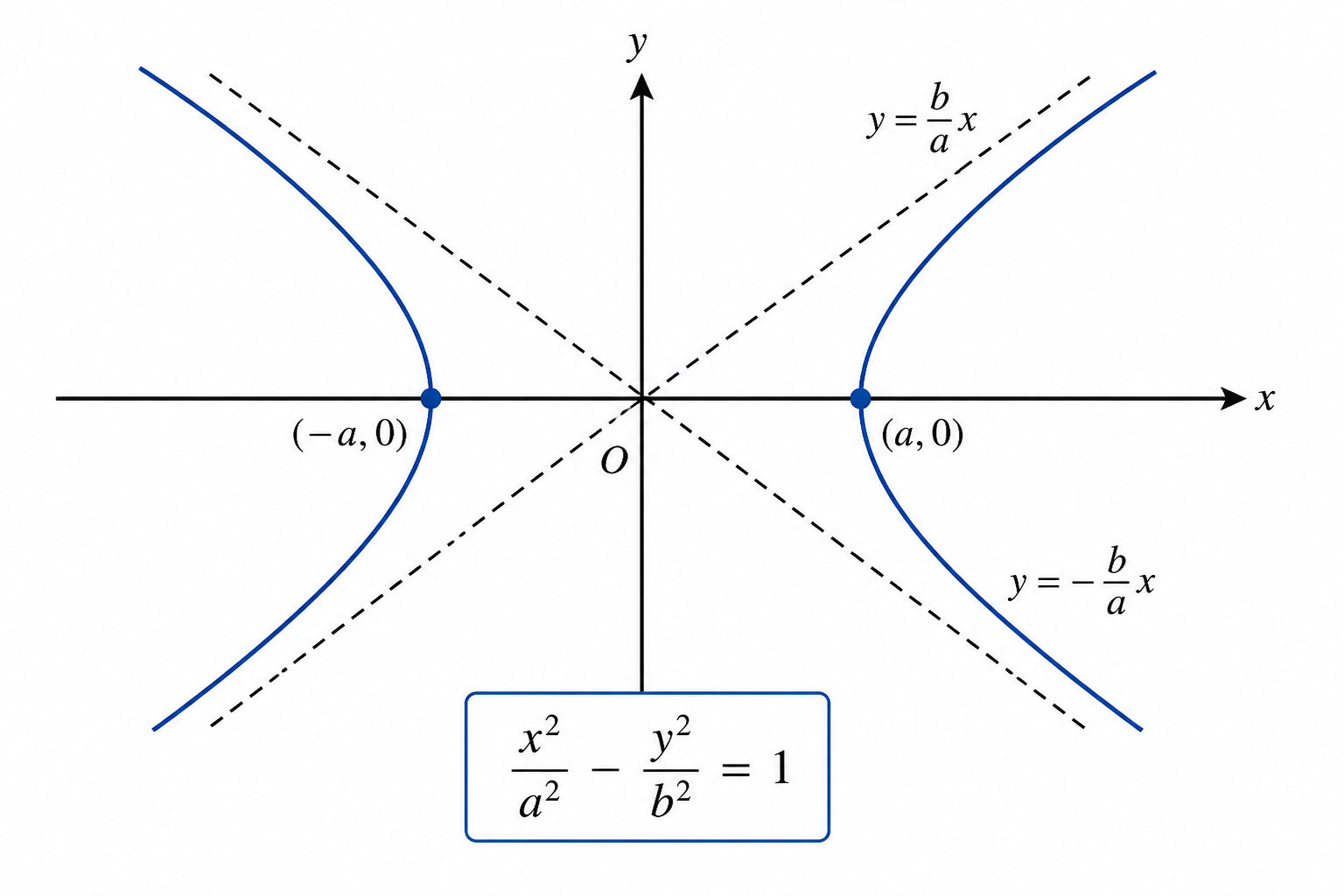
Standard form (center at origin, opening left–right):
\[ \boxed{\frac{x^2}{a^2} - \frac{y^2}{b^2} = 1} \]- Shape: two separate open branches, symmetric about both axes.
- Asymptotes: lines \(y = \pm \dfrac{b}{a}\,x\).
- Foci: \((\pm c,0)\) with \(c^2=a^2+b^2\).
- Vertical form: \(\dfrac{y^2}{a^2}-\dfrac{x^2}{b^2}=1\) opens up–down.
- Everyday names: the two arms of an hourglass shadow on a wall, the trajectory of a comet slingshotting past the Sun (hyperbolic orbit), or the outline you get when a cooling tower is sliced at the right angle.
5.2 Hyperboloid (3D — rotate the hyperbola)#
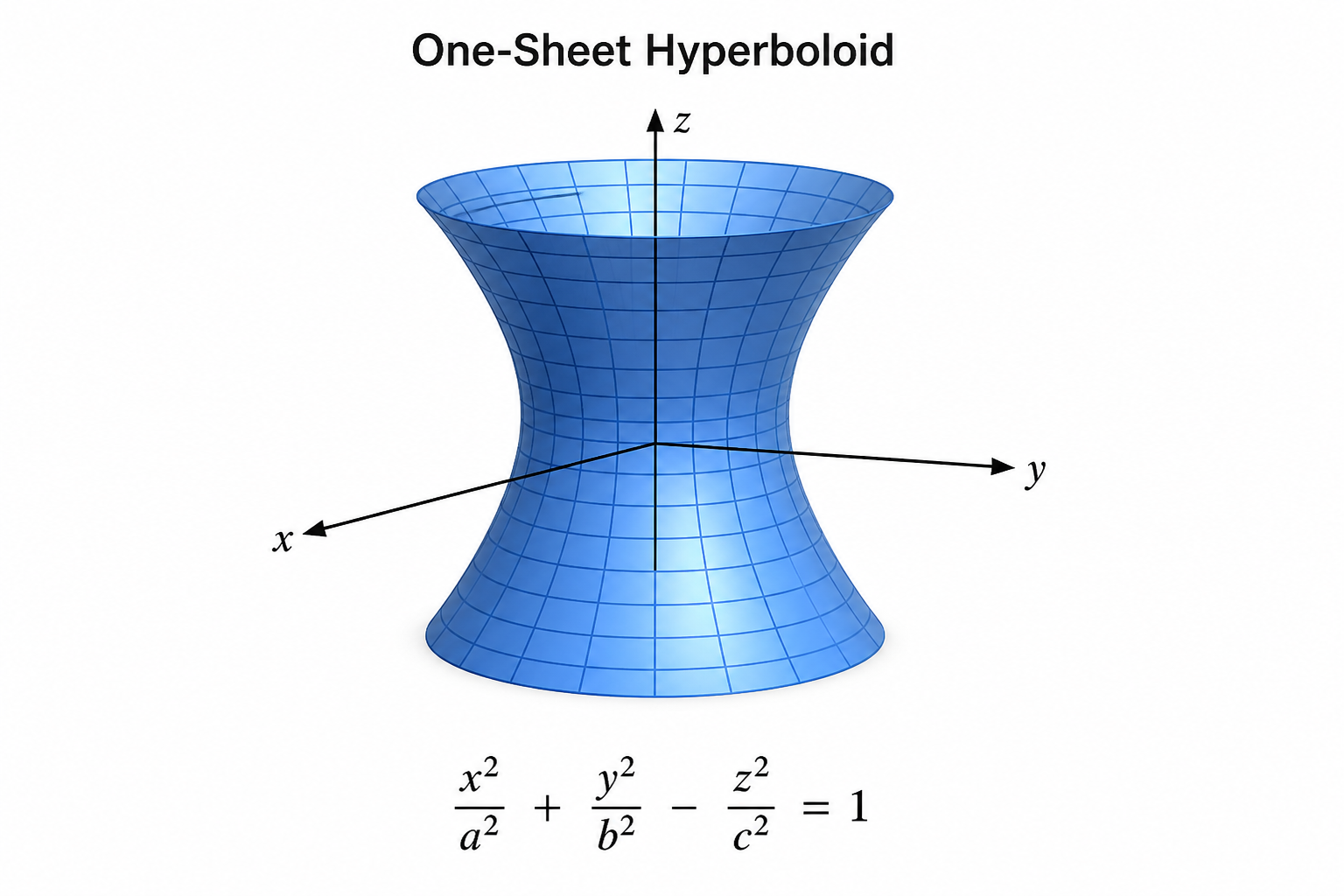
The one-sheet hyperboloid (cooling-tower shape):
\[ \boxed{\frac{x^2}{a^2} + \frac{y^2}{b^2} - \frac{z^2}{c^2} = 1} \]The two-sheet hyperboloid (two separate bowl-like pieces):
\[ \boxed{\frac{z^2}{c^2} - \frac{x^2}{a^2} - \frac{y^2}{b^2} = 1} \]- One-sheet: a single connected surface, surprisingly ruled — made of straight lines even though it looks curved (architectural towers exploit this).
- Two-sheet: upper and lower sheets separated by a gap; each sheet opens along \(z\).
- Everyday names (one-sheet): a nuclear cooling tower, an hourglass vase with a pinched waist, some transmission-tower legs, or a Pringles chip (hyperbolic paraboloid is a cousin — close enough to trigger the right mental image).
- Everyday names (two-sheet): two separate bowl halves facing away from each other, like the upper and lower nappes of a light cone in spacetime diagrams.
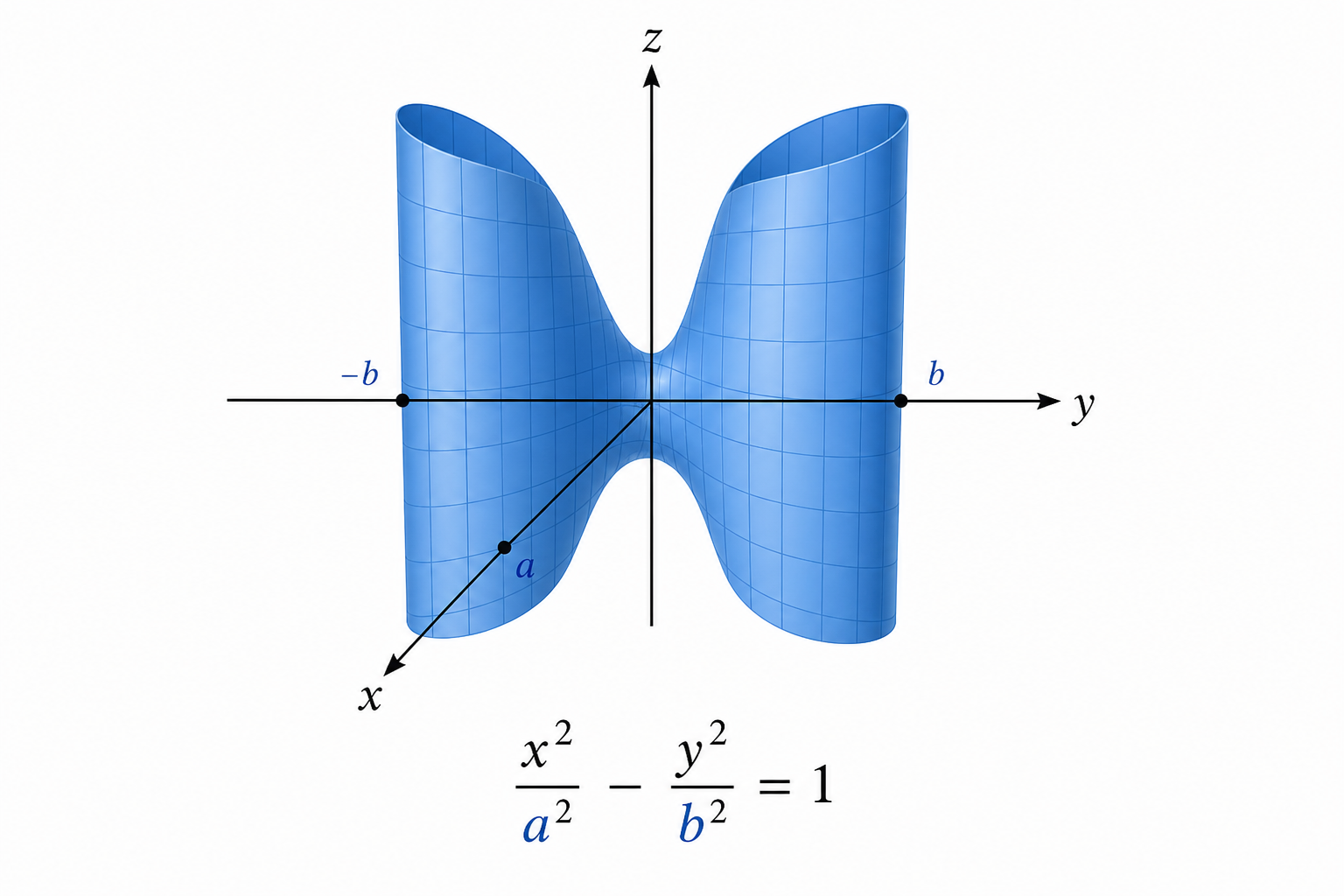
5.3 Hyperbolic cylinder (3D — extrude the hyperbola)#
\[ \boxed{\frac{x^2}{a^2} - \frac{y^2}{b^2} = 1} \]with \(z\) free.
- Shape: two parallel curved sheets (one for each branch of the hyperbola), extending infinitely in \(z\).
- Asymptotic directions: at large \(|x|\), each sheet approaches its asymptotic plane pair.
- Everyday names: less common as a finished product, but think of two parallel curved walls in modern architecture, or the ruled surface of a saddle-shaped roof extended along a ridge — a hyperbolic flavor even when the exact equation differs.
6. Quick reference — all twelve shapes#
| # | Shape | Everyday names | Standard equation |
|---|---|---|---|
| 1 | Circle | wheel, coin, clock face | \(x^2+y^2=r^2\) |
| 2 | Sphere | basketball, baseball, globe, orange | \(x^2+y^2+z^2=r^2\) |
| 3 | Right circular cylinder | soda can, pipe, drum | \(x^2+y^2=r^2\) |
| 4 | Ellipse | running track, planetary orbit, egg (side view) | \(\dfrac{x^2}{a^2}+\dfrac{y^2}{b^2}=1\) |
| 5 | Ellipsoid | football, rugby ball, egg, Earth | \(\dfrac{x^2}{a^2}+\dfrac{y^2}{b^2}+\dfrac{z^2}{c^2}=1\) |
| 6 | Elliptic cylinder | oval duct, squeezed roll | \(\dfrac{x^2}{a^2}+\dfrac{y^2}{b^2}=1\) |
| 7 | Parabola | thrown ball, fountain arc, dish profile | \(y=\dfrac{x^2}{4p}\) |
| 8 | Paraboloid | mixing bowl, satellite dish, wok | \(z=\dfrac{x^2}{a^2}+\dfrac{y^2}{b^2}\) |
| 9 | Parabolic cylinder | roof gutter, ski-jump profile | \(y^2=4px\) |
| 10 | Hyperbola | comet path, hourglass shadow | \(\dfrac{x^2}{a^2}-\dfrac{y^2}{b^2}=1\) |
| 11 | Hyperboloid (one sheet) | cooling tower, hourglass vase | \(\dfrac{x^2}{a^2}+\dfrac{y^2}{b^2}-\dfrac{z^2}{c^2}=1\) |
| 12 | Hyperbolic cylinder | parallel curved walls, saddle roof | \(\dfrac{x^2}{a^2}-\dfrac{y^2}{b^2}=1\) |
Reading the sign pattern#
- All plus signs (after moving everything to one side): circle / ellipse type — closed bounded curves or surfaces.
- One plus, one minus: hyperbola type — open branches or ruled hyperboloids.
- One squared term plus a linear term (no minus on the other squared term): parabola type — open curves and bowls.
From plane to space — two recipes#
- Rotation about the \(z\)-axis: replace \(x^2+y^2\) with the appropriate combination; add a \(z^2\) term with the same sign as the existing squared terms (for elliptic/hyperbolic types) or replace the linear axis with \(z\) (for parabolic type).
- Extrusion along \(z\): leave the \(x,y\) equation unchanged; do not restrict \(z\).
These recipes are not proofs — they are mnemonics. A full classification of quadric surfaces (all degree-2 surfaces in 3D) completes the picture with rotated and shifted versions of the same canonical forms.
7. Where you meet these shapes#
The Everyday names column in §6 is the fastest memory hook. A few cross-domain reminders:
- Machine learning: ellipsoids appear as level sets of multivariate Gaussians; paraboloids as bowl-shaped loss surfaces near a minimum; hyperbolas as decision boundaries for some kernel methods.
- Physics: planetary orbits are ellipses (Kepler); comets can follow hyperbolic paths; parabolic mirrors focus light.
- Engineering: cylinders and spheres are pressure vessels; hyperboloid cooling towers and parabolic antennas are structural staples.
If you are revisiting linear algebra or multivariable calculus, treat the quick-reference table as a visual index. When a formula shows \(x^2/a^2+y^2/b^2-z^2/c^2=1\), you should instantly picture a cooling tower — not because the algebra is magic, but because the sign pattern and the everyday name have been paired deliberately.
Hashtags#
#ConicSections #AnalyticGeometry #Circle #Ellipse #Parabola #Hyperbola #QuadricSurfaces #Mathematics #MathForML #Visualization #Geometry #AppliedMathematics

Comments: