The Grammar of Mathematics: Operators, Functions, Relations, and Symbols Explained#
Part 14 of the Learning Quantum Physics series.
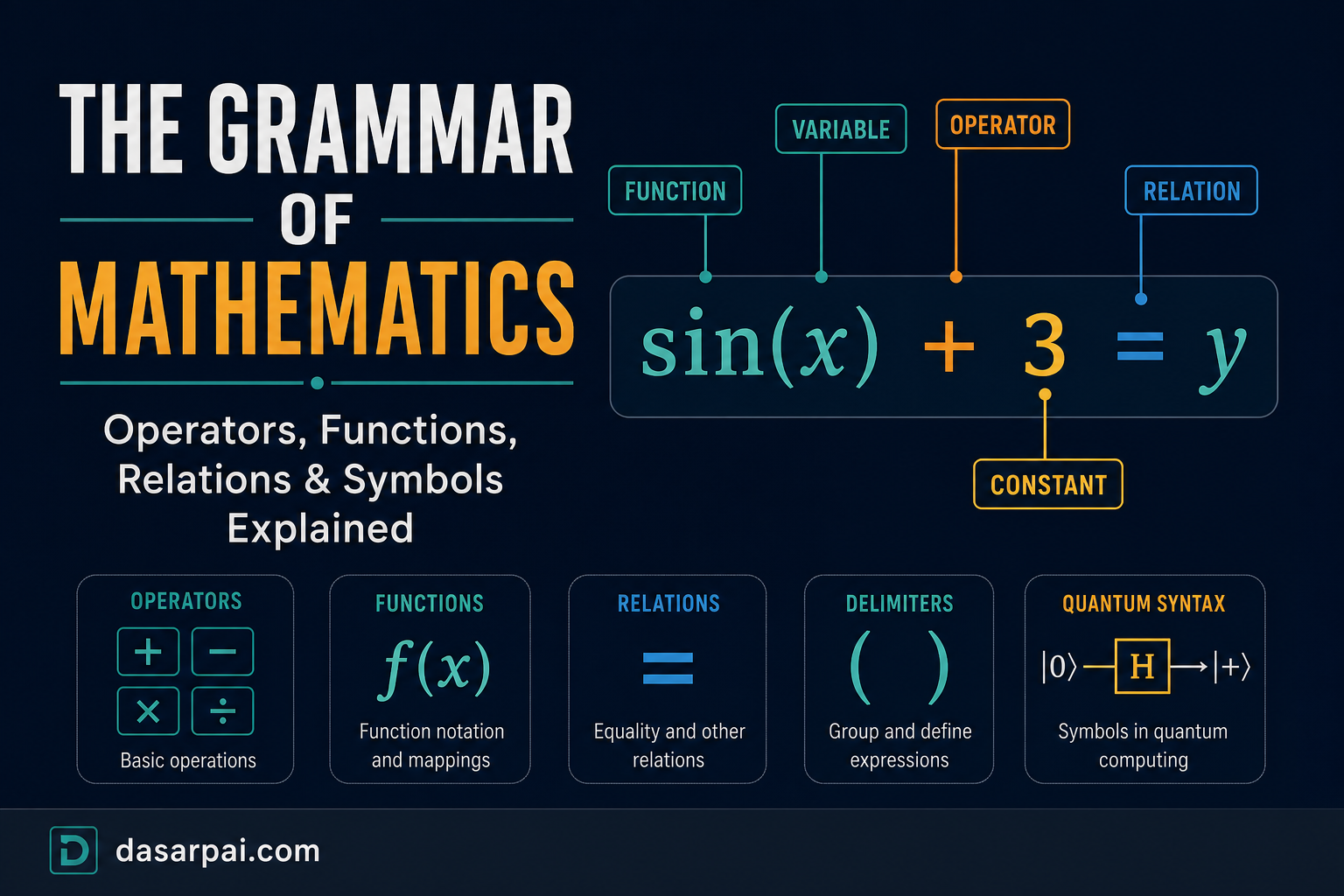
Mathematics often becomes difficult not because the ideas are difficult, but because the language used to express those ideas is unfamiliar. A beginner may look at an expression such as
sin(x) + 3 = y
and see only a collection of strange symbols.
But each part has a specific role.
sin   -> function
x     -> variable / argument
+     -> operator
3     -> constant value
=     -> relation
y     -> variable
( )   -> function notation / grouping
Once we learn to identify these roles, mathematical expressions become much easier to read. The same skill scales from elementary arithmetic through calculus, linear algebra, and quantum computing — context tells us which role each symbol plays.
1. Mathematics Has a Grammar#
Natural language has:
- nouns,
- verbs,
- adjectives,
- relationships,
- punctuation.
Mathematics has its own comparable structure:
- numbers,
- constants,
- variables,
- operands,
- operators,
- functions,
- relations,
- delimiters,
- expressions.
Consider:
3 + 4 = 7
Here:
3, 4, 7  -> numbers
+         -> operator
=         -> relation
Now consider:
sqrt(x)
Here:
sqrt   -> function
x      -> argument
( )    -> function notation
And later, in quantum computing:
H|0> = |+>
Here:
H       -> quantum operator
|0>     -> input quantum state
=       -> relation
|+>     -> resulting state
The important skill is therefore not merely memorizing symbols.
It is learning:
What role is each symbol playing?
2. Mathematical Objects Come First#
Before discussing operators and functions, we need to know what they act upon.
Mathematics contains many kinds of objects:
numbers
vectors
matrices
sets
functions
quantum states
An operator or function acts on one or more such objects and produces another object.
3. Numbers#
Some of the most familiar mathematical objects are numbers.
Examples:
0
1
-5
3.14
1/2
Different kinds of numbers include:
- natural numbers,
- integers,
- rational numbers,
- irrational numbers,
- real numbers,
- complex numbers.
For this article, what matters is simply that numbers can serve as inputs and outputs of mathematical operations.
4. Constants#
The word constant needs careful treatment because there are at least two important categories.
4.1 Mathematical Constants#
A mathematical constant is a fixed mathematical value.
Examples include:
pi
e
i
where:
pi  -> ratio related to circles
e   -> base of the natural logarithm
i   -> square root of -1
These arise from mathematical definitions and mathematical structures.
Their values do not depend on experimental measurement.
5. Physical Constants#
Physics also uses constants.
Examples include:
c
h
G
k
where, depending on context:
c  -> speed of light in vacuum
h  -> Planck constant
G  -> gravitational constant
k  -> Boltzmann constant
These describe quantitative properties of the physical universe.
So we should distinguish:
| Type | Example | Meaning |
|---|---|---|
| Mathematical constant | pi | fixed by mathematics |
| Mathematical constant | e | fixed by mathematics |
| Physical constant | c | physical property of nature |
| Physical constant | h | physical property of nature |
This distinction matters.
A mathematical constant arises from mathematical relationships.
A physical constant connects mathematics with experimentally observed nature.
6. Constant Does Not Always Mean a Special Universal Constant#
There is another use of the word constant.
Consider:
y = 3x + 5
Here 5 is often called a constant term.
It is not a universal mathematical constant like pi.
It simply remains fixed while x varies.
So the word constant may refer to:
- a mathematical constant such as
pi, - a physical constant such as
c, - a fixed value within a particular expression, such as
5.
Context tells us which meaning is intended.
7. Variables#
A variable is a symbol representing an object whose value may vary or may not yet be specified.
Examples:
x
y
n
t
But variables do not have to represent ordinary numbers.
A variable may represent:
x      -> number
v      -> vector
A      -> matrix
f      -> function
S      -> set
|psi>  -> quantum state
The letter itself does not determine the type.
The surrounding context does.
8. What Is an Operand?#
Before defining operators, we need the word operand.
Consider:
3 + 4
The symbol
+
is an operator.
The numbers
3
4
are the operands.
So:
An operand is an object on which an operator acts.
Consider:
-x
Here:
-  -> operator
x  -> operand
Consider:
n!
Here:
!  -> operator
n  -> operand
9. What Is an Operator?#
An operator performs an operation on one or more operands.
The general idea: input —operator—> output. For example:
3, 4 ---+---> 7 written as 3 + 4 = 7
10. Familiar Arithmetic Operators#
Some common operators are:
| Operator | Name | Example |
|---|---|---|
+ | addition | 3 + 4 |
- | subtraction | 7 - 2 |
* | multiplication | 3 * 4 |
/ | division | 8 / 2 |
^ | exponentiation | 2^3 |
! | factorial | 5! |
% | percentage or modulo, depending on context | 25% |
Notice immediately that symbols do not always have one universal meaning.
We will return to that later.
11. Operators by Number of Operands#
The number of operands an operation accepts is called its arity.
Unary Operator#
A unary operator acts on one operand.
Examples:
-x
n!
|x|
One input enters the operation.
12. Binary Operator#
A binary operator acts on two operands.
Examples:
x + y
x - y
x * y
x / y
x^y
Addition therefore has two operands:
3 + 4
13. Ternary and N-ary Operations#
Some operations may work with three inputs or many inputs.
For example, a function may be defined as:
f(x, y, z)
An operation involving an arbitrary number of inputs is sometimes called n-ary.
The important point is:
Operators and functions are not restricted to one input.
14. Operators Can Be Written in Different Positions#
An operator does not always appear in the same location relative to its operands.
There are several common styles.
15. Prefix Operators#
A prefix operator appears before its operand.
Example:
-x
Here the operator comes first.
operator operand
   -       x
16. Infix Operators#
An infix operator appears between two operands.
Example:
x + y
Structure:
operand operator operand
   x       +       y
Most ordinary arithmetic operators are written this way.
17. Postfix Operators#
A postfix operator appears after its operand.
Example:
n!
Structure:
operand operator
   n       !
Percentage notation is also commonly postfix:
25%
which means:
25 / 100
or:
0.25
18. Enclosing Notation#
Some operations are expressed by placing symbols around an object.
Example:
|x|
which represents absolute value.
For:
|-5|
the result is:
5
The same visual symbols may also serve other purposes in different contexts.
That is why notation must always be interpreted in context.
19. What Is a Function?#
A function is a rule that maps allowed inputs to exactly one output: input —function—> output.
For example, with f(x) = x^2 and x = 3:
3 ---f---> 9 i.e. f(3) = 9
20. Function, Input, Argument, and Output#
Consider:
f(x)
Here:
f  -> function
x  -> argument
The word argument usually refers to the input supplied to a function.
For example:
sin(x)
x is the argument of the sine function.
This parallels operator terminology:
x + y
where x and y are called operands.
So:
function -> arguments
operator -> operands
Conceptually, both are inputs.
21. Named Functions#
Many important mathematical operations are traditionally written as named functions.
Examples:
sqrt(x)
sin(x)
cos(x)
tan(x)
log(x)
exp(x)
These represent rules that map inputs to outputs.
For example:
sqrt(9) = 3
sin(pi/2) = 1
log10(100) = 2
22. Is sqrt a Function or an Operator?#
This is where terminology begins to overlap.
Consider:
f(x) = sqrt(x)
Clearly, this defines a function.
So sqrt is normally described as a function.
But we may also say:
Apply the square-root operation.
And some contexts may speak informally of the square-root operator.
The important distinction is therefore not purely about the computation being performed.
It is about how we are viewing that computation.
23. Function vs Operator#
This is the central idea of the article.
A useful distinction is:
A function emphasizes mapping from input to output.
while:
An operator emphasizes an action being performed on one or more mathematical objects.
Consider:
f(x) = x^2
The emphasis is:
input -> rule -> output
Now consider:
x + y
The emphasis is:
operand -> operation <- operand
Yet mathematically the distinction is not absolute.
24. An Operator Can Often Be Written as a Function#
Take addition:
3 + 4 = 7
We could define a function:
add(x, y) = x + y
Then write:
add(3, 4) = 7
Instead of:
3 + 4 = 7
So mathematically:
x + y
and
add(x, y)
can represent the same mapping.
The difference is mainly notation and mathematical convention.
This gives us a powerful conclusion:
Many operators can mathematically be viewed as functions.
25. Function vs Operator: A Comparison#
| Property | Function | Operator |
|---|---|---|
| Main emphasis | mapping | action |
| Input terminology | arguments | operands |
| Typical notation | f(x) | x + y |
| Can have one input? | yes | yes |
| Can have multiple inputs? | yes | yes |
| Produces output? | yes | yes |
| Mathematically a mapping? | yes | usually yes |
Therefore function and operator are not completely separate species.
They are often different perspectives on mathematical transformations.
26. What Is an Expression?#
An expression is a valid combination of mathematical objects, functions, and operators.
Examples:
x + y
sqrt(x)
x^2 + 3x + 2
sin(x) + log(y)
An important distinction:
+
is an operator.
But:
x + y
is an expression containing that operator.
Similarly:
sin
names a function.
But:
sin(x)
is an expression representing that function applied to x.
An equation adds a relation — typically \(=\) — between two expressions. For example, \(x + 3\) is an expression; \(x + 3 = 7\) is an equation. The grammar rules are the same; an equation just asserts that the two sides stand in a stated relationship.
27. Relations Are Different from Operators#
Consider:
3 + 4 = 7
The symbol:
+
performs an operation.
The symbol:
=
does something different.
It states that the expression on the left and the expression on the right have the same value.
So = is called a relation.
Common relations include:
| Relation | Meaning |
|---|---|
= | equal to |
!= | not equal to |
< | less than |
> | greater than |
<= | less than or equal to |
>= | greater than or equal to |
Relations describe how mathematical objects are connected.
28. Operators Usually Produce; Relations Usually Compare#
A useful beginner-friendly distinction is:
operator
inputs -> result
while:
relation
object <relationship> object
Example:
3 + 4
produces:
7
But:
7 = 7
states a relationship.
This distinction is not perfect in every advanced formal system, but it is an excellent working model.
29. Delimiters and Grouping Symbols#
Indices, subscripts, and superscripts pack extra meaning into a symbol without introducing a new operator. In \(a_{ij}\), the subscripts identify the row and column; in \(x^2\), the superscript marks exponentiation (see §38). Treat them as part of the symbol’s name unless they sit on an operator itself (as in \(\sum_{i=1}^n\)).
Some mathematical symbols mainly organize expressions.
Common examples include:
( )
[ ]
{ }
For example:
2 * (3 + 4)
The parentheses tell us which operation should be performed first.
They do not themselves represent ordinary arithmetic.
30. Parentheses Can Have Multiple Roles#
Consider:
f(x)
Here parentheses identify the argument supplied to a function.
But consider:
2 * (3 + 4)
Here parentheses group an expression.
So the same symbol may perform different notational roles.
Again:
Context determines meaning.
31. The Same Symbol Can Have Different Meanings#
One of the biggest sources of confusion in mathematics and programming is symbol overloading.
The same symbol may mean different things in different contexts.
32. The % Symbol#
In ordinary mathematics:
25%
means:
25 / 100
so:
25% = 0.25
Here % behaves like a postfix operation.
But in many programming languages:
17 % 5
means the remainder after division:
17 % 5 = 2
Same symbol.
Different operation.
33. The - Symbol#
Consider:
5 - 3
Here - is a binary subtraction operator.
But:
-3
uses - as a unary negation operator.
So even within elementary arithmetic, the same symbol represents two related but distinct operations.
34. The * Symbol#
Depending on context, * may represent:
- multiplication,
- scalar multiplication,
- complex conjugation in some notation,
- an adjoint in some notation,
- convolution in some fields,
- a wildcard in computing.
Therefore one should never interpret a symbol completely outside its context.
35. The Vertical Bar |#
The vertical bar is especially overloaded.
It may appear in:
|x|
for absolute value.
Or in probability:
P(A | B)
meaning probability of A given B.
Or in set notation, where it may mean:
such that
Or in quantum mechanics:
|0>
as part of ket notation.
So the symbol itself is not the mathematical idea.
It is notation whose meaning depends on context.
36. Handwriting Makes Symbols Ambiguous#
Printed textbooks use carefully designed fonts. Your notebook does not.
When we solve problems by hand, the same squiggle can mean more than one symbol — and we often misread our own writing halfway through a calculation. The grammar rules in this article assume symbols are legible. Handwriting breaks that assumption unless we adopt a few deliberate habits.
The failure mode is predictable:
ambiguous symbol ---> misread later ---> wrong rule ---> wrong result
Common handwritten confusions#
| If you write… | It may be read as… | Typical consequence |
|---|---|---|
. between numbers | decimal point or multiplication dot | 3.14 vs 3 · 14; 2.5 vs 2 × 5 |
. between terms | dot product, scalar product, or decimal | a . b vs a.b vs a, b |
x (variable) | multiplication sign × | 2x read as 2 × x is fine; ax read as a × x vs variable name ax |
× (multiply) | letter x | 3 × 4 misread as 3x4 or 3x 4 |
2 | z or Z | 26 vs z6; 2n vs zn in sequences |
5 | S | 5x vs Sx in variable names |
6 | b or G | coefficients swapped in quadratics |
9 | g or q | index or base misread |
0 | O, o, or θ | 10 vs 1O; angles vs zero |
1 | l, I, or | | 1 + 1 vs l + l; |x| vs 1x1 |
i | 1, |, or \sqrt{-1} | complex unit vs index; 1 vs i in |1| |
l (ell) | 1 or I | especially in l, 1, I all in one problem |
- (minus) | _ (subscript) or fraction bar | -3 looks like subscript on previous line |
+ | t, †, or sloppy \oplus | sign lost in fast algebra |
> | ) or } | x > 0 misread as (x 0) or {x 0 |
< | ( or { | breaks inequalities and intervals |
( | c, C, or < | unbalanced grouping |
) | j, ) with tail like > | early close of an expression |
{ | } | < | > when drawn loosely | set notation vs comparison |
\oplus (circled plus) | ordinary + with a loop | direct sum / XOR vs addition |
\otimes (circled times) | x inside a circle, or \times | tensor product vs ordinary product |
\odot (circled dot) | decimal point or \cdot | Hadamard product vs decimal |
° (degree) | superscript 0 | \sin 30° vs \sin 30^0 |
, | decimal separator (EU) or thousands separator (US) | 3,14 vs 3,140 |
~ | - or \approx | sign error in approximations |
= | two dashes, \equiv, or \approx | false “solution” from sloppy equals |
∫ | long f or S | integral vs function name |
Σ | capital E | sum vs variable E |
∂ | d or \delta | partial vs ordinary derivative |
√ without vinculum | square root of wrong length | \sqrt{2+3} vs \sqrt{2}+3 |
| short fraction bar | unclear scope | \frac{a+b}{c} vs a + \frac{b}{c} |
This list is not exhaustive. The pattern is always the same: two legitimate symbols collapse into one shape on paper.
Habits that prevent handwriting errors#
- Separate digits from letters. Write
2with a flat base; writezwith a tail. Cross7; put a bar onZ. Dotiandj; crosstwhen it could be+. - Never use
xas multiplication. Use\cdot,\times, or parentheses:2 · xor2(x), not a fuzzyxbetween factors. - Mark decimals explicitly. In mixed work, prefer
\cdotfor multiplication and reserve.for decimals — or write the decimal as0.5with a leading zero so the dot is unambiguous. - Distinguish
\|,1,l, andI. Make\|taller and straighter; make1with a serif or bottom bar; never use bare\|when you mean the number 1. - Write inequalities with care. Add space:
x > 0, notx>0jammed together. Use\leqand\geqwhen<and>keep looking like brackets. - Draw brackets large enough. A tall
(or{that wraps the whole grouped expression prevents the eye from treating<or{as a relation. - Use circled operators only when you mean them. If you need
\oplusor\otimes, draw the circle clearly; otherwise use plain+or\timesso you do not invent a symbol mid-derivation. - Extend radical bars and fraction bars across the full radicand or numerator — the most common handwritten error is correct symbols with wrong scope.
- When in doubt, add parentheses — even one extra pair is cheaper than re-solving the whole problem.
- Copy the line you are about to use. Before substituting, rewrite the previous step’s result cleanly; do not chain from a smudge.
Handwriting ambiguity is not a separate topic from the grammar of mathematics. It is what happens when role and shape diverge on the page. Reading mathematics means assigning roles to symbols; sloppy ink removes the clues that context normally supplies.
2 read as z, a loose > read as ), one more hour when I should have stopped. Do not solve math problems when you are physically or mentally tired. The longer you push through, the more notation mistakes compound. A clean line tomorrow beats another smudged page tonight.37. Notation Is Not the Mathematical Object#
This is a very important distinction.
Consider:
x + y
and:
add(x, y)
Both could represent exactly the same addition operation.
The notation is different.
The mathematical operation is the same.
Therefore:
A symbol is a representation of a mathematical idea, not the idea itself.
This principle becomes increasingly important in advanced mathematics and physics.
38. Operator Precedence#
Once several operators appear in one expression, another question arises:
Which operation happens first?
Consider:
3 + 4 * 5
The multiplication has higher precedence than addition.
So this means:
3 + (4 * 5)
not:
(3 + 4) * 5
The result is therefore:
23
rather than:
35
39. Common Precedence Order#
When several operations compete in one expression, a simplified priority order is:
- Grouping — parentheses, brackets, braces (when they appear)
- Powers — exponentiation
- Multiplication and division — same priority level; usually left to right
- Addition and subtraction — same priority level; usually left to right
Higher on the list binds tighter. Grouping always wins when it is present. If there are no grouping symbols, start at step 2.
Example without grouping#
2 + 3^2 * 4
No parentheses here, so we skip step 1 and work down the list:
Step 2 — powers: 3^2 = 9, giving 2 + 9 * 4
Step 3 — multiplication: 9 * 4 = 36, giving 2 + 36
Step 4 — addition: 2 + 36 = 38
Why not 2 + 3^(2 * 4)?#
Nothing in the shape of the symbols prevents that reading — the digits and operators sit in a row with no built-in “do this first” marker. Precedence is the rule that settles it.
Between ^ and *, exponentiation outranks multiplication (steps 2 and 3 above). So the ^ binds 3 and 2 into 3^2 before the * combines the result with 4:
2 + 3^2 * 4 means 2 + (3^2) * 4 = 2 + 9 * 4 = 38
not:
2 + 3^2 * 4 ≠ 2 + 3^(2 * 4) = 2 + 3^8 = 6561
To mean 2 + 3^(2 * 4), you must write the grouping explicitly:
2 + 3^(2 * 4)
Without those parentheses, treating * before ^ is a precedence error — the same kind of mistake as computing (3 + 4) * 5 when the expression says 3 + 4 * 5. When in doubt, add parentheses; do not rely on the reader to guess your intended order.
Example with grouping first#
(2 + 3)^2 * 4
Here step 1 applies before anything else:
Step 1 — grouping: (2 + 3) = 5, giving 5^2 * 4
Step 2 — powers: 5^2 = 25, giving 25 * 4
Step 3 — multiplication: 25 * 4 = 100
40. Associativity#
Precedence tells us which different operators act first.
Associativity tells us how repeated operators of similar precedence group.
Consider:
10 - 5 - 2
Subtraction is normally interpreted left to right:
(10 - 5) - 2
which gives:
3
not:
10 - (5 - 2)
which would give:
7
41. Exponentiation Can Associate Differently#
Consider:
a^b^c
Many mathematical conventions interpret this as:
a^(b^c)
rather than:
(a^b)^c
Whenever notation may be ambiguous, parentheses are preferable.
42. Domain of a Function#
A function is not merely a formula.
It also has a set of allowed inputs.
That set is called its domain.
Consider:
f(x) = sqrt(x)
If we restrict ourselves to real numbers, then:
x >= 0
because the real square root of a negative number is not defined.
So the function’s domain matters.
43. Logarithm Gives Another Example#
Consider:
f(x) = log(x)
For a real-valued logarithm:
x > 0
So:
log(10)
is valid.
But:
log(-10)
is not a real-valued result.
It can be handled in complex mathematics, but that changes the domain and codomain.
44. Domain, Codomain, and Range#
Three terms are useful.
domain
means:
allowed inputs
codomain
means:
declared set in which outputs live
range
means:
outputs actually produced
The full definition of a function includes more than merely its formula.
45. Functions Can Have Multiple Inputs#
Functions are often introduced as:
f(x)
but they may have several inputs.
For example:
f(x, y) = x + y
or:
distance(x1, y1, x2, y2) = sqrt((x2 - x1)^2 + (y2 - y1)^2)
So one-input notation should not make us think that all functions are unary.
46. This Again Connects Functions and Operators#
Addition:
x + y
is normally written as an infix operator.
But it can also be represented as:
add(x, y)
which looks like an ordinary two-input function.
Therefore syntax alone should not be mistaken for mathematical essence.
47. Function Composition#
Functions can also be connected together.
Suppose:
g(x) = x^2
and:
f(x) = sqrt(x)
Then:
f(g(x))
applies g first, then f — read the nesting inside out:
x ---g---> g(x) ---f---> f(g(x)) e.g. 9 ---g---> 81 ---f---> 9
This is called function composition.
48. Operators Can Act on Functions#
In elementary mathematics, operators usually act on numbers.
But in calculus, an operator may act on an entire function.
Consider the derivative — a function in, a new function out:
x^2 ---d/dx---> 2x (function ---operator---> new function)
This is an important reason advanced mathematics uses the word operator so frequently.
49. Integration Can Also Be Viewed as an Operator#
Integration similarly acts on functions:
2x ---integral---> x^2 + C
So operators need not act only on numbers. They may act on functions, vectors, matrices, and quantum states.
50. Operators in Linear Algebra#
Suppose A v = w — a matrix acting as a linear operator on a vector:
v ---A---> w (A = matrix, v = input vector, w = output vector)
This idea is fundamental to linear algebra.
51. Matrix and Vector Operations#
Linear algebra introduces many new operations.
Examples include:
- matrix multiplication,
- dot product,
- inner product,
- outer product,
- cross product,
- Hadamard product,
- tensor product,
- transpose,
- inverse,
- conjugate transpose.
These operations answer different mathematical questions.
They should not be assumed to be interchangeable simply because all are sometimes called “products” or “operations.”
52. Operators in Quantum Computing#
The operator idea becomes central in quantum mechanics and quantum computing.
Suppose X|0> = |1> — the Pauli-X operator flips the state:
|0> ---X---> |1>
The operator transforms one quantum state into another.
53. The Hadamard Operator#
The Hadamard operator H sends each computational basis state to an equal superposition:
|0> ---H---> |+>
|1> ---H---> |->
where the output states are (in ket notation, |+> and |->):
So \(H|0\rangle = |+\rangle\) and \(H|1\rangle = |-\rangle\) — same pipeline as earlier; only the mathematical objects have changed.
54. Quantum Gates Are Operators#
In quantum computing, quantum gates are represented mathematically by unitary operators.
Examples include:
X
Y
Z
H
CNOT
They act on quantum states and produce new quantum states while preserving the mathematical structure required by quantum mechanics.
So the humble idea of an operator introduced with 3 + 4 eventually grows into unitary gates such as U|ψ>:
3, 4 ---+---> 7 ... grows into ... |ψ> ---U---> new state
55. Operator, Transformation, and Matrix#
These three words are related but should not be treated as identical.
A transformation describes a mapping from one object to another.
An operator is commonly a transformation viewed as acting on mathematical objects.
A matrix can represent a linear transformation or linear operator after a basis has been chosen.
So:
abstract transformation --> linear operator --> matrix representation
They are closely connected but conceptually distinct.
56. One Expression Fully Dissected#
Consider:
y = sqrt(x^2 + 1)
We can classify every part.
| Part | Role |
|---|---|
y | variable |
= | relation |
sqrt | function |
x | variable / argument |
^ | exponentiation operator |
2 | constant value |
+ | binary operator |
1 | constant value |
( ) | grouping / function notation |
What initially looked like one complicated expression is now a structured mathematical sentence.
57. A Quantum Expression Fully Dissected#
Consider:
H|0> = |+>
Here:
| Part | Role |
|---|---|
H | quantum operator |
|0> | input quantum state |
H|0> | operator applied to state |
= | relation |
|+> | resulting quantum state |
The grammar is different from elementary arithmetic, but the underlying structure remains recognizable.
58. A Master Classification Table#
| Symbol / notation | Typical name | Main category | Inputs | Example |
|---|---|---|---|---|
+ | addition | operator | 2 | 3 + 4 |
- | subtraction | operator | 2 | 7 - 2 |
-x | negation | operator | 1 | -5 |
* | multiplication | operator | 2 | 3 * 4 |
/ | division | operator | 2 | 8 / 2 |
^ | exponentiation | operator | 2 | 2^3 |
! | factorial | operator | 1 | 5! |
% | percentage | operator-like notation | 1 | 25% |
sqrt(x) | square root | function | 1 | sqrt(9) |
sin(x) | sine | function | 1 | sin(x) |
cos(x) | cosine | function | 1 | cos(x) |
log(x) | logarithm | function | 1 | log(x) |
= | equality | relation | 2 sides | x = 5 |
< | less than | relation | 2 | x < 5 |
> | greater than | relation | 2 | x > 5 |
( ) | parentheses | delimiter / notation | — | (x + y) |
[ ] | brackets | delimiter / notation | — | [1,2] |
{ } | braces | delimiter / notation | — | {1,2,3} |
d/dx | derivative | operator | function | derivative of f(x) |
matrix A acting on v | linear operator | operator | vector | Av |
H | Hadamard | quantum operator | quantum state | `H |
X | Pauli-X | quantum operator | quantum state | `X |
∈ | element of | relation | 2 | x ∈ S |
∉ | not an element of | relation | 2 | x ∉ S |
Σ | summation | operator-like notation | sequence | Σ_{i=1}^n i |
Π | product | operator-like notation | sequence | Π_{i=1}^n i |
59. Common Questions#
Is sqrt a function or an operator?#
Primarily, it is called a function.
But taking a square root is also an operation.
Is sin a function or an operator?#
Normally it is called a function.
sin(x)
maps an input angle to an output value.
Is log a function?#
Yes.
Its exact meaning also depends on the chosen base.
Is + a function?#
Conventionally, + is called an operator.
But mathematically it can be represented as a two-input function:
add(x, y)
Is = an operator?#
Normally no.
It is an equality relation.
Is % an operator?#
In percentage notation, it acts like a postfix unary operation.
In programming, % usually represents a binary remainder or modulo operation.
Is absolute value a function?#
Yes.
We can define:
f(x) = |x|
The vertical bars are the notation used to express the absolute-value function.
Is differentiation a function?#
Formally, differentiation is a mapping.
But because it acts on functions and produces functions, it is normally called an operator.
60. The Most Important Concept#
A beginner often asks:
What does this symbol mean?
A better question is:
What role is this symbol playing in this context?
That shift in thinking resolves many apparent contradictions.
For example:
-
may mean negation or subtraction.
|
may participate in absolute value, probability, set notation, or quantum notation.
%
may mean percentage or remainder.
On paper, the same shape may be even harder to classify:
x
may mean a variable or multiplication; 2 may look like z; > may look like ) — see §36.
Mathematical symbols do not carry complete meaning in isolation.
Context completes their meaning.
61. A Final Mental Model#
We can organize the ideas like this:
MATHEMATICAL OBJECTS

numbers
constants
variables
vectors
matrices
sets
functions
quantum states


MATHEMATICAL ACTIONS

operators
functions
transformations


MATHEMATICAL RELATIONSHIPS

equality
inequality
membership
comparison


MATHEMATICAL NOTATION

parentheses
brackets
braces
indices
arrows
bars
special symbols
And the most useful compact model is:
object ---function/operator---> new object
object ---relationship---> object
Conclusion#
Mathematics becomes much easier when we stop treating an equation as a wall of symbols.
Every part has a job.
A number represents a value.
A variable represents an object whose value may vary.
A constant may be a fixed mathematical value, a physical constant describing nature, or simply a fixed value within a particular expression.
An operand is an object on which an operator acts.
An operator emphasizes an action.
A function emphasizes a mapping.
A relation connects or compares mathematical objects.
A delimiter organizes notation.
An expression combines these pieces into meaningful mathematical language.
When working by hand, keep symbols legible and unambiguous — many wrong answers come from misreading your own ink, not from faulty reasoning (see §36).
And perhaps the most important lesson is this:
Notation is not mathematics itself. Notation is the language we use to represent mathematical ideas.
Once that distinction becomes clear, symbols such as:
+
-
!
%
sqrt
sin
log
=
|
d/dx
H
X
stop looking like unrelated marks.
They become parts of a coherent grammar.
And that grammar carries us continuously from elementary arithmetic to calculus, linear algebra, physics, and quantum computing.
Hashtags#
#MathematicalNotation #MathGrammar #OperatorsAndFunctions #LinearAlgebra #QuantumComputing #Calculus #Mathematics #MathForML #AppliedMathematics #LearnMathematics #HandwritingMathematics

Comments: