The Invisible Prisoner: Why We Can See Trapped Water but Not Trapped Light#
Part 29 of the Learning Quantum Physics series.
A seed scatters lamp light and stays inside the crystal. A stored photon does not. You see it when it leaves, or from a second object that met the field.
Quantum Gates: Matrices, Mirrors, and Beam Splitters follows one photon through glass. Quantum Measurement, Randomness, and Everyday Technology says what a detector does when a photon arrives. This article asks whether light itself can sit in a cage, and whether you can see it while it is still inside.
1. Why can we see a seed inside a crystal?#
A clear crystal can hold a drop of water for millions of years. Amber can hold an insect from a much older landscape. You can look at both without opening the solid.
The water stays in because the crystal blocks every path out. You still see the water. Light from a lamp enters the crystal, meets the water and the boundary around it, and some of that light travels to your eye. The water does not have to leave.
Three things take part:
- The prisoner. The water, the seed, or the insect.
- The cage. The solid around it.
- The messenger. Light that carries a record of the prisoner to your eye.
The prisoner stays inside. Only the messenger has to reach you.
The next sections ask what changes when the prisoner is light.
2. Can light be trapped?#
Yes. A photon is one packet of the electromagnetic field. It has no rest mass. It carries energy and momentum.
Laboratories hold electromagnetic radiation in several kinds of cage.
| Method | How it works |
|---|---|
| Optical cavity | Mirrors bounce light back and forth |
| Ring resonator | Light travels around a closed path |
| Whispering-gallery resonator | Light travels around the rim of a clear sphere or disk |
| Photonic crystal cavity | A designed solid holds one electromagnetic pattern in place |
| Quantum optical memory | The quantum state of the light is written into matter, then read out later |
The first four keep electromagnetic energy in a confined mode for a time. A mode is one allowed pattern of the field inside the cage.
A quantum optical memory is a different job. The original photon can be absorbed. Its quantum state sits in atoms, or in a joint motion of many atoms. A new photon can be made later from that state.
Keeping a photon, and keeping the information that photon carried, are two different results.
3. Could light stay trapped for millions of years?#
Picture a hollow sphere whose inner wall reflects every photon that hits it. One photon enters. The entrance closes. Inside, the field keeps moving, held by the wall.
If that wall absorbed nothing and leaked nothing, the excitation could stay inside with no end time. An excitation is the field carrying energy above its empty state.
Real mirrors absorb a little, or let a little through. Defects scatter light. Materials age. Those small losses add up.
No laboratory has kept the same confined photons for millions of years. A photon has no known built-in expiry date. The hard part is the cage. The cage has to keep the energy.
4. Why can we see a trapped seed but not trapped light?#
Take two clear cages.
Cage A holds a seed. A flashlight shines through the cage. Photons meet the seed. Some of them reach your eye. You see the seed. The seed stays inside.
Cage B holds one photon. The same flashlight shines in. In ordinary glass and air, photons barely scatter off one another. Light waves pass through one another. An incoming photon does not light up the stored photon the way it lights up the seed.
A seed scatters light toward you. An isolated photon, in ordinary conditions, does not.
Photon–photon scattering does exist in quantum electrodynamics. Quantum electrodynamics is the theory of light and of charged matter. That scattering is extremely weak in a room, a crystal, or a normal optical cavity. It shows up in extreme fields, not in a museum lamp.
Quantum Gates: Matrices, Mirrors, and Beam Splitters uses the same fact. Two photons barely change each other in ordinary glass.
5. What if the crystal glows?#
A faint blue glow means some visible light is leaving the object and entering your eye. That light can come from more than one process.
- Light leaking out of the cavity.
- Fluorescence from the crystal. Fluorescence is light the material emits after it has absorbed other light.
- New radiation made when something interacts with the stored field.
These are different events.
If a stored photon leaves and hits the retina, that photon is no longer confined. Ordinary vision absorbs the photon in light-sensitive molecules in the eye. The record arrives because the eye takes in that photon.
| Condition | What you get |
|---|---|
| Perfect confinement | No stored photon leaves for direct viewing |
| Partial confinement | Some photons leak, and those photons can be seen |
| Full release | The stored optical energy is outside the cage |
| Indirect measurement | A second object reports the photons while they stay inside. See §6 |
A glow can be leakage, fluorescence, or new light. It does not, by itself, mean you are looking at the original stored photons. A dark crystal can still hold a confined mode. No stored photon is on a path to your eye.
Visibility and confinement are different properties.
6. Can we detect trapped light without destroying it?#
A camera records a photon by absorbing it. Quantum physics also allows a measurement that reports a number and leaves the photons in the cavity.
One laboratory method sends prepared atoms through the cavity. Each atom interacts with the confined field. After the atom leaves, its state depends on how many photons are inside. Reading the atoms tells you whether photons are present. Under the right conditions, those photons stay in the cavity.
That method is a quantum nondemolition measurement. Nondemolition means the quantity you asked about is still there after the question. Here the quantity is the number of photons in the cavity.
This does not let you copy every unknown quantum state with no disturbance. Quantum measurement has limits. Quantum Measurement, Randomness, and Everyday Technology states the everyday form: a detector that absorbs the photon ends that photon’s trip.
A report that a photon is present does not always destroy that photon.
You can read an effect of the imprisoned light while the cage stays closed.
7. Can we open the cage and see the light leave?#
Yes, in principle. Build the cavity with a switch you can open. Physicists call that switch a controllable coupling. At first the energy stays inside. Later you open a path, and the stored radiation leaves.
If that light is visible, bright enough, and aimed at the eye, a person can see the flash. One photon is not a practical test for human vision. A single-photon detector is the instrument for that job. A large store of visible light can make a flash a person can see.
You see that light while it is leaving. You do not see it as a picture of an object that is still sealed inside.
A seed can stay inside while reflected light carries the record out. To receive an imprisoned photon directly, that photon has to reach a detector or the eye. Arrival ends the confinement.
8. Light, information, and the physical carrier#
A photon is physical. Its energy and momentum can be measured. Its polarization, and other quantum properties, can carry information. Polarization is the line along which the light wave moves back and forth.
Information is a set of distinctions. The carrier is the physical system that holds those distinctions.
Recorded music can sit in any of these carriers:
- vibrations of air
- electrical signals
- magnetic or electronic states in a store
- sound waves from a speaker
The carrier changes. The musical distinctions can stay.
A laboratory can absorb a photon, store its quantum state in matter, and later emit light that carries that state. The original photon does not have to remain a photon the whole time. The information sits in the state of a physical system.
Matter and fields are the carriers. A state is the condition of a carrier. Information is the set of distinctions written in that condition.
The mathematics can be abstract. The thing that implements it is a physical system.
9. Must something be visible to exist?#
Return to three crystals.
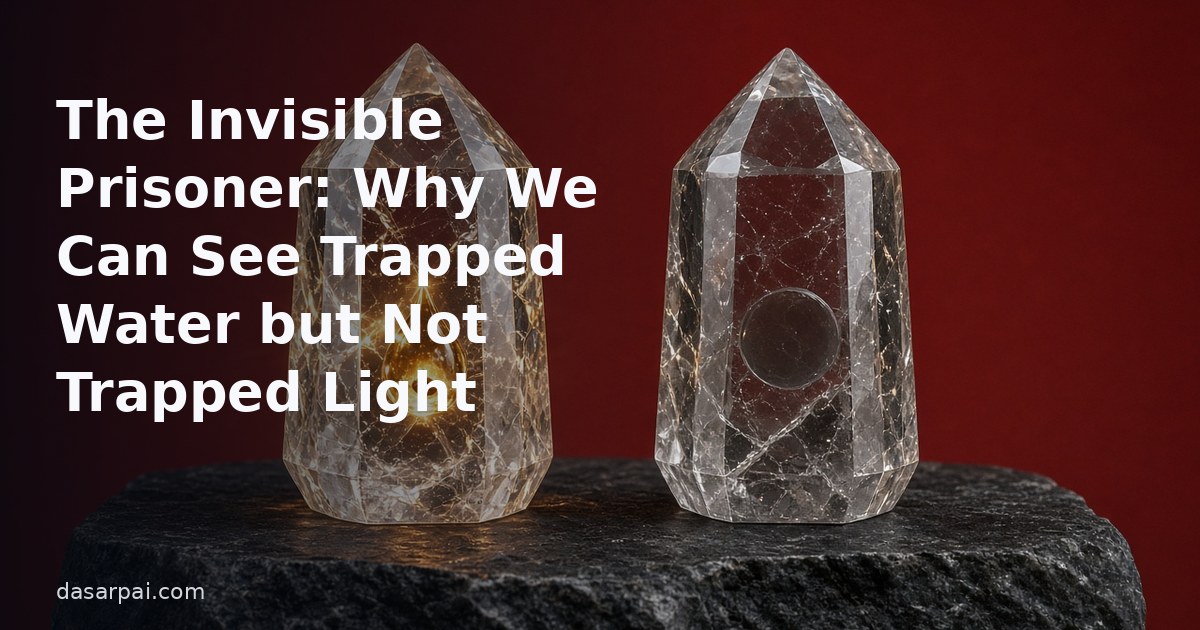
The first holds water. The second holds a seed. The third holds perfectly confined light.
You can name the contents of the first two by looking. The third looks empty. It can still hold electromagnetic energy. None of the stored photons is reaching your eye.
Existence is a fact about the system. Visibility is a relation between that system and an observer.
A system can exist while you cannot see it. A system can be visible while you do not yet know what it is made of.
Seeing is a physical process. Information reaches the senses through interactions. Some systems send that information by reflected light. Others need an instrument, an indirect measurement, or a different interaction.
One failed method does not prove that the system is absent. A missing observation is also not proof that the system is present. A scientific claim needs a test and a result.
The observer and the observed#
Looking feels like standing apart and watching. In the laboratory, looking is an interaction.
A photon reaches the retina. An atom changes a meter. A detector absorbs energy. The system becomes correlated with its surroundings. Correlated means a later reading of one part is tied to the state of the other part.
In quantum mechanics those interactions can change what is measured. They do not always destroy the system. The atom method in §6 leaves the photon number in the cavity.
Every physical record comes from some physical interaction. The interaction does not have to empty the cage.
10. The invisible prisoner#
Suppose a crystal holds light taken from an ancient sunrise, and the cavity has kept that energy for a million years. This is a thought experiment. The scientific note states what laboratories can actually do.
The crystal looks dark. No stored photon has a path to an eye.
Open the confinement. The stored electromagnetic energy travels out. Only then does an observer receive that light directly.
For that million years the crystal was dark, and the energy was still inside. Dark meant there was no path from the stored field to an observer.
Three questions stay separate:
What exists, what we can observe, and what we can know are three different things.
Nature does not need an observer in order to exist. Knowledge of nature needs a physical relation to nature. Sometimes you open the cage and the prisoner leaves. Sometimes a measurement reports the prisoner while the cage stays closed.
Scientific note#
The million-year photon cavity is a thought experiment. It is not a device you can build today. Real optical cavities store light for a finite time. Quantum memories keep an encoded state by a physical interaction with matter. They do not store information with no carrier. The split between existence, visibility, and knowledge is a reading laid on top of those laboratory facts.
Related reading#
- Quantum Gates: Matrices, Mirrors, and Beam Splitters
- Quantum Measurement, Randomness, and Everyday Technology
- Building a 20-Qubit Quantum System Using Photons
- Operators in Quantum Mechanics
- Bell’s Inequality: What It Actually Tests About Reality
Hashtags#
#TrappedLight #OpticalCavity #Photons #QuantumOptics #QuantumMeasurement #QuantumNondemolition #QuantumMemory #PhotonScattering #ElectromagneticField #PhilosophyOfScience #QuantumMechanics #Visibility

Comments: