A closed tube, a mountain, a leaf, or a heart is still a shape. You can ask where its points are, how much surface it has, and whether it can become another shape without a cut.
A cube and a sphere come with formulas you can memorize. An unfamiliar shape needs a method that still works when no formula is on the page. Coordinates name the points. Integrals and meshes measure them. Topology says which features survive a stretch.
1. What is this shape?#
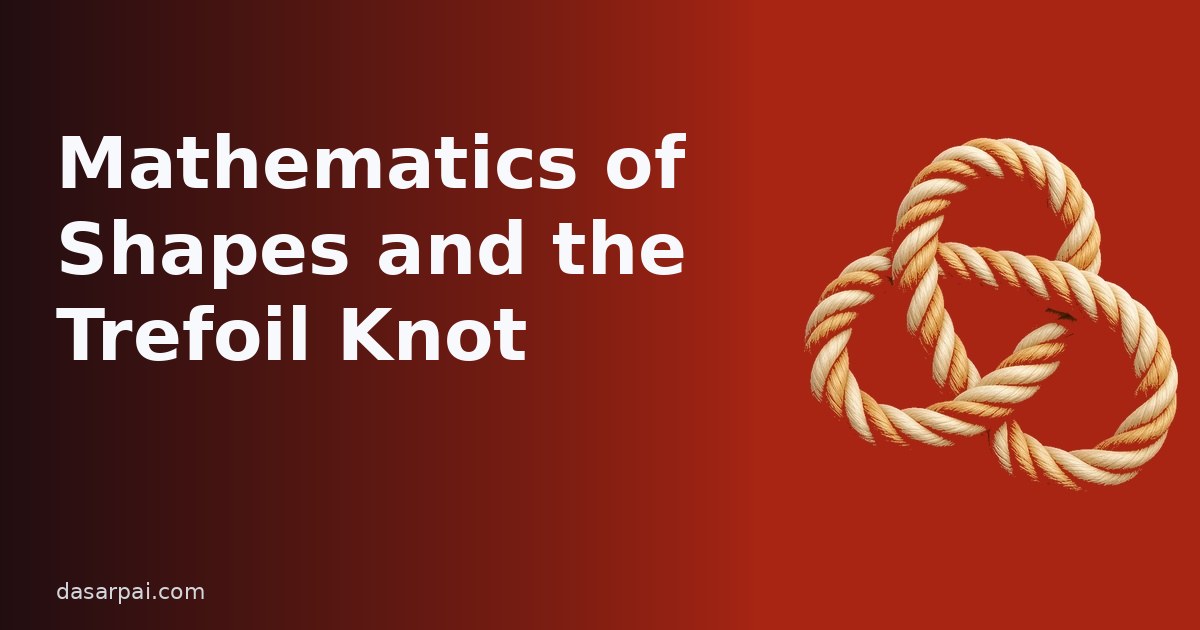
A trefoil knot is the simplest knot that is not a plain loop. Tie an ordinary overhand knot in a rope and join the two ends. You cannot turn that closed loop into a circle without cutting it or passing one part through another.
A mathematical knot is a closed curve in three-dimensional space that does not pass through itself. Give that curve a circular cross-section and you get a tubular knot. The boundary is a surface. The region inside the boundary is a solid.
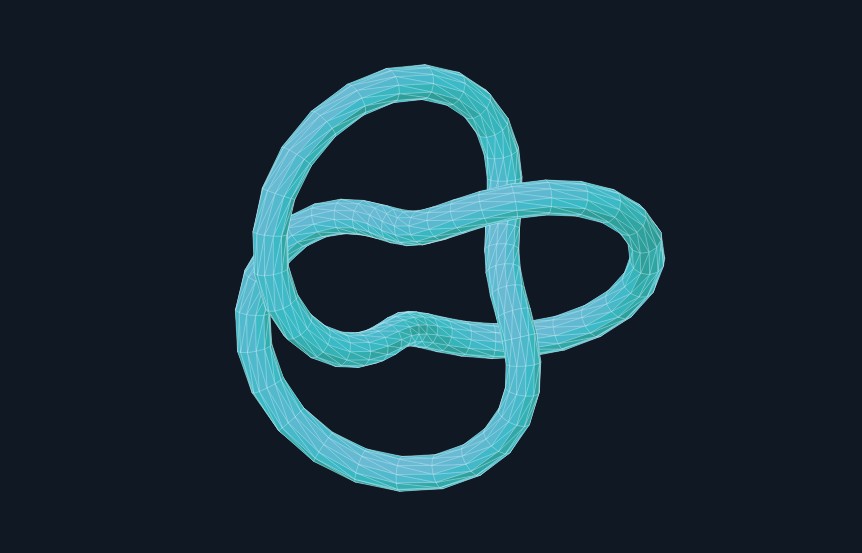
This picture is a screenshot of the laboratory. It draws the equations in §4. It is not a photograph, and it is not fitted to one.
| Object | Intrinsic dimension | Ambient dimension |
|---|---|---|
| Point | 0 | 3 |
| Knot centerline | 1 | 3 |
| Boundary of a tubular knot | 2 | 3 |
| Solid tubular knot | 3 | 3 |
Intrinsic dimension is how many numbers you need on the object itself. Ambient dimension is the dimension of the space the object sits in. A surface can be two-dimensional while it bends through three-dimensional space. An ant on that surface needs only two local coordinates to name its position.
The same X, Y, and Z directions are drawn in Seeing Three Dimensions: Colors, Planes, a Sphere and the Meaning of Rotation.
2. What questions can mathematics ask about any shape?#
| Question | Mathematical concept |
|---|---|
| How can we describe its points? | Coordinates and equations |
| How long is a curve? | Arc length |
| How much material covers the boundary? | Surface area |
| How much space is enclosed? | Volume |
| How many independent coordinates are needed locally? | Intrinsic dimension |
| Where is its center? | Centroid and center of mass |
| How sharply does it bend? | Curvature |
| How does a spatial curve twist? | Torsion |
| What is the shortest route along its surface? | Geodesics |
| Can it be flattened without stretching? | Intrinsic geometry and Gaussian curvature |
| What transformations leave it unchanged? | Symmetry and group theory |
| How many connected components or handles does it have? | Topology and genus |
| Can it be untied without cutting? | Knot theory |
| Does it intersect itself? | Intersection and embedding |
| Does it have a consistent choice of surface normal? | Orientability |
| How does it look from different viewpoints? | Projection |
| How can a computer approximate it? | Meshes and triangulation |
| What is its smallest enclosing box or sphere? | Geometric optimization |
| How would it vibrate? | Spectral geometry and mechanics |
| How would heat diffuse along it? | Differential equations |
These questions belong to different branches. Geometry measures. Topology studies what stays connected when you stretch the object without tearing it. Differential geometry studies local bending. Computational geometry turns the same ideas into algorithms.
A few questions need extra physical facts. Center of mass needs a density. Vibration and heat flow need material properties and boundary conditions.
A short gloss for the less familiar names:
- Torsion is how a curve twists out of a single plane.
- A geodesic is a shortest route that stays on the surface.
- Gaussian curvature is a local bending number you can measure without leaving the surface. It is one reason a curved patch may refuse to lie flat without a stretch.
- Genus counts handles. A sphere has genus 0. A ring has genus 1.
- Orientability means you can choose one consistent “outward” direction all over the surface.
3. How do we represent a shape mathematically?#
There is no single best representation for every object.
| Representation | Example | Useful for |
|---|---|---|
| Explicit equation | y = x² | Graphs of functions |
| Implicit equation | x² + y² + z² = R² | Sphere boundary and level sets |
| Parametric curve | x(t), y(t), z(t) | Paths and knots |
| Parametric surface | x(u,v), y(u,v), z(u,v) | Curved surfaces |
| Inequality | x² + y² + z² ≤ R² | Solid regions |
| Point cloud | Collection of 3D coordinates | Scanned objects |
| Polygon mesh | Vertices, edges, and faces | Digital models and simulation |
| Voxel grid | Occupied 3D cells | Medical imaging and solids |
An ordinary function y = f(x) cannot describe every curve. A circle already has two heights for many values of x. Functions, Equations, and Their Shapes separates that case from a graph that has one y for each allowed x. Parametric equations let several coordinates depend on one shared parameter, so the circle and the knot both fit.
4. Constructing a trefoil knot with equations#
One convenient trefoil centerline is:
\[x(t)=(2+\cos 3t)\cos 2t\]\[y(t)=(2+\cos 3t)\sin 2t\]\[z(t)=\sin 3t\]The parameter t runs from 0 to 2π. These coordinates have no length unit yet. Multiply them by a length scale when you want centimeters or meters. The curve winds twice around the central axis and three times around the small circle of an imaginary torus. The winding numbers 2 and 3 share no common factor other than 1, so the path is one closed piece.
To build the tube, place a small circle perpendicular to the centerline at every point. Let C(t) be the centerline. Let N(t) and B(t) be a perpendicular pair of unit vectors in the plane that cuts across the tube. One standard choice is the Frenet normal and binormal, where those vectors are defined. Let r be the tube radius. Let v be the angle around the cross-section.
\[S(t,v)=C(t)+r\cos v\, N(t)+r\sin v\, B(t)\]Both parameters run from 0 to 2π. One moves along the knot. The other moves around the tube. The radius has to stay small enough that the tube does not pinch and does not pass through itself.
5. Three ways to calculate surface area#
Method A: The shortcut for a uniform circular tube#
A straight cylinder with no end caps has lateral area equal to circumference times length. The same formula stays exact for a smooth closed circular tube of constant radius, when the tube does not overlap itself.
\[A=2\pi r L\]L is the length of the centerline. Bending stretches the outside of the tube and compresses the inside. In the total area, those two effects cancel. The formula does not say the surface can be flattened or straightened without stretching. Area can match after a bend even when distances along some paths change.
The centerline length is ordinary one-variable calculus:
\[L=\int_0^{2\pi}|C'(t)|\,dt\]For the trefoil above, the speed has a short form:
\[|C'(t)|=\sqrt{9+4(2+\cos 3t)^{2}}\]Compute the integral numerically, then multiply by the circumference 2πr. The volume of the solid inside the tube is just as short:
\[V=\pi r^{2} L\]A non-overlapping closed tube of length 100 cm and radius 2 cm has area 400π cm², about 1,256.64 cm². Its volume is 400π cm³, about 1,256.64 cm³. The matching numerals are a coincidence. Area and volume have different units.
Method B: The general surface integral#
The shortcut needs a constant circular radius. A changing radius, a non-circular cross-section, or an object that is not a tube at all needs the general method.
Suppose a smooth surface is S(u,v). A small step in u moves you along one tangent. A small step in v moves you along another.
\[a=\frac{\partial S}{\partial u},\qquad b=\frac{\partial S}{\partial v}\]The length of their cross product is the area of the parallelogram those two vectors span. The cross product is the 3D product in §13 of the product guide. For tiny parameter steps, the patch has area
\[dA=|a\times b|\,du\,dv\]Add every patch. For a regular parametrization that covers the surface once, apart from seams of area zero, the exact area is
\[A=\iint_D |a\times b|\,du\,dv\]If the surface needs several coordinate patches, add the integrals and do not count an overlap twice. In a higher-dimensional surrounding space, the same area factor is
\[\sqrt{(a\cdot a)(b\cdot b)-(a\cdot b)^{2}}\]That square root is the square root of the Gram determinant. It is the linear-algebra form of the same area.
Why the shortcut works. Take a centerline with unit speed and curvature κ. Where the tube is regular and rκ < 1, the area element is
\[r(1-r\kappa\cos v)\,ds\,dv\]The cosine term adds to zero around a full cross-section. What remains is 2πrL, for any torsion.
Method C: Triangulation, how a computer measures a surface#
The laboratory picture is a mesh. Vertices are joined by edges. Split each quadrilateral into two triangles.
For one triangle with 3D vertices P, Q, and R:
\[A_i=\frac{1}{2}|(Q-P)\times(R-P)|\]Add every triangle:
\[A_{\mathrm{mesh}}=\sum_{i=1}^{N} A_i\]Take P = (0,0,0), Q = (3,0,0), and R = (0,4,0). The cross product is (0,0,12). The triangle area is 6 square units.
That sum is exact for the flat mesh. It is approximate for the smooth surface the mesh stands in for. Well-shaped triangles and a steady refinement of a smooth surface make the approximation converge. Dropping extra vertices in at random does not guarantee a better area.
The same idea is used in CAD, 3D scanning, medical imaging, graphics, and scientific simulation. A point cloud by itself does not say which points form a triangle. Building that connectivity is a separate problem.
In the laboratory, the triangle count is twice the centerline segments times the cross-section segments. The seams wrap around. The last segment along the knot meets the first, and the last segment around the tube meets the first.
6. Interactive laboratory#
Rotate the trefoil. Change the tube radius and the mesh resolution. The tube formula uses the numerically integrated centerline length. The mesh area is the sum of the triangle areas. Raise the resolution and watch the relative error fall. One coordinate unit is one length unit.
At a fixed radius, a coarse mesh and a fine mesh should tell the same story. The fine mesh area should sit closer to 2πrL.
Open the interactive trefoil laboratory
7. Familiar formulas and general methods#
| Object | Surface area |
|---|---|
| Cube, side a | 6a² |
| Sphere, radius r | 4πr² |
| Closed cylinder, radius r, height h | 2πr(r + h) |
| Ring torus, major radius R greater than minor radius r | 4π²Rr |
| Regular closed uniform circular tube | 2πrL |
| General smooth surface | Surface integral |
| Polygonal 3D mesh | Sum of triangle areas |
| Unmeasured physical object | Scan or measure, reconstruct, then estimate |
An ordinary ring torus is a special case of the tube formula. Its centerline is a circle of radius R, so L = 2πR. Multiply by 2πr and you get 4π²Rr.
8. Geometry and topology: two views of the same object#
A sphere can be stretched into an ellipsoid without a tear. Area and curvature can change. The topology does not.
An ordinary torus and the boundary of a tubular trefoil are both genus-one surfaces: each has one handle. As abstract surfaces they are homeomorphic. A homeomorphism is a continuous stretch from one surface to the other, with a continuous stretch back, and no tear. Their placements in three-dimensional space are different. You cannot untie the knotted tube into a plain ring by a motion that forbids cutting and forbids one part passing through another.
The solid inside each boundary is a solid torus, as an abstract solid. A sphere’s boundary has genus zero. Counting openings in a perspective drawing is a poor way to read genus. A drawing can hide a handle or show a hole that is only a gap in the view.
| Geometry | Topology |
|---|---|
| Length, angles, and area | Connectivity and genus |
| Depends on distances | Preserved by homeomorphisms |
| A sphere and an ellipsoid have different geometry | They have the same surface topology |
| Curvature can change during a stretch | Genus stays the same |
Knot theory asks a further question: how is the object embedded in the surrounding space? Intrinsic surface topology does not answer that.
9. What if we are given only a photograph?#
A photograph is a two-dimensional view of a three-dimensional object. Different objects can make similar pictures. The physical scale may be unknown. The surface area of the photographed object cannot be computed from the picture alone.
You need an equation that includes a length, a calibrated 3D mesh, or enough measurements to rebuild a model. Several calibrated views, or a depth scan, can supply that. The area you then compute still depends on the quality of the reconstruction and on the resolution.
10. Questions worth exploring#
- Can two shapes have the same area and the same volume, and different topology?
- What is the shortest rope of fixed thickness that forms a chosen knot? That is the ropelength problem.
- Can a curved surface be flattened without stretching? Gaussian curvature is an important local obstruction. Global constraints matter too.
- Can the vibration spectrum determine a shape by itself? In general, no. Distinct shapes can be isospectral: they can share the same vibration spectrum.
- How do you measure a two-dimensional surface that sits in four or more dimensions?
- What is the surface area of an object whose roughness gets finer without end? For some idealized fractal surfaces, ordinary area is infinite, or you need a different measure.
Conclusion#
A curve can be a set of equations. Its length is an integral. A surface is local tangent vectors. Its area is an integral of small patches, or a sum of triangle areas. Topology names the features that survive a stretch without a tear.
The useful habit is not a formula for every shape you have already seen. It is a method that still works on a shape you have not seen before.
Further reading#
- OpenStax, Calculus Volume 3, section on surface integrals: https://openstax.org/books/calculus-volume-3/pages/6-6-surface-integrals
- Wolfram MathWorld, Trefoil Knot: https://mathworld.wolfram.com/TrefoilKnot.html
- Wolfram MathWorld, Tube: https://mathworld.wolfram.com/Tube.html
Related reading#
- Functions, Equations, and Their Shapes
- Types of Equations: A Quick Map from Algebra to Calculus
- One Word, Many Meanings: Understanding Every Kind of Product in Linear Algebra and Quantum Computing
- Seeing Three Dimensions: Colors, Planes, a Sphere and the Meaning of Rotation
- From Geometry to Quantum Mechanics
Hashtags#
#Geometry #Topology #TrefoilKnot #SurfaceArea #Calculus #LinearAlgebra #KnotTheory #ComputationalGeometry #SurfaceIntegral #DifferentialGeometry #Mathematics #Meshes

Comments: