Quantum Hardware Is Not a Smaller or Stranger Classical Computer#
A ground-up guide for engineers coming from classical computing#
Part 19 of the Learning Quantum Physics series.
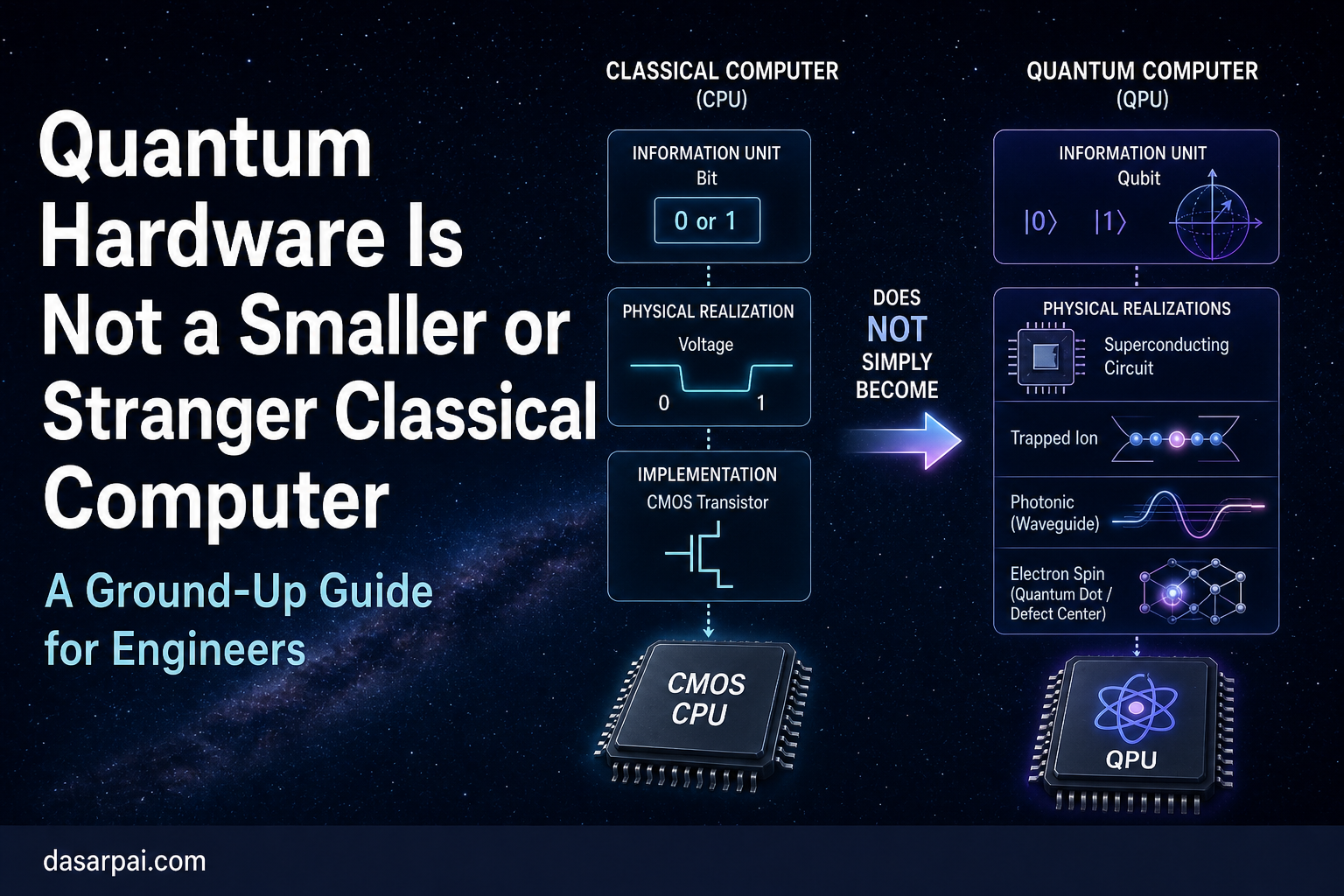
A quantum computer is not a classical computer with unusual transistors. There is no single part that plays the role of the transistor on every quantum machine. Superconducting circuits, trapped ions, and photons can all run an H gate. Physically, those three gates can be three different machines.
When engineers first encounter quantum computing, the default mental model looks like this:
Classical computer  →  replace bits with qubits
→  replace gates  →  Quantum computer
That picture helps you learn algorithms. As a description of hardware, it is seriously incomplete.
A quantum computer is not a classical computer with unusual transistors. The principles for storing, transforming, protecting, connecting, and measuring information can be fundamentally different. Worse: there is currently no single equivalent of the transistor that all quantum computers share.
Superconducting, trapped-ion, and photonic systems may all implement an H gate — but physically, those three H gates can be completely different machines.
To understand quantum hardware, start before transistors:
What does it mean for information to have a physical implementation?
This article walks through that question step by step. No prior quantum mechanics assumed — only familiarity with how classical computers work.
1. Information is abstract; computation must be physical#
A classical bit is the symbols 0 and 1. There is no tiny physical object called 0 inside your laptop.
A computer chooses two distinguishable physical states and maps them to logic:
state A  →  0
state B  →  1
In modern CMOS, those states are usually voltage levels:
| Physical state | Logical bit |
|---|---|
| Low voltage | 0 |
| High voltage | 1 |
Voltage is not information in the abstract mathematical sense. It is the physical encoding.
Think of classical computing as a stack of layers. Each higher layer is built from the ones below — not the other way around. Every layer above transistors is still hardware (including the CPU). What rises is the level of abstraction — how much physical detail is hidden from the layer above.
| Level | Layer | Classical example |
|---|---|---|
| ↑ | Logical view (software) | bit: 0 or 1 — what programs reason about |
| — | hardware / software boundary | programs never see voltages or gates |
| Integrated processor | CPU chip — adders, registers, control (still transistors) | |
| Functional blocks | memory cells, ALU slices (gates wired together) | |
| Logic gate | AND, OR, NOT, XOR (many transistors → one gate) | |
| Physical encoding | low / high voltage (state A → 0, state B → 1) | |
| ↓ | Physical device | transistor |
A single AND gate may take a dozen transistors. The CPU is the top of the hardware stack — not a software layer. It is the most integrated piece of hardware, built from gates and blocks below. Software then treats the CPU’s behavior as if information were simply 0 and 1.
This hierarchy matters even more in quantum computing. §3 draws the same stack as an explicit bottom-to-top pyramid with a LEGO analogy.
2. What does “physical” mean — and where does information fit?#
In everyday language, physical often means solid and touchable. In physics it is broader. But hardware engineering needs one more category: information — which is not physical itself, but about physical things.
Work through one example — an electron used as a spin qubit:
| Step | Category | Example | Physical? |
|---|---|---|---|
| 1 | Physical system | electron | yes — a real object in the lab |
| 2 | Physical property | spin | yes — a measurable attribute of that electron |
| 3 | Physical state | spin-up or spin-down (at this moment) | yes — how the property actually is in nature |
| 4 | Information | we label that state |0⟩ or |1⟩ | no — symbols we assign; about the physical state |
The electron is real. Its spin is real. Spin-up is a real configuration. 0, 1, |0⟩, and |1⟩ are not tiny objects inside the device — they are the information layer: the meaning we agree to attach to distinguishable physical states.
  electron  →  spin    →  spin-up   →  we call it |0⟩
  physical     physical   physical     information
  system       property   state        (about physical)
The same four-level pattern appears in classical computing:
| Step | Category | Classical example |
|---|---|---|
| 1 | Physical system | transistor channel, magnetic grain, punched card |
| 2 | Physical property | voltage, magnetization, hole present/absent |
| 3 | Physical state | low voltage or high voltage (right now) |
| 4 | Information | we label that state 0 or 1 |
transistor region  →  voltage  →  high voltage  →  we call it 1
     physical         physical    physical         information
Vocabulary summary#
| Category | What it is | Examples |
|---|---|---|
| Physical system | the object or device | electron, photon, atom, superconducting circuit |
| Physical property | an attribute we can measure | spin, polarization, charge, energy |
| Physical state | how that property is configured now | spin-up, spin-down, ground state, excited state |
| Physical quantity | a measured value (not an “object”) | energy, voltage, momentum |
| Information | abstract labels about states | bit: 0 / 1; qubit: |0⟩ / |1⟩ (and superpositions) |
Photons have zero rest mass but unquestionably participate in physical interactions. Energy is a quantity associated with a system’s state, not a separate object floating in space.
Bit and qubit belong to the information layer#
A bit is classical information: one of two symbols, 0 or 1, assigned to two physical states we can reliably tell apart.
A qubit is quantum information: two basis labels |0⟩ and |1⟩ assigned to two physical states — plus, when the hardware preserves it, superpositions such as α|0⟩ + β|1⟩ that describe how the physical system is configured before measurement.
| Bit | Qubit | |
|---|---|---|
| Layer | information (about physical) | information (about physical) |
| Symbols | 0, 1 | |0⟩, |1⟩ (and combinations) |
| Implemented by | voltage, magnetism, charge, … | spin, polarization, energy levels, … |
| The symbols themselves | not physical | not physical |
This distinction prevents the most common beginner mistake: confusing the particle with the qubit. The electron is physical; the qubit is the information we encode using its spin state.
§5 catalogs particles and properties in depth. §1 showed how classical hardware hides the whole physical stack so software sees only bits.
3. Classical hardware chose a powerful abstraction#
Modern classical computing succeeded partly by crushing physical complexity into:
LOW / HIGH or 0 / 1
The whole game — read this bottom to top#
The confusing part is direction. The transistor is the bottom — the smallest useful building block. The CPU chip is the top of hardware — the most assembled piece. Everything in between is “many of the level below, wired together.”
Analogy: transistors are like LEGO bricks. You do not compute with one brick. You snap many bricks into a wall (gate), many walls into a room (functional block), many rooms into a building (CPU). The building is not the smallest unit — it is the largest hardware unit.
                      ┌─────────────────────────┐
  software sees ────► │  0 and 1 (information)  │  not hardware
                      └───────────┬─────────────┘
                                  │  CPU hides everything below
                      ┌───────────▼───────────┐
  top of hardware ──► │  CPU chip             │  whole processor die
                      └───────────┬───────────┘
                                  │  many blocks wired together
                      ┌───────────▼───────────┐
                      │  Functional blocks    │  adder, register, ALU, …
                      └───────────┬───────────┘
                                  │  many gates wired together
                      ┌───────────▼──────────┐
                      │  Logic gates         │  AND, OR, NOT (each = many
                      └───────────┬──────────┘   transistors)
                                  │  voltage levels mean 0 or 1
                      ┌───────────▼─────────┐
                      │  Transistors        │  tiny switches (BOTTOM —
                      └─────────────────────┘  start here)
| Step | Layer | Built from | One sentence |
|---|---|---|---|
| 1 ↓ bottom | Transistor | silicon physics | One switch that can be on or off |
| 2 | Voltage encoding | transistor output | High ≈ 1, low ≈ 0 — we label the physical state |
| 3 | Logic gate | many transistors | One AND or OR (e.g. ~10–30 transistors) |
| 4 | Functional block | many gates | Adder, register, multiplexer, ALU slice |
| 5 ↑ top of hardware | CPU chip | many blocks | The full processor — still only transistors inside |
| 6 | Software view | CPU behavior | Program sees 0 and 1 — not gates or voltages |
Key points:
- The CPU is not the lowest level. It is the highest hardware level — the finished assembly.
- Opening a laptop and seeing a chip does not mean the chip is “fundamental.” Inside that chip are billions of transistors.
- A transistor does not understand addition or
250 + 47. It only responds to voltage. Engineers stack layers until the chip behaves as if it computes.
What lives at the “functional block” layer?#
Functional blocks sit between gates and the CPU — peer components, not a linear chain:
| Block | What it does |
|---|---|
| Adder | adds two binary numbers (hardware behind 250 + 47) |
| Multiplier / divider | word-level arithmetic (often built from adders + shift logic) |
| Register | holds a word of bits temporarily inside the CPU |
| Multiplexer | selects one of several data paths |
| Comparator | decides which of two values is larger |
| Memory cell / flip-flop | stores one bit across clock cycles |
| ALU | combines adders and logic on whole words |
| Control logic | schedules which block runs when |
An adder is a circuit made of gates (which are made of transistors). The CPU contains many such blocks working together.
Classical is not literally “only voltage”#
Historically, classical information has used many encodings:
| Medium | Physical encoding |
|---|---|
| CMOS logic | voltage / charge |
| Hard drives | magnetic orientation |
| Flash memory | trapped charge |
| Early computing | punched holes, relays |
The precise statement:
Modern digital logic overwhelmingly uses robust electrical binary states — especially voltage and charge.
A programmer can write 250 + 47 without knowing about doping, MOSFET channels, or threshold voltage. The hardware stack hides all of the layers above.
Quantum computing deliberately preserves richer microscopic properties that classical engineering normally suppresses.
4. The qubit is also abstract#
Section §2 placed bits and qubits on the information layer — labels about physical states, not physical objects themselves. Here we make that concrete for quantum hardware.
Just as 0 and 1 are symbols, so are |0⟩ and |1⟩. They are not particles.
A quantum computer must pick two controllable states of some quantum system:
physical state A  →  |0⟩
physical state B  →  |1⟩
See §5 for the full catalog of systems, properties, and encoding maps.
A qubit is quantum information encoded in two controlled states of a physical system.
Saying “this ion is a qubit” is shorthand. More precisely: a chosen degree of freedom of that ion encodes the qubit.
5. Quantum systems and the properties we can encode#
Classical computing mostly standardizes on one physical story: voltage on a transistor channel → bit 0 or 1.
Quantum hardware opens a menu of physical systems (what exists in the lab) and properties (which attribute of that system we control). The engineer must choose both, then map two physical states to |0⟩ and |1⟩.
Recall the chain from §2:
physical system  →  physical property  →
physical state  →  information |0⟩ / |1⟩
Step 1 — Physical systems (what can carry a qubit?)#
| System | What it is | Notes |
|---|---|---|
| Electron | fundamental charged particle | often isolated in a quantum dot or defect site |
| Photon | quantum of light | no mass; excellent for communication |
| Atom | neutral atom (e.g. rubidium, ytterbium) | identical copies from nature |
| Ion | atom minus one electron (net charge) | held in electromagnetic traps |
| Atomic nucleus | core of atom | extremely isolated; slow but long-lived |
| Superconducting circuit | engineered electrical resonator + Josephson junction | macroscopic object with discrete quantum levels |
| Crystal defect | missing/wrong atom in a lattice (e.g. NV center in diamond) | defect creates a controllable two-level system |
| Topological mode | collective excitation in special materials | research stage; information stored nonlocally |
Not every system is a qubit. The system is the carrier; the qubit lives in one chosen property of that carrier.
Step 2 — Properties (degrees of freedom we can measure and control)#
A single particle may offer several usable properties. The engineer picks one as the qubit and treats the others as noise channels or auxiliary controls.
| Property | Typical system | What varies physically | Example physical states |
|---|---|---|---|
| Electron spin | electron, defect | intrinsic angular momentum | spin-up / spin-down |
| Nuclear spin | nucleus, NV center | nuclear angular momentum | two spin orientations |
| Polarization | photon | electric field orientation | horizontal / vertical |
| Path / mode | photon | which waveguide or spatial mode | path A / path B |
| Time bin | photon | early vs late arrival | early pulse / late pulse |
| Frequency / color | photon, atom | optical frequency | two spectral lines |
| Energy level | atom, ion, circuit | which quantum energy state | ground / excited |
| Hyperfine state | atom, ion | coupled electron + nucleus states | two hyperfine sublevels |
| Charge / flux / phase | superconducting circuit | collective circuit variable | two stable operating points |
| Orbital state | atom in solid | electron orbital occupancy | two orbital configurations |
Important: saying “a photon is a qubit” is incomplete. A photon might encode information in polarization, path, time bin, or frequency — four different qubit definitions on the same particle.
Step 3 — System + property → |0⟩ and |1⟩ (the encoding map)#
| System | Property used | Physical |0⟩ state | Physical |1⟩ state | Platform / use |
|---|---|---|---|---|
| Electron | spin | spin-up | spin-down | semiconductor spin qubits |
| Electron | charge (rare today) | one charge state | another | early charge qubits |
| Photon | polarization | horizontal (H) | vertical (V) | photonic QC, QKD |
| Photon | path | left path | right path | integrated photonics |
| Photon | time bin | early slot | late slot | fiber-based systems |
| Atom / ion | energy level | ground state | excited state | some ion schemes |
| Atom / ion | hyperfine | hyperfine state A | hyperfine state B | ions, neutral atoms |
| Nucleus | nuclear spin | spin-up | spin-down | quantum memories |
| Superconducting circuit | energy (transmon) | ground |g⟩ | first excited |e⟩ | IBM, Google |
| Superconducting circuit | flux / charge | designed state A | designed state B | other circuit types |
| NV defect | electron spin | ms = 0 | ms = −1 (or similar pair) | sensing, networking |
| NV defect | nearby nuclear spin | nuclear state A | nuclear state B | long-lived memory |
One photon, four possible qubit definitions#
| If you encode in… | |0⟩ might mean | |1⟩ might mean | Other properties become… |
|---|---|---|---|
| Polarization | H | V | path, timing — noise or waste |
| Path | upper arm | lower arm | polarization — must stabilize |
| Time bin | early | late | frequency — must filter |
| Frequency | color A | color B | polarization — must control |
You cannot use all degrees of freedom as one qubit. You pick one, control it, and protect it from mixing with the others.
What makes a property good for qubit hardware?#
Not every physical property works in practice. Engineers look for:
| Requirement | Why it matters |
|---|---|
| Two well-separated states | must map cleanly to |0⟩ and |1⟩ |
| Initialization | can prepare |0⟩ reliably |
| Control | can apply gates (rotations, flips) |
| Measurement | can read out |0⟩ vs |1⟩ |
| Coherence | superposition survives long enough |
| Coupling | can entangle with a neighbor qubit |
| Scalability | can repeat at thousands of sites |
Nuclear spin scores high on coherence but low on speed. Superconducting qubits score high on gate speed but need cryogenics. Photons score high on transmission but struggle with photon–photon interaction.
How this connects to platforms#
§9 groups these system-and-property choices into engineering platforms (IBM superconducting, IonQ trapped ion, photonic, etc.).
Key insight
The hardware landscape is large because nature offers many quantum systems, and each system offers multiple properties — not because quantum engineers enjoy confusion.
6. The same electron, two different jobs#
Electrons appear in both classical and quantum hardware — but not always in the same role.
| Classical CMOS | Electron-spin qubit | |
|---|---|---|
| What we use | collective behavior of many electrons | quantum state of one isolated electron |
| Physical layer | voltage, current, conductivity | spin-up / spin-down |
| Information | 0 / 1 | |0⟩ / |1⟩ and superpositions α|0⟩ + β|1⟩ |
| Engineering goal | suppress quantum detail | preserve and control quantum detail |
      CLASSICAL                          QUANTUM
many charge carriers               one controlled quantum system
       ↓                                  ↓
robust electrical state            spin, phase, entanglement
       ↓                                  ↓
     0 / 1                            α|0⟩ + β|1⟩
The distinction is not “classical = electrons, quantum = exotic particles.” It is which physical layer you engineer on.
7. Classical gate vs quantum gate#
The word gate is shared — and that causes confusion.
| Classical gate | Quantum gate | |
|---|---|---|
| Operates on | bits (0/1) | quantum states |
| Example | AND: (1,1)→1 | X: |0⟩→|1⟩ |
| Built from | transistor arrangements | platform-specific physical interactions |
| Same symbol, different physics? | AND is always electrical logic | H gate may be microwaves, lasers, or optics |
An H gate transforms |0⟩ into (|0⟩ + |1⟩)/√2 mathematically. Physically, that rotation might come from a microwave pulse, a laser, or an optical interferometer — depending on the platform.
8. There is no universal “quantum transistor”#
Classical computing converged on one stack — semiconductor → MOSFET → CMOS → CPU. Quantum computing has not converged on one physical technology.
The competing platforms, their control methods, and trade-offs are summarized once in §9. The industry-wide question is still open: which approach can scale to fault-tolerant computing?
9. The hardware landscape at a glance#
§5 explained which particles and properties exist. This section groups them into engineering platforms — the competing answers to “how do we actually build a machine?”
| Platform | Physical system | What encodes |0⟩/|1⟩ | How gates work | Key strength | Key challenge |
|---|---|---|---|---|---|
| Superconducting | fabricated circuit + Josephson junction | discrete energy levels | microwave pulses | fast gates, chip fab, industry investment | cryogenics (~mK), noise, wiring density |
| Trapped ion | single charged atom | internal atomic states | lasers / microwaves | identical atoms, high fidelity, long coherence | vacuum, laser complexity, scaling optics |
| Neutral atom | atom in optical tweezer | hyperfine / internal states | lasers; Rydberg for entanglement | large reconfigurable arrays | atom loss, laser stability, loading |
| Photonic | photon | polarization, path, or time-bin | beam splitters, phase shifters, interference | natural for communication, low transit decoherence | photon loss, weak photon–photon interaction |
| Electron spin | electron in quantum dot | spin direction | microwaves, electric/magnetic gates | tiny footprint, silicon fab overlap | single-electron control, variation |
| Nuclear spin | atomic nucleus | nuclear spin states | RF / magnetic fields | extremely long coherence | slow, hard to control |
| Defect center | crystal defect (e.g. NV in diamond) | electronic or nuclear spin | optical + microwave | sensing, memory, networking potential | fabrication, integration at scale |
| Topological | engineered quantum matter | nonlocal topological state | specialized | potential intrinsic protection | unproven at scale; active research |
Photonic quantum hardware — dedicated inventory#
The photonic row above summarizes the platform. Table B in §17 lists generic quantum subsystems; the table below is photonic-specific — every component you would touch when building a polarization- or path-encoded photonic QPU.
| Photonic component | Purpose in the system |
|---|---|
| Single-photon source (SPDC, quantum dot, heralded emitter) | produce exactly one photon per qubit mode — the raw qubit carrier |
| Pump laser | drives nonlinear crystals or emitters that create photon pairs |
| Polarizer | prepare photons in a known |0⟩ or |1⟩ polarization before the circuit runs |
| Half-wave plate (HWP) | rotate polarization — implements bit-flip–like (X) operations on polarization qubits |
| Quarter-wave plate (QWP) | create superposition — implements Hadamard-like (H) rotations on polarization qubits |
| Beam splitter | split and recombine light paths; quantum interference at the core of many photonic gates |
| Phase shifter | insert a controlled optical phase — needed for universal single-qubit rotations |
| Interferometer (Mach–Zehnder, etc.) | structured path recombination for interference-based gates |
| Waveguide / optical fiber | route photons between sources, gates, and detectors with minimal loss |
| Polarizing beam splitter (PBS) | separate horizontal vs vertical polarization at measurement |
| Optical switch / router | reconfigure which paths connect — programmable connectivity |
| Delay line / time-bin optics | encode qubits in early vs late arrival (time-bin encoding instead of polarization) |
| Spectral filter / bandpass optics | enforce indistinguishability in frequency; support frequency-bin encoding |
| Fiber–chip coupler | connect integrated silicon-photonic chips to external fiber networks |
| Integrated photonic chip | lithographed waveguides, splitters, and modulators on one die — the photonic “processor” |
| Single-photon detector (SPD, SNSPD) | read out |0⟩ vs |1⟩; measurement destroys the photon |
| Ancilla photon sources | extra photons for fusion, entangling, or cluster-state schemes |
| Optical table / vibration isolation | keep path lengths and alignment stable — photonic “environment” (not a cryostat) |
| Feed-forward electronics | when measurement on one photon must trigger a switch on a later photon in the same run |
| Classical host + pulse/timing control | schedules optical settings, records detector clicks, runs calibration |
Encoding note: polarization qubits lean heavily on wave plates and PBS; path qubits lean on beam splitters and interferometers; time-bin qubits add delay lines. The component list shifts with the encoding chosen (§5).
For a step-by-step build of a 20-qubit photonic system, see Building a 20-Qubit Quantum System Using Photons.
There is no classical-era table with eight competing CPU paradigms of comparable importance. That alone tells you how early quantum hardware still is.
10. The engineer’s checklist — what changes from classical hardware#
A classical hardware engineer often starts with one question: How do I build a reliable switch?
A quantum hardware engineer inherits a longer checklist — because every layer from §5 must be chosen, built, and kept stable:
| # | Quantum hardware engineer must answer |
|---|---|
| 1 | Which physical system represents the qubit? (electron, photon, ion, circuit, …) |
| 2 | Which property encodes information? (spin, polarization, energy level, …) |
| 3 | Which two physical states map to |0⟩ and |1⟩? |
| 4 | How do I prepare superpositions and control relative phase? |
| 5 | How do I entangle qubits and measure outcomes reliably? |
| 6 | How do I isolate the qubit from the environment without losing control? |
| 7 | How do I scale to thousands of qubits with acceptable error rates? |
Quantum hardware is not an improved transistor problem. It is a systems problem across physics, control, and manufacturing.
Design sequence: classical vs quantum#
The table below maps the classical design path (left) to the quantum path (right) — steps 1–3 match rows 1–3 above; steps 4–5 cover entanglement, coherence, and scale:
| Step | Classical processor | Quantum processor |
|---|---|---|
| 1 | electrical state | choose a quantum system (electron, photon, ion, …) |
| 2 | voltage level | choose a degree of freedom (spin, polarization, energy…) |
| 3 | binary logic | map two physical states to |0⟩ and |1⟩ |
| 4 | — | preserve amplitude, relative phase, and entanglement |
| 5 | — | engineer controlled interactions between qubits |
Every extra degree of freedom is also another path for environmental disturbance (§11–§12).
11. Why quantum hardware is harder: what must be preserved#
Classical bits tolerate noise through margins. On 5 V logic the usual classroom picture is:
| Voltage | Still reads as |
|---|---|
| About 0–2 V | 0 |
| About 3–5 V | 1 |
| The 2–3 V band in between | undefined — a transition or a fault |
TTL is a little tighter (0 below 0.8 V, 1 above 2.0 V). Modern chips use lower supplies, but they keep the same idea: a large slice of the range is reserved so ordinary noise does not flip the bit. Digital design creates regions: fall confidently into 0 or 1, not in between.
A qubit in superposition α|0⟩ + β|1⟩ must preserve:
| Quantity | Why it matters |
|---|---|
| |α| and |β| | population of |0⟩ vs |1⟩ |
| Relative phase between |0⟩ and |1⟩ | quantum algorithms use interference |
A disturbance that scrambles phase can ruin the computation even when |0⟩ and |1⟩ populations look almost unchanged. Quantum hardware is extraordinarily sensitive compared with digital logic.
12. Decoherence: isolate vs control#
Unwanted interactions with the environment — thermal radiation, stray fields, vibrations, neighboring qubits, control-line noise — destroy useful quantum information. This is decoherence.
We must ISOLATE the qubit from the environment
              BUT
We must INTERACT with the qubit to compute
| Too isolated | Too exposed |
|---|---|
| hard to control | state destroyed quickly |
Finding that balance is a central engineering problem — not a footnote.
13. A quantum gate is a controlled physical interaction#
A quantum gate is a deliberately engineered physical interaction that transforms the quantum state while adding as little unwanted disturbance as possible.
The mechanism depends on the platform (§9): microwave pulses (superconducting), lasers (ions and atoms), optical interference (photons), or electromagnetic gates (semiconductor spins). Mathematically they may all implement H, X, or CNOT; physically they may share almost nothing.
14. From software H(q0) to hardware pulses#
A programmer writes H(q0). Hardware cannot execute the letter H.
This resembles classical compilation in spirit. The lowest layers — cryogenic wiring, laser stability, optical loss — are entirely different.
15. Quantum hardware still needs classical hardware#
A quantum computer does not replace classical electronics. It sits inside a classical control stack:
IBM, IonQ, and others describe their systems this way: quantum chip plus extensive classical infrastructure for input, output, and calibration.
The future looks like classical computing + quantum processing, not classical replaced by quantum.
16. CPU vs QPU — and three things that break classical intuition#
CPU vs QPU#
| Classical CPU | Quantum QPU | |
|---|---|---|
| Information unit | bit | qubit |
| State | 0 or 1 | quantum state (superposition, entanglement) |
| Basic device | transistor (standardized) | platform-dependent |
| Control | voltage | microwave / optical / magnetic |
| Operating temperature | often room temperature | often cryogenic or vacuum |
| Copying | fan-out, amplification | no cloning of unknown states |
| Measurement | usually nondestructive read | collapses quantum state |
| Scale today | billions of transistors | hundreds–thousands of qubits (variable quality) |
| Maturity | converged CMOS stack | competing platforms |
Three classical assumptions that fail#
| Classical habit | Quantum reality |
|---|---|
| Wire — move bits through interconnects | coupling may need capacitive links, shared resonators, ion motion, Rydberg, or optical photons — an architecture choice |
| Copy — duplicate and fan out | no-cloning theorem: arbitrary unknown states cannot be copied perfectly |
| Measure — read without destroying | measurement converts quantum → classical; superposition is generally gone afterward |
Readout itself is hardware: microwave resonators (superconducting), fluorescence (ions), single-photon detectors (photonics), spin-to-charge (semiconductor).
Every QPU must solve four physical tasks: prepare · control · couple · measure — each with different components. §17 lists the full component inventory.
17. Hardware components: what classical and quantum machines are made of#
A laptop and a quantum computer are both systems of parts — not one magic chip. Most components do not have a one-to-one parallel. Two separate tables make that clearer than forcing a single combined list.
Table A — Classical computer hardware components#
| Component | Function |
|---|---|
| Transistor | smallest switch; voltage on/off (foundation of digital logic) |
| Logic gate | combines transistors into Boolean ops (AND, OR, NOT, XOR) |
| Functional block | combines gates into useful units (adder, register, multiplexer, ALU slice) |
| CPU | executes instructions; integrates ALU, registers, control logic |
| RAM | stores bits temporarily for running programs |
| Cache | fast on-chip memory near the CPU |
| Memory controller | manages traffic between CPU and RAM |
| System bus / interconnect | moves data and addresses between CPU, memory, and I/O |
| Clock generator | synchronizes operations to a timing reference |
| I/O controller | interfaces to keyboard, disk, network, USB, etc. |
| Storage (SSD / HDD) | nonvolatile bit storage |
| GPU (optional) | parallel arithmetic for graphics / ML |
| Motherboard / PCB | wires and mounts components |
| Power supply | converts mains power to stable voltages |
| Cooling (fan, heatsink) | removes heat so transistors stay in spec |
| Firmware / BIOS | low-level startup and hardware configuration |
All of the above ultimately reduce to transistors implementing 0/1 at the bottom — see §3.
Table B — Quantum computer hardware components#
Components vary by platform (§9). The Photonic column marks relevance to photon-based QPUs: Primary = essential on a photonic machine; Partial = used but shared with other platforms; — = not typical for photonics. For the full photonic parts list, see §9 photonic inventory.
| Component | Function | Photonic |
|---|---|---|
| Physical qubit | stores quantum information in a chosen system + property (§5) | Primary |
| QPU core | chip, ion trap, or optical table where qubits live and operate | Primary (integrated photonic chip or optical bench) |
| State preparation hardware | initializes qubits into |0⟩ or a known state (optical pumping, reset pulses, etc.) | Primary (polarizers, pump lasers) |
| Gate / control hardware | applies operations — microwave lines, lasers, wave plates, electrode pulses | Primary (wave plates, beam splitters, phase shifters — not microwaves) |
| Coupling mechanism | links qubits for entangling gates (capacitive coupling, ion motion, Rydberg, optical links) | Primary (interference, fusion, ancilla photons) |
| Readout / measurement | converts quantum state to classical bit (resonators, fluorescence detectors, single-photon detectors) | Primary (single-photon detectors, PBS) |
| Isolation environment | cryostat, dilution refrigerator, vacuum chamber, vibration isolation | Partial (optical table / isolation — room-temperature, not cryogenic) |
| Shielding | blocks stray EM fields, light, and noise that cause decoherence | Partial (dark enclosures, stray-light baffles) |
| Control electronics | DACs, AWGs, FPGAs, ASICs — generate timed pulses and sequences | Partial (modulator drivers, detector electronics) |
| Amplifiers / filters | boost and shape microwave or RF signals at cryogenic stages | — |
| Laser systems | (ions, atoms, defects) drive transitions and gates | Partial (pump lasers for SPDC / heralded sources) |
| Optical network | (photonic / hybrid) waveguides, beam splitters, interferometers, modulators | Primary |
| Photon sources & detectors | create and detect single photons for photonic or readout paths | Primary |
| Cryogenic / vacuum wiring | special cabling and feedthroughs that survive extreme environments | — |
| Classical host computer | runs compiler, scheduler, calibration, experiment orchestration | Partial |
| Pulse compiler / scheduler | maps abstract gates (H, CNOT) to physical control waveforms | Partial |
| Calibration & characterization | tunes frequencies, pulse shapes, and error rates per qubit | Partial |
| Error-correction decoder | (fault-tolerant systems) classical logic processing syndromes | Partial |
| Classical I/O & networking | connects the quantum system to users and other machines | Partial |
There is no single “quantum transistor” that replaces the classical one. The qubit, the gate mechanism, the isolation chamber, and the control rack are different subsystems, not one unified building block.
Parallels at a glance — where names match and physics diverges#
| Classical component | Closest quantum counterpart | Parallel? |
|---|---|---|
| Transistor | physical qubit element | Weak — qubit is not a standardized switch |
| Logic gate | quantum gate (control pulse + interaction) | Name only — different math and physics |
| CPU | QPU | Structural — both “processors,” different internals |
| RAM / register | quantum register / qubit array | Weak — no free copy; superposition and entanglement |
| Bus / wire | coupling link (microwave bus, ion chain, fiber) | Weak — connectivity is a major design choice |
| Clock | gate-timing / synchronization electronics | Moderate — timing still critical |
| Power supply | cryogenic + laser + RF power systems | Weak — often dominates lab footprint |
| Cooling | dilution fridge / vacuum / cryostat | Stronger — thermal control essential, but far more extreme |
| Readout / ADC | measurement + digitization chain | Moderate — always destroys quantum state |
| Compiler | quantum compiler + pulse scheduler | Moderate — maps abstractions to hardware, lower layer is pulses not voltages |
| Error correction | QEC decoder + many physical qubits | Conceptual — far heavier than classical ECC |
| Motherboard | cryogenic package / optical bench / trap assembly | Weak — integration problem is harder |
| Storage (SSD) | quantum memory (research) | Mostly none today — no general quantum disk |
For the full component lists, see §17.
18. Quantum hardware is systems engineering#
A usable quantum machine assembles many subsystems — see Table B in §17. The qubit chip is only one piece. Here is how three platforms populate that list differently:
| Subsystem | Superconducting | Trapped ion | Photonic |
|---|---|---|---|
| Core quantum element | Josephson qubit chip | ions in trap | photon sources + waveguides |
| Environment | dilution refrigerator | ultra-high vacuum | low-loss optical network |
| Control | microwave generators, filters, amps | laser systems, optics | phase shifters, switches |
| Readout | microwave resonators | fluorescence + detectors | single-photon detectors |
| Classical layer | FPGA/ASIC, calibration SW | control electronics, SW | feed-forward, electronics |
| Cross-cutting | error correction, compiler | same | same |
Quantum hardware is interdisciplinary — not a narrow branch of semiconductor design.
19. Scaling, fidelity, and logical qubits#
Classical scaling rode transistor miniaturization. Quantum scaling is multidimensional:
| Metric | Why it matters |
|---|---|
| Qubit count | raw capacity |
| Gate fidelity | errors per operation |
| Coherence time | how long states survive |
| Connectivity | which two-qubit gates are native |
| Gate speed | throughput |
| Measurement fidelity | reliable readout |
| Control scalability | thousands of channels |
A million low-quality qubits are not automatically better than thousands of excellent ones.
Errors are unavoidable → quantum error correction combines many physical qubits into one protected logical qubit:
many physical qubits → error-correcting code → one logical qubit
The engineering question is not “can we build one good qubit?” but “can we manufacture, control, connect, measure, and continuously error-correct enormous numbers as one coherent machine?”
20. Where we are in history#
Today’s quantum industry may resemble classical computing before the transistor won — when vacuum tubes, relays, and magnetic logic still competed.
Quantum today:  superconducting?  ions?  atoms?  photons?  spins?  hybrid?
Classical then:  tubes?  relays?  transistors?  magnetic logic?
Hybrid futures are plausible:
| Role | Candidate technology |
|---|---|
| Computation / memory | superconducting, ions, spins |
| Communication | photons |
| Control / orchestration | classical electronics + CPUs |
No platform has yet become the undisputed “CMOS of quantum.”
21. What transfers from classical engineering?#
Many engineering disciplines transfer directly (§22). For name parallels (CPU vs QPU, gate vs gate), see §17.
What has no classical digital equivalent:
| Quantum resource | Why classical digital lacks it |
|---|---|
| Superposition | bit is definitively 0 or 1 |
| Relative quantum phase | not part of Boolean logic |
| Entanglement | no classical correlation of this type |
| Measurement collapse | classical read is usually nondestructive |
| No-cloning | bits copy freely |
| Decoherence | classical margins absorb noise |
Interference exists in classical waves — but quantum probability amplitudes interfere in entangled states. That distinction drives quantum algorithms.
22. Who builds quantum hardware?#
The opportunity is broader than “quantum physicist”:
| Discipline | Examples of contribution |
|---|---|
| Electrical / RF | microwaves, cryogenic electronics, DAC/ADC, amplifiers |
| Semiconductor | Josephson junctions, quantum dots, lithography, packaging |
| Photonics | lasers, waveguides, interferometers, single-photon devices |
| Mechanical | cryostats, vacuum, vibration isolation, alignment |
| Materials | superconductors, diamond, silicon, defect engineering |
| Control engineering | calibration, feedback, pulse optimization |
| Computer / software | compilers, pulse schedules, error decoding, orchestration |
Classical engineers already bring abstraction, modularity, noise engineering, fault tolerance, testing, and packaging. The new skill is knowing where classical intuition still applies and where quantum mechanics breaks it.
23. The complete picture#
Classical hardware simplifies nature — engineer robust 0/1 states and suppress microscopic detail until software sees only bits.
Quantum hardware exploits nature — isolate selected quantum states, preserve amplitude and phase, couple them deliberately, then measure.
That is why quantum hardware is not “the next generation of transistor.” It is a new way of engineering physical reality for information processing — and we are still discovering what the winning physical platforms will be (§8–§9).
Also in this series: Learning Quantum Physics series index · Previous: Bell’s Inequality: What It Actually Tests About Reality (Part 18)
Hashtags#
#QuantumHardware #QuantumComputing #QPUvsCPU #SuperconductingQubits #TrappedIons #PhotonicQuantumComputing #QuantumEngineering #SemiconductorQubits #QuantumDecoherence #FaultTolerantQuantum #EngineeringForPhysicists #LearningQuantumPhysics

Comments: