Six Trigonometric Functions — One Diagram#
All six trig values as lengths on one unit-circle picture#
Part 15 of the Learning Quantum Physics series.
Most textbooks introduce \(\sin\theta\), \(\cos\theta\), and \(\tan\theta\) on the unit circle, then treat \(\cot\theta\), \(\sec\theta\), and \(\csc\theta\) as afterthoughts — “just take the reciprocal.” That works algebraically, but it hides the geometry.
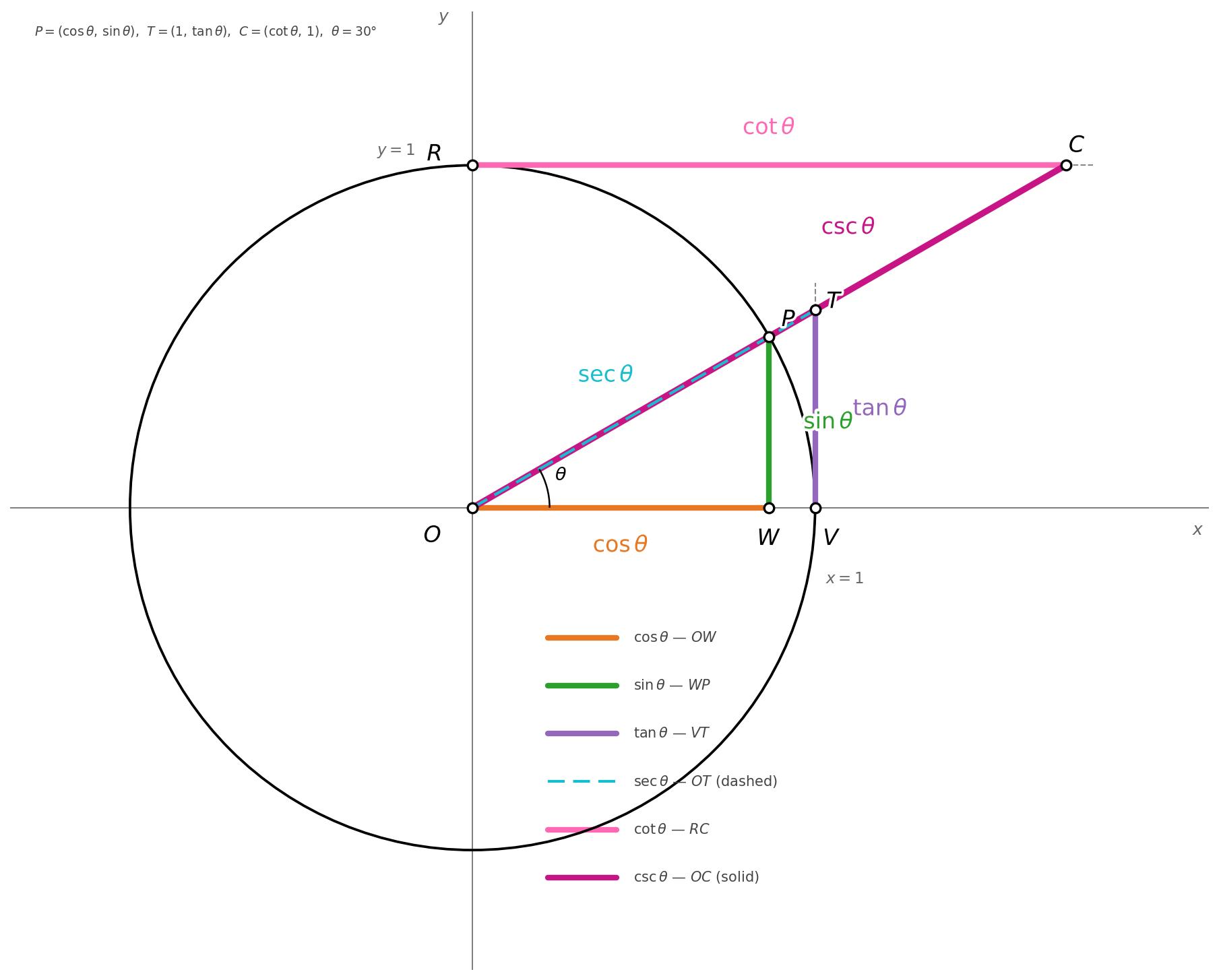
This article follows one diagram: a full unit circle, one angle \(\theta\), one ray from the origin, and six colored segments that are the six trigonometric values when the radius is \(1\). The construction is standard mathematics — similar-triangle geometry on the unit circle with tangent lines at \(x=1\) and \(y=1\). What is less common is drawing all six segments together in one figure; each piece is classical, the synthesis is for teaching.
The figure uses \(\theta = 30^\circ\) on purpose (§11). At that angle every segment has a different length, \(T\) and \(C\) are different points, and the dashed secant ray \(OT\) is visibly shorter than the solid cosecant ray \(OC\).
Reciprocal pairs (\(\cos/\sec\), \(\sin/\csc\), \(\tan/\cot\)) are not mirror images on the diagram — see §8 and §9.
1. The setup#
Work in the \(xy\)-plane with a unit circle (radius \(1\)) centered at the origin \(O=(0,0)\). The figure shows the entire circle; the six colored segments belong to the first-quadrant construction where all lengths are positive.
- Draw the ray that makes angle \(\theta\) with the positive \(x\)-axis.
- Let \(P\) be where that ray meets the circle: \[ P = (\cos\theta,\;\sin\theta). \]
- Drop a vertical from \(P\) to the \(x\)-axis. Call the foot \(W=(\cos\theta,\,0)\).
- Draw the vertical tangent \(x=1\) (it touches the circle at \(V=(1,0)\)).
- Draw the horizontal tangent \(y=1\) (it touches the circle at \(R=(0,1)\)).
- Extend the ray \(OP\) until it meets \(x=1\) at \(T\) and \(y=1\) at \(C\).
Because the radius is \(1\), each segment length equals the numerical value of its function — not merely “proportional to” it. On a circle of radius \(R\), every length would scale by \(R\).
2. Reading the figure#
Before the algebra, know how to read the drawing:
| Element | What to look for |
|---|---|
| Labeled points | \(O,\,W,\,V,\,P,\,T,\,R,\,C\) — each marks a corner of the construction |
| Orange / green | \(\cos\theta\) horizontal on the \(x\)-axis; \(\sin\theta\) vertical up to \(P\) |
| Purple / pink | \(\tan\theta\) on the vertical tangent \(x=1\); \(\cot\theta\) on the horizontal tangent \(y=1\) |
| Cyan dashed \(OT\) | \(\sec\theta\) — one straight ray from \(O\) through \(P\) to \(T\) |
| Magenta solid \(OC\) | \(\csc\theta\) — the same ray extended farther to \(C\) on \(y=1\) |
| Legend | Compact color key in the fourth quadrant (\(x>0\), \(y<0\)) |
The dashed-versus-solid styling matters: from \(O\) to \(T\) both sec and csc share the same line, but \(OT\) stops at \(x=1\) while \(OC\) continues to \(y=1\). At \(\theta=30^\circ\), \(OT \approx 1.15\) and \(OC = 2\), so the two rays are easy to tell apart.
3. The six segments — color key#
| Color | Style | Segment | Function |
|---|---|---|---|
| Orange | solid | \(OW\) on the \(x\)-axis | \(\cos\theta\) |
| Green | solid | \(WP\) up to \(P\) | \(\sin\theta\) |
| Purple | solid | \(VT\) on \(x=1\) | \(\tan\theta\) |
| Cyan | dashed | \(OT\) — ray \(O \to T\) | \(\sec\theta\) |
| Pink | solid | \(RC\) on \(y=1\) | \(\cot\theta\) |
| Magenta | solid | \(OC\) — ray \(O \to C\) | \(\csc\theta\) |
Every function is a visible segment, not a mysterious calculator key.
4. Why \(\cos\theta\) and \(\sin\theta\) are the orange and green legs#
Point \(P\) on the unit circle defines cosine and sine by its coordinates:
\[ OW = \cos\theta \quad\text{(orange)}, \qquad WP = \sin\theta \quad\text{(green)}. \]This is the usual right-triangle picture: horizontal run and vertical rise to \(P\). In the first quadrant (as drawn) both are positive. In other quadrants, use directed segments — the sign of each function matches the direction of its leg.
5. Why \(\tan\theta\) is the purple segment#
The ray through \(P\) has slope \(\sin\theta/\cos\theta = \tan\theta\). At \(x=1\) it reaches height \(y=\tan\theta\), so
\[ T = (1,\;\tan\theta), \qquad VT = \tan\theta \quad\text{(purple)}. \]Similar triangles \(\triangle OWP\) and \(\triangle OVT\) (shared angle \(\theta\) at \(O\)) give
\[ \frac{WP}{OW} = \frac{VT}{OV} = \frac{\sin\theta}{\cos\theta} = \tan\theta. \]6. Why \(\sec\theta\) is the cyan dashed ray#
On the same triangle pair,
\[ \frac{OT}{OV} = \frac{OP}{OW}. \]With \(OP=1\) and \(OV=1\),
\[ OT = \frac{1}{\cos\theta} = \sec\theta \quad\text{(cyan)}. \]\(OT\) is one straight ray — the same line as \(OP\), not two glued segments. Point \(P\) lies on the ray because \(P\) is where angle \(\theta\) meets the circle. The secant length is the full distance from \(O\) to \(T\), which splits as
\[ OT = OP + PT = 1 + (\sec\theta - 1). \]At \(\theta=30^\circ\), \(\sec\theta \approx 1.15\), so the part beyond the circle is only \(PT \approx 0.15\) — a short extension on the same line.
Secant is literally how far the ray travels to reach the vertical tangent \(x=1\). That is why \(\sec\theta \ge 1\) whenever it exists.
7. Why \(\cot\theta\) and \(\csc\theta\) are the pink and magenta rays#
The same ray meets \(y=1\) at
\[ C = (\cot\theta,\;1), \]so the horizontal run from \(R=(0,1)\) to \(C\) is
\[ RC = \cot\theta \quad\text{(pink)}. \]The distance from the origin to \(C\) is
\[ OC = \frac{1}{\sin\theta} = \csc\theta \quad\text{(magenta)}. \]\(OC\) is again one straight ray through \(P\), but it reaches a different point than \(OT\): \(C\) on \(y=1\), not \(T\) on \(x=1\). At \(\theta=30^\circ\), \(\csc\theta = 2\), so \(OC\) is noticeably longer than \(OT\).
| Reciprocal pair | Primary | Reciprocal | Tangent line hit |
|---|---|---|---|
| \(\cos\theta \leftrightarrow \sec\theta\) | \(OW\) (orange) | \(OT\) (cyan dashed) | \(x=1\) |
| \(\sin\theta \leftrightarrow \csc\theta\) | \(WP\) (green) | \(OC\) (magenta solid) | \(y=1\) |
| \(\tan\theta \leftrightarrow \cot\theta\) | \(VT\) (purple) | \(RC\) (pink) | opposite tangents |
8. Reciprocal versus inverse — do not mix them up#
Two different ideas both use a “\(-1\)” in notation. On this diagram, sec, csc, and cot are reciprocals — not inverse functions.
Reciprocal (flip the numeric value)#
\[ \sec\theta = \frac{1}{\cos\theta} = (\cos\theta)^{-1} \]\[ \csc\theta = \frac{1}{\sin\theta} = (\sin\theta)^{-1} \]\[ \cot\theta = \frac{1}{\tan\theta} = (\tan\theta)^{-1}. \]Here \(-1\) is an exponent on the function value: “one divided by cosine,” not “the angle whose cosine is ….”
That is exactly what the cyan dashed ray \(OT\) shows: when the orange leg \(OW=\cos\theta\) is short, the ray to \(x=1\) must be long — \(\sec\theta = 1/\cos\theta\).
Inverse (undo the function — an angle from a ratio)#
\[ \cos^{-1}(x), \; \sin^{-1}(x), \; \tan^{-1}(x) \]mean arc-cosine, arc-sine, arc-tangent: the angle whose cosine, sine, or tangent is \(x\). Likewise \(\sec^{-1}(x)\) (also written \(\operatorname{arcsec}(x)\)) is the angle whose secant is \(x\) — not \(1/\sec x\).
| Write this | Means | Does not mean |
|---|---|---|
| \(\sec\theta\) | \(1/\cos\theta = (\cos\theta)^{-1}\) | \(\sec^{-1}(\theta)\) |
| \(\cos^{-1}(x)\) | angle with cosine \(x\) (arccos) | \(1/\cos x\) |
| \(\sec^{-1}(x)\) | angle with secant \(x\) (arcsec) | \(1/\sec x\) |
Why the names sec, csc, cot exist#
If we wrote \(\cos^{-1}\theta\) for “one over cosine,” it would collide with \(\cos^{-1}(x)\) for arccos. The reciprocal names sec, csc, cot avoid that clash. On the diagram:
- Reciprocal = paired segment on a similar triangle (\(OW\) with \(OT\), etc.)
- Inverse = not drawn here; it answers “what angle gives this ratio?”
For a broader notation map (operators, functions, relations), see Grammar of Mathematics: Operators, Functions, Relations, and Symbols.
9. Why reciprocal lengths multiply to 1#
Reciprocals do not look like “reverse segments” on the figure — horizontal \(OW\) versus slant \(OT\) point in different directions. The geometry becomes intuitive when you use products, not mirrors.
The key identity on the unit circle#
From similar triangles \(\triangle OWP \sim \triangle OVT\) in §6:
\[ \frac{OW}{OP} = \frac{OP}{OT} \quad\Rightarrow\quad OW \cdot OT = OP^2 = 1. \]Substitute segment names and function values:
\[ \boxed{ OW \times OT = \cos\theta \cdot \sec\theta = (\cos\theta)\cdot(\cos\theta)^{-1} = 1 } \]When the orange leg shrinks, the cyan secant ray must grow — and their product stays 1. That is the picture behind “\(\sec = 1/\cos\).”
At \(\theta=30^\circ\): \(OW \approx 0.866\) and \(OT \approx 1.155\), and \(0.866 \times 1.155 \approx 1\).
The other two reciprocal pairs#
The same similar-triangle logic on the horizontal tangent gives
\[ WP \times OC = \sin\theta \cdot \csc\theta = (\sin\theta)\cdot(\sin\theta)^{-1} = 1, \]and on the two tangent lines,
\[ VT \times RC = \tan\theta \cdot \cot\theta = (\tan\theta)\cdot(\tan\theta)^{-1} = 1. \]| Pair | Segment product | Algebraic form |
|---|---|---|
| \(\cos\leftrightarrow\sec\) | \(OW \times OT = 1\) | \(\cos\theta \cdot \sec\theta = 1\) |
| \(\sin\leftrightarrow\csc\) | \(WP \times OC = 1\) | \(\sin\theta \cdot \csc\theta = 1\) |
| \(\tan\leftrightarrow\cot\) | \(VT \times RC = 1\) | \(\tan\theta \cdot \cot\theta = 1\) |
So “reciprocal trig” on this diagram means: one segment is small, its partner is large, and the two lengths multiply to 1 (on the unit circle). It is inverse scaling, not a flipped or reversed line.
10. One angle, six identities you can see#
For \(\cos\theta \neq 0\) and \(\sin\theta \neq 0\):
\[ \tan\theta = \frac{WP}{OW}, \qquad \cot\theta = \frac{OW}{WP}, \]\[ \sec\theta = \frac{OT}{OW}, \qquad \csc\theta = \frac{OC}{WP}. \]Right triangle \(OWP\) gives the Pythagorean identity:
\[ OW^2 + WP^2 = OP^2 = 1 \quad\Longleftrightarrow\quad \cos^2\theta + \sin^2\theta = 1. \]That identity is the first operation on these ratios — square the two legs, add, and the hypotenuse stays \(1\). For the rest of the identity handbook (odd/even, angle addition, double-angle, Euler), see Trigonometric Identities as Operations on Ratios.
11. Why we draw \(\theta = 30^\circ\), not \(45^\circ\)#
The angle in the figure is a design choice, not an accident. Some angles make the diagram collapse or hide distinctions:
At \(\theta = 45^\circ\):
\[ \tan 45^\circ = \cot 45^\circ = 1 \quad\Rightarrow\quad T = (1,1) = C. \]So \(OT\) and \(OC\) become the same segment, and \(\sec 45^\circ = \csc 45^\circ = \sqrt{2}\). You also get \(\cos 45^\circ = \sin 45^\circ\) (equal orange and green legs) and \(\tan 45^\circ = \cot 45^\circ\) (equal purple and pink segments). The “six different measurements” picture degenerates into a symmetric special case.
At \(\theta = 30^\circ\):
| Quantity | Value | Distinct? |
|---|---|---|
| \(T\) | \((1,\,\tan 30^\circ \approx 0.58)\) | Yes |
| \(C\) | \((\cot 30^\circ \approx 1.73,\,1)\) | Yes |
| \(OT\) | \(\sec 30^\circ \approx 1.15\) | Shorter |
| \(OC\) | \(\csc 30^\circ = 2\) | Longer |
Every segment has a different length; \(T \neq C\); the dashed secant and solid cosecant rays are clearly different. Similar sweet spots exist near \(20^\circ\)–\(35^\circ\).
Angles to avoid in this construction: \(0^\circ, 90^\circ, 180^\circ, \ldots\) (some functions undefined) and \(45^\circ\) (everything pairs up).
12. When each segment is defined#
\(\cos\theta\) and \(\sin\theta\) exist for every real \(\theta\). The other four depend on where the ray lands:
| Function | Undefined when | Geometric reason |
|---|---|---|
| \(\tan\theta,\;\sec\theta\) | \(\cos\theta = 0\) | Ray parallel to \(x=1\); no intersection |
| \(\cot\theta,\;\csc\theta\) | \(\sin\theta = 0\) | Ray parallel to \(y=1\); no intersection |
Watch which tangent the ray “misses” as \(\theta\) moves — that is the cleanest memory hook for undefined values.
13. Is this standard geometry?#
Yes. Each segment comes from a classical unit-circle construction:
- \(\cos\theta,\,\sin\theta\) — coordinates of \(P\)
- \(\tan\theta,\,\sec\theta\) — similar triangles to the vertical tangent \(x=1\)
- \(\cot\theta,\,\csc\theta\) — the same on the horizontal tangent \(y=1\)
Many books show the first group (or \(\sin,\cos,\tan\) only) and leave reciprocals as algebraic afterthoughts. Combining all six on one figure is a pedagogical synthesis — but nothing in the diagram is invented notation. It is one geometry viewed six useful ways.
14. How to use this diagram#
- Learn the colors — orange \(\cos\), green \(\sin\), purple \(\tan\), cyan dashed \(\sec\), pink \(\cot\), magenta solid \(\csc\).
- Trace one ray from \(O\) through \(P\): dashed cyan stops at \(T\); solid magenta continues to \(C\).
- Pair reciprocals by products — \(OW \times OT = 1\), \(WP \times OC = 1\), \(VT \times RC = 1\); remember \(\sec\theta = (\cos\theta)^{-1}\), not \(\sec^{-1}\theta\).
- Separate reciprocal from inverse — \(\cos^{-1}(x)\) is arccos; \(\sec\theta\) is \(1/\cos\theta\).
- Pick a generic angle — use \(30^\circ\), not \(45^\circ\), when you want six distinct segments.
- Track signs by quadrant — directed segments flip; the sign table follows from which coordinates are negative.
- When you need an identity — Trigonometric Identities as Operations on Ratios treats each formula as an operation on these same lengths.
Once this picture is fixed in memory, the six functions stop feeling unrelated. They become one ray and its projections — measured six useful ways on the unit circle.
Hashtags#
#Trigonometry #UnitCircle #SinCosTan #SecCscCot #Mathematics #MathForML #Geometry #Visualization #AppliedMathematics #MathEducation #SimilarTriangles #InverseTrig #ReciprocalTrig

Comments: