
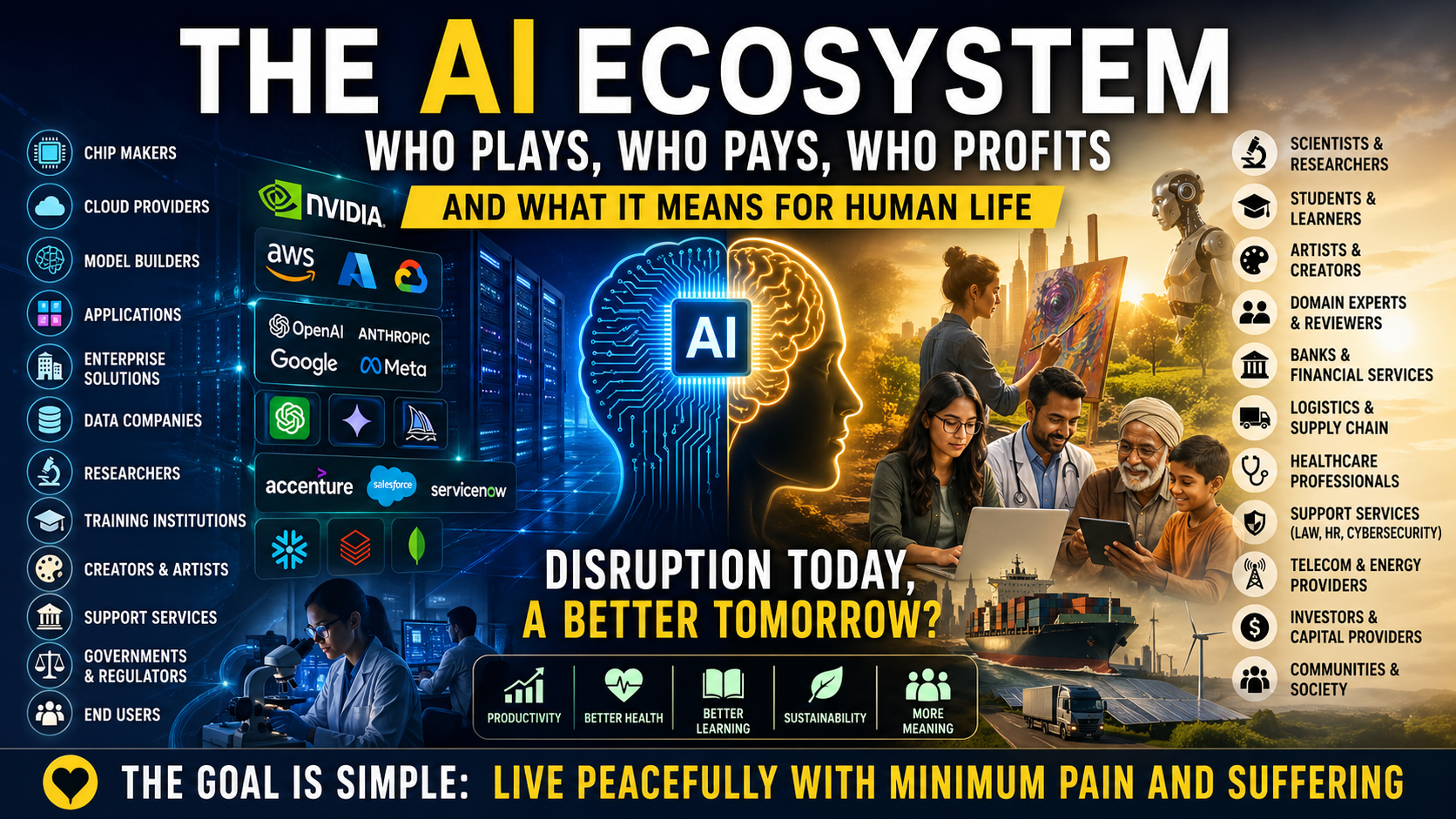
The AI Market Ecosystem#
Who the Players Are, Who Earns, Who Spends, and What It Means for Human Life
Artificial Intelligence is often discussed in extremes. Some see it as salvation. Others see it as destruction. Many see only one part of the picture and become anxious about the future.
A software engineer fears automation. A designer fears generative tools. A student fears job uncertainty. A company fears being left behind. An investor fears missing the next wave. A government fears strategic dependence. Each person sees AI through one narrow window.
But AI is not one machine descending upon humanity. AI is a vast economic, technological, social, and political ecosystem with many different players, incentives, risks, and opportunities.
To understand AI clearly, we must widen the lens.
And beyond markets and money, we must ask a deeper question:
What is the goal of human life?
For many people, stripped of philosophy and slogans, the practical answer is simple:
To live peacefully, with minimum unnecessary pain and suffering, while having dignity, meaning, and opportunity.
So the real question is not whether AI is powerful. The real question is:
Does AI help human beings move toward a more peaceful and less painful life—now and in the long run?
Part I: The Full AI Market Ecosystem#
1. Chip and Compute Makers#
These build the engines of AI.
Examples: NVIDIA, AMD, Intel, Google TPU, AWS Trainium.
They currently capture enormous value because every serious AI system needs compute power.
2. Semiconductor Manufacturers#
They manufacture advanced chips.
Examples: TSMC, Samsung, Intel Foundry, ASML.
Without them, no large-scale AI exists.
3. Cloud and Data Center Providers#
They provide computing infrastructure.
Examples: Microsoft Azure, AWS, Google Cloud, Oracle Cloud.
They spend massive capital on data centers, power, cooling, and networking.
4. Foundation Model Builders#
They create general-purpose AI models.
Examples: OpenAI, Anthropic, Google DeepMind, Meta AI, xAI, Mistral.
They spend heavily on training, talent, and inference.
5. Application Companies#
They turn AI into products people use.
Examples: ChatGPT, Copilot, Cursor, Perplexity, Midjourney, Notion AI.
This is where users directly feel AI.
6. Enterprise Solution Providers#
They solve business problems.
Examples: Accenture, Infosys, TCS, Deloitte, IBM, Salesforce, ServiceNow.
They convert AI hype into workflows, automation, compliance, and productivity.
7. Data Companies#
They manage, clean, store, and organize the fuel of AI.
Examples: Databricks, Snowflake, MongoDB, Elastic, vector database providers.
8. Education and Training Players#
They train people for the AI era.
Examples: universities, bootcamps, online platforms, trainers, consultants.
9. Researchers and Scientific Community#
They create new knowledge.
Examples: universities, independent researchers, open-source communities.
10. Creators and Artists#
They both use AI and compete with AI-generated output.
Examples: writers, designers, musicians, filmmakers, teachers.
11. Governments and Regulators#
They create rules, standards, incentives, and restrictions.
12. Support Ecosystem#
Banks, logistics, law firms, HR, cybersecurity, energy providers, telecoms, insurers.
These players often remain invisible, but they support the whole system.
13. End Users#
Workers, students, families, consumers, citizens.
Ultimately, they decide whether AI succeeds.
Part II: Who Makes the Money? Who Spends the Money?#
Today’s Main Winners#
Infrastructure layers often win first:
- Chip makers
- Cloud providers
- Data-center builders
- Enterprise software firms with distribution
Heavy Spenders#
- Model labs
- Cloud hyperscalers
- Startups racing for growth
- Governments building sovereign AI capacity
Future Winners May Be Different#
Long-term value may shift to those who control:
- Trust
- Distribution
- Proprietary data
- Customer relationships
- Domain expertise
- Real-world workflows
- Regulation-compliant execution
Part III: Why People Feel Anxiety#
Most people do not study the full ecosystem. They experience only one local effect.
A programmer sees code generation. A call-center worker sees automation. A student sees uncertainty. A parent sees changing careers. An artist sees imitation. A nation sees dependence.
So anxiety is natural when perception is partial.
This happened before:
- Industrial machines
- Electricity
- Computers
- Internet
- Smartphones
Every wave displaced something and created something.
The pain is real. But the story is larger than the pain.
Part IV: What Is the Goal of Human Life?#
If technology grows but suffering also grows, then something is incomplete.
If GDP rises but loneliness rises, something is incomplete.
If productivity rises but meaning collapses, something is incomplete.
If convenience rises but mental rest disappears, something is incomplete.
So we return to the practical human goal:
A peaceful life with reduced unnecessary suffering.
That includes:
- Food security
- Health
- Shelter
- Dignity
- Useful work
- Time for family
- Freedom from fear
- Learning
- Meaning
- Inner calm
Technology must be judged against these outcomes.
Part V: Is AI Helping in the Short Run?#
Positive Effects Now#
1. Productivity#
AI helps write, code, summarize, analyze, design, translate, and automate repetitive tasks.
2. Access to Knowledge#
A villager, student, entrepreneur, or retiree can access explanations instantly.
3. Medical and Scientific Support#
Faster research, diagnostics assistance, drug discovery acceleration.
4. Accessibility#
Speech-to-text, translation, assistive tools, tutoring.
5. Small-Team Empowerment#
One person can now do what once required ten.
Negative Effects Now#
1. Job Anxiety#
Real and widespread.
2. Misinformation#
Fake images, fake audio, manipulation.
3. Overdependence#
People may outsource thinking.
4. Surveillance Risk#
AI can centralize control.
5. Inequality#
Those with capital and compute may gain faster.
So in the short run, AI is mixed: powerful benefits plus disruptive pain.
Part VI: Is AI Helping in the Long Run?#
That depends less on AI itself and more on human choices.
If Managed Wisely#
AI may lead to:
- Abundance of knowledge
- Better healthcare
- Safer transport
- Cleaner industry
- Personalized education
- Reduced drudgery
- More creative time
If Managed Poorly#
AI may lead to:
- Concentrated wealth
- Permanent surveillance
- Psychological manipulation
- Mass dependency
- Loss of meaning
- Social fragmentation
So long-run outcomes are governance outcomes, not merely technology outcomes.
Part VII: What Should Individuals Do?#
Do not panic. Adapt intelligently.
1. Build Human Skills Hard to Automate#
- Judgment
- Trust-building
- Leadership
- Domain expertise
- Ethics
- Creativity with depth
- Systems thinking
2. Use AI as a Tool, Not Identity#
Let it assist you, not replace your agency.
3. Stay Economically Flexible#
Learn continuously. Careers will evolve.
4. Preserve Inner Stability#
Anxious societies become easy to manipulate.
5. Focus on Service#
Those who solve real human problems remain valuable.
Part VIII: Final Truth#
AI disruption is real. But fear often comes from partial vision.
The AI market is not a monster with one face. It is an ecosystem with many players, many incentives, many opportunities, and many risks.
And beyond all economics lies a deeper test:
Does it reduce suffering? Does it increase dignity? Does it create peace?
If yes, AI is progress. If no, then it is merely power without wisdom.
Closing Line#
The future will not be decided by AI alone. It will be decided by the kind of humans who choose how AI is used.

Comments: