
Understanding Batteries: Sizes, Chemistry, Voltage, Capacity and Lifespan#
A practical guide to AA, AAA, alkaline, lithium-ion, NiMH, LFP, mAh, Wh, charging, safety, and choosing the right battery.
Energy is a current topic, and I wanted to understand batteries. The subject grew as I read, so I wrote a full article. Most of my articles are about data science, quantum computing and advaita vedanta. Batteries are a different subject. They are still worth knowing in this much detail.
A battery stores energy chemically and converts it into electrical energy. Labels such as AA, 1.5 V, 2500 mAh, lithium-ion, and rechargeable do not describe the same thing. AA names the dimensions. 1.5 V names the voltage. 2500 mAh names the charge capacity. Lithium-ion names a family of chemistry. Rechargeable names whether the electrochemical reaction can be reversed in normal use.
Core idea: A battery is not described by one number. Its suitability depends on physical fit, chemistry, voltage, energy, current capability, charging method, life, safety, and cost.
1. How batteries work#
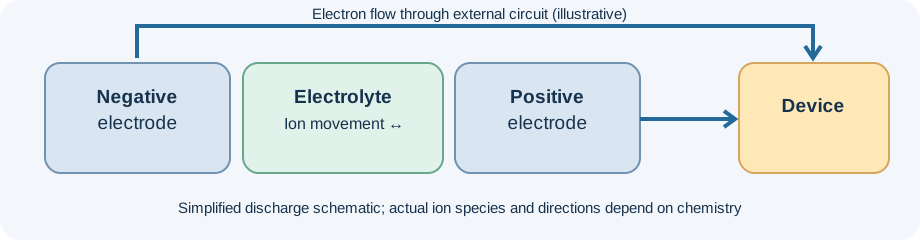
A cell has two electrodes and an electrolyte. During discharge, electrochemical reactions move electrons through the external circuit while ions move inside the cell. That completes the charge-transfer process. The appliance uses the delivered electrical energy. A compatible charger can drive the reactions in a rechargeable cell in reverse.
Cell versus battery: A cell is one electrochemical unit. A battery may contain one or more cells. Everyday speech often calls a single AA cell a battery.
2. The battery classification framework#
| Dimension | What it describes | Example |
|---|---|---|
| Size | Physical dimensions | AAA, AA, C, D, 18650, 21700 |
| Form factor | Physical geometry | Cylindrical, coin, pouch, prismatic |
| Chemistry | Electrodes and electrolyte | Alkaline, NiMH, Li-ion, LFP |
| Rechargeability | Primary or secondary | Disposable, rechargeable |
| Nominal voltage | Typical operating voltage | 1.2 V, 1.5 V, 3.2 V, 3.7 V |
| Capacity | Electric charge that can be delivered | 800 mAh, 2500 mAh, 5 Ah |
| Energy | Total electrical work available | 2 Wh, 10 Wh, 60 Wh |
| Current | Rate of charge flow | 0.1 A, 2 A, 20 A |
| Power | Rate of energy delivery | 1 W, 10 W, 100 W |
| Discharge rate | Current compared with capacity | 0.2C, 1C, 5C |
| Internal resistance | Voltage drop and heat under load | Milliohms or ohms |
| Cycle life | Repeated charge–discharge durability | Hundreds or thousands of cycles |
| Shelf life / calendar life | Aging with time | Years; depends on chemistry and storage |
| Temperature tolerance | Safe and effective operating conditions | Specified in the datasheet |
| Protection | Electrical and thermal safeguards | Fuse, protection PCB, BMS |
| Cost / sustainability | Lifecycle expense and disposal | Cost per Wh or per use |
3. Size and shape: AA is not a chemistry#
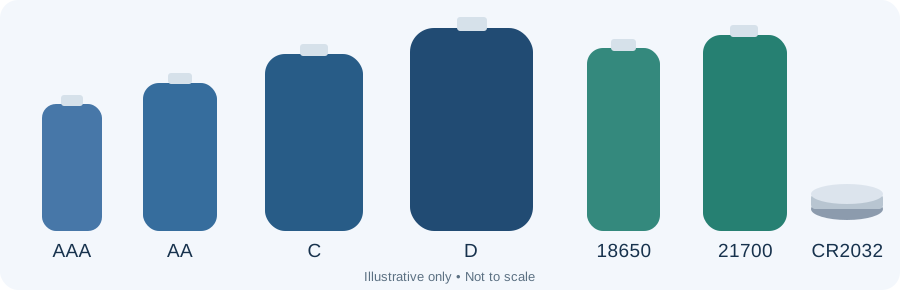
| Format | Approximate size | Typical use |
|---|---|---|
| AAA | 10.5 × 44.5 mm | Remotes, compact lights |
| AA | 14.5 × 50.5 mm | Toys, clocks, portable devices |
| C | 26.2 × 50 mm | Larger portable devices |
| D | 34.2 × 61.5 mm | High-capacity flashlights |
| 9 V rectangular | 26.5 × 17.5 × 48.5 mm | Instruments, certain alarms |
| 18650 | Approximately 18 × 65 mm | Flashlights, battery packs |
| 21700 | Approximately 21 × 70 mm | E-bikes, EV modules, power tools |
| CR2032 | 20 × 3.2 mm | Small memory backups, key fobs |
The first two digits of 18650 mean about 18 mm diameter. The next two mean 65 mm length. The last digit historically means a cylindrical format. 21700 likewise means about 21 × 70 mm.
Critical safety rule: A 14500 lithium-ion cell may fit an AA compartment, but its nominal voltage is typically near 3.6–3.7 V, not the 1.5 V an ordinary AA device expects. Physical fit does not mean electrical compatibility. Protected cells may also be slightly longer than the nominal dimensions.
4. Primary versus rechargeable batteries#
Primary cells are made for one discharge: zinc-carbon, most alkaline AA/AAA cells, lithium iron disulfide AA, and many coin cells. They suit intermittent use and often store well. Do not try to recharge primary cells.
Secondary cells can be charged and discharged repeatedly: NiMH, lithium-ion, lithium iron phosphate (LFP), and lead-acid. Recharging means you replace the cell less often. It needs the correct charge control, and the charger is an extra cost up front.
5. Battery chemistry compared#
| Chemistry | Nominal voltage per cell | Rechargeable? | Typical strengths | Limitations / examples |
|---|---|---|---|---|
| Zinc-carbon | 1.5 V | No | Low purchase price | Low-drain use; less capable at high current |
| Alkaline Zn–MnO₂ | 1.5 V | Generally no | Widely available, long storage | Performance falls with high drain; leakage possible |
| Lithium FeS₂ (primary AA) | 1.5 V | No | Good shelf life, high-drain performance | Higher initial price |
| Lithium coin (Li–MnO₂, for example CR2032) | 3.0 V | No | Compact, low self-discharge | Low continuous current capability |
| NiMH | 1.2 V | Yes | Reusable AA/AAA, good moderate and high-drain behavior | Needs a NiMH charger; voltage differs from alkaline |
| NiCd | 1.2 V | Yes | Rugged in some applications | Toxic cadmium; largely displaced |
| Li-ion (common NMC/NCA/LCO) | ~3.6–3.7 V | Yes | High gravimetric and volumetric energy | Protection and careful charging required |
| LFP (LiFePO₄) | ~3.2 V | Yes | Long cycle life, strong thermal stability | Lower energy density than many other Li-ion types |
| Lead-acid | ~2.0 V | Yes | Affordable, high starter current | Heavy; performance and life depend on discharge depth |
| Sodium-ion | Varies by design | Yes | Alternative resource base, developing applications | Specifications vary significantly |
Terminology note: Alkaline names the alkaline electrolyte. Lithium-ion names a broader rechargeable family, not one fixed recipe. Nickel, cobalt, manganese, and iron name particular electrode ingredients. NMC means nickel–manganese–cobalt. NCA means nickel–cobalt–aluminum. LFP is lithium iron phosphate.
6. Volt, ampere, mAh, watt, and watt-hour#
- Voltage (V): Electric potential difference that drives charge through a connected load.
- Current (A): Rate of charge flow. 1 A equals 1 coulomb per second. One electron carries a charge of $-1.602176634 \times 10^{-19}$ coulomb. One coulomb is the charge of about $6.241509 \times 10^{18}$ electrons.
- Capacity (Ah or mAh): Charge that can be delivered under specified conditions. Capacity is not energy by itself.
- Power (W): Rate of energy use or delivery.
- Energy (Wh): Amount of electrical energy.
Power (W) = Voltage (V) × Current (A)
Approximate nominal energy (Wh) = Nominal voltage (V) × Capacity (Ah)
1000 mAh = 1 Ah
Example: a hypothetical AA alkaline battery rated 1.5 V, 2000 mAh has a nominal product of 3 Wh. A rechargeable NiMH cell rated 1.2 V, 2500 mAh also has 3 Wh nominally. A larger mAh number does not necessarily mean more energy. Real battery voltage changes during discharge, so multiplying by the nominal voltage only estimates energy.
For alkaline cells, the delivered mAh depends strongly on how fast the cell is discharged, the ambient temperature, and the cutoff voltage the device uses.
7. Interactive battery runtime calculator#
Change the values to estimate one cell's runtime under steady power use. This is an approximate constant-power estimate. It is not an accurate discharge simulator.
8. Runtime, cycle life, and calendar life#
The phrase battery life can mean three separate things:
- Runtime: Hours of operation from one charge or from a new cell.
- Cycle life: Number of charge–discharge cycles before a stated drop in capacity (often 80% remaining capacity, but not always).
- Calendar or shelf life: Change during storage and aging, even if the battery is rarely used.
For a device that uses a fairly steady amount of power:
Estimated runtime (hours) ≈ usable energy (Wh) ÷ device power (W)
For illustration, if a battery has 10 Wh nominal energy and 85% is treated as usable, a 2 W device could run about 4.25 hours. The 85% is an adjustable illustration. It is not a universal battery efficiency. Electronics, high current, cold temperatures, and voltage cutoff can change the result by a large amount.
9. Power capability, C-rate, and resistance#
A battery with 2 Ah capacity discharging at 1C supplies 2 A. At 2C, it supplies 4 A. A higher C-rate can increase heating and reduce usable energy. The allowable continuous and peak currents are set by the manufacturer.
Internal resistance makes the terminal voltage drop under load and produces heat. A cell that works in a clock can perform poorly in a powerful flashlight even when both accept AA size.
Energy density (Wh/kg or Wh/L) measures how much energy fits into a weight or a volume. Power density (W/kg) measures how rapidly power can be delivered relative to mass. A high-energy design and a high-power design are not always the same design.
10. Series versus parallel: packs and battery management#
- Series: Voltages add. Three 1.2 V NiMH cells in series provide about 3.6 V nominal. The ampere-hour rating stays that of one matched cell.
- Parallel: Ampere-hour capacity adds at the same nominal voltage, when the pack is designed and the cells are matched. Pack current capability can also increase.
Large rechargeable packs generally need battery management and protective electronics. Connecting mismatched cells, different chemistries, or cells at different states of charge can create dangerous currents and imbalance. Do not assemble lithium packs without the appropriate design expertise and safety controls.
11. How to choose a battery for common applications#
| Device / task | Common suitable choice | Why |
|---|---|---|
| Low-drain TV remote | Alkaline AAA | Convenient shelf life, low current |
| Wall clock | Alkaline AA | Low-power operation; check the instructions |
| Frequently used toys | NiMH AA | Rechargeable, repeated high drain |
| High-drain flashlight | Manufacturer-approved Li-ion or NiMH | Strong current delivery |
| Camera flash | NiMH AA, if supported | Repeated bursts of current |
| Laptop / phone | Built-in Li-ion pack | Energy density, integrated charge control |
| Car starter | Automotive lead-acid or the specified alternative | High starting current |
| Solar or home backup | An engineered LFP or lead-acid system | Cost, cycle life, and the safety the application needs |
| Wristwatch / key fob | The specified coin cell | Compact, long storage life |
| UPS | Lead-acid designed for UPS, or a supported lithium pack | Backup power and a compatible charger |
Selection checklist: (1) exact device specification, (2) form factor and contact orientation, (3) voltage, (4) chemistry, (5) continuous and peak current, (6) required runtime and Wh, (7) temperature environment, (8) charger and BMS compatibility, (9) lifecycle cost, (10) disposal route.
12. Battery lifespan and care#
Rechargeable batteries age through both use and time. Life depends on depth of discharge, charging voltage, current, heat, storage state of charge, and chemistry. Lithium-ion cells especially benefit from avoiding excessive heat and long periods at extreme charge levels. Follow each device’s built-in charging recommendations.
Store spare batteries in a cool, dry place, following the manufacturer instructions. Do not mix new and exhausted cells in one device. Do not mix incompatible chemistries. Keep loose cells away from metal objects that could short the terminals. Never puncture, crush, overheat, or try to recharge a primary battery. Take swollen, leaking, unusually hot, or visibly damaged rechargeable packs out of use and handle them under local recycling guidance.
Coin-cell warning: Button and coin batteries are particularly dangerous if a child or a pet swallows one. Secure the compartment. If you suspect ingestion, get emergency care immediately.
13. Frequently asked questions#
Is AA a chemical type?#
No. AA is a size. AA cells may be alkaline, NiMH, or another chemistry, with different voltages.
Why is a smaller lithium-ion cell often 3.7 V while a large D alkaline cell is 1.5 V?#
Cell voltage is set by the electrochemical reactions and the electrode potentials, not by physical volume. A larger D cell generally contains more active material and can deliver more energy, but a single alkaline D cell still has roughly 1.5 V nominal voltage.
Is 2500 mAh always better than 2000 mAh?#
Not necessarily. Compare voltage, discharge conditions, current limits, efficiency, quality, price, and the device cutoff. The 2500 mAh cell may have less usable energy in a particular device.
Can I replace 1.5 V alkaline AA with 1.2 V NiMH AA?#
Many devices support NiMH, but not all. Some devices require a higher voltage or use voltage to estimate remaining charge. Check the manual.
Can lithium-ion AA-sized 14500 batteries replace regular AA?#
Usually no. A standard 14500 lithium-ion cell has a much higher voltage and may damage the device. Use it only when the device explicitly supports it.
Is a battery that is fully charged always healthy?#
No. State of charge tells how full it is today. State of health estimates how it has aged.
Which battery lasts longest?#
It depends on whether you mean runtime, shelf life, cycle life, or years of service. There is no universally longest-lasting battery.
14. Putting it all together#
When you read a battery label, ask five questions first: Will it fit? Is the voltage right? What is its chemistry? How many watt-hours can it deliver under this load? Is it safe and compatible with this device and charger? Then look at lifespan, current rating, storage, cost, and what happens at the end of its life.
A battery is an electrochemical system. Size, voltage, charge capacity, energy, output capability, safety, and service life each mean something different, and each one is a separate engineering tradeoff.
Sources and further reading#
- U.S. Department of Energy — DOE Explains: Batteries
- Battery University — Confusion with Voltages
- Battery University — Primary and Secondary Battery Loading
- Battery University — Comparison of Secondary Batteries
- SparkFun — Battery Technologies
- Energizer — Alkaline Manganese Dioxide Handbook and Application Manual
Educational resource. For a real device or pack, the manufacturer datasheet and safety instructions override these generalized comparisons and estimates.
Hashtags#
#Batteries #BatteryChemistry #LithiumIon #NiMH #AlkalineBattery #EnergyStorage #WattHour #BatterySafety #ElectricalEngineering #LFP #AmpereHour #CoinCellSafety

Comments: