What is CAPTCHA?#
CAPTCHA stands for “Completely Automated Public Turing test to tell Computers and Humans Apart.” It is a security mechanism used by websites to determine whether the user is a human or a computer program (bot). CAPTCHAs are typically implemented as tests or challenges presented to the user, which are easy for humans to solve but difficult for bots.
The purpose of CAPTCHA is to prevent automated bots from performing actions that are intended for human users, such as creating accounts, submitting forms, or accessing restricted content. By requiring users to complete a CAPTCHA, websites can verify their humanity and protect against spam, brute-force attacks, data scraping, and other malicious activities.
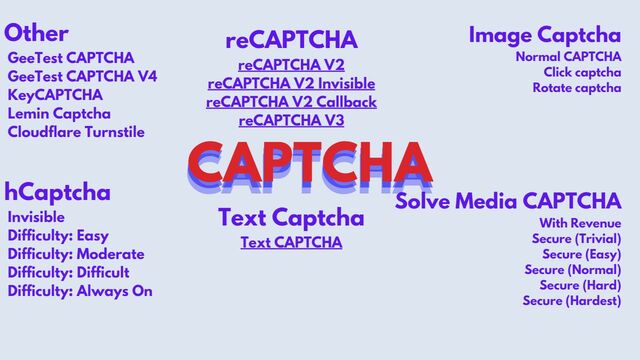
CAPTCHAs can take various forms, such as
- Distorted images of alphanumeric characters,
- Math problems,
- Logical puzzles,
- Audio challenges: What is said,
- Audio challenges: What is not said,
- Audio challenges: whose voice is that.
- Audio challenges: Is it bird, child or animal voice.
- Identify image spoken
- Image Challenge: Identify image for which text is typed in disorted form
- Image Challenge: Locate an object in an image
- Simple checkboxes.
The idea is to create a task that is easy for humans to interpret and complete, but challenging for bots to understand and solve accurately.
In recent years, CAPTCHAs have become more sophisticated with the use of advanced algorithms and machine learning techniques. This has led to the development of more secure and user-friendly CAPTCHA mechanisms that are difficult for bots to bypass while maintaining a better user experience for human users.

Comments: