What Is Distance?#
From metres to light-travel time — and what it really means for an object to have a size#
Part 17 of the Learning Quantum Physics series.
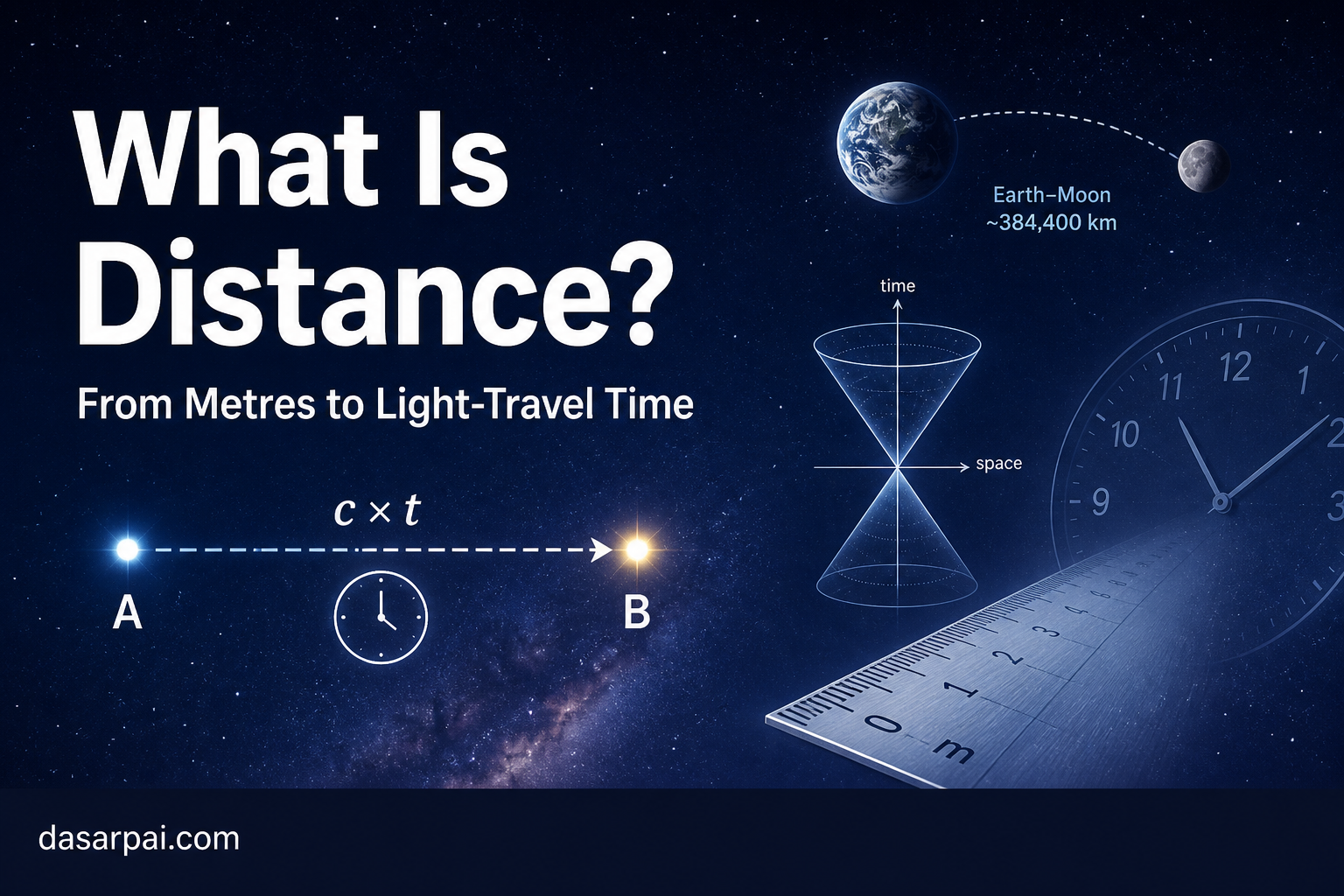
The metre is a human unit. Nature does not contain metre marks. Send a pulse of light from A to B, measure the time, and the distance is \(c\) times that time. Everyday size is mostly built from smaller structure. It is not a length the object simply possesses.
We use distance so naturally that we rarely stop to ask what it actually means.
A table is two metres long.
A person is 1.7 metres tall.
The Moon is about 384,000 kilometres away.
The Sun is about 150 million kilometres away.
These statements feel fundamental. We tend to imagine that the universe somehow contains an invisible three-dimensional ruler, with lengths already built into space.
But nature contains no metre marks.
There are no kilometres painted between the Earth and the Moon.
The metre is a human unit.
So a deeper question appears:
What is distance before we introduce metres, feet, kilometres, miles, or any other human-created unit?
And an even deeper question follows:
What does it actually mean for an object to have a size?
To explore these questions, we connect four ideas that thread through the sections below:
- distance,
- time,
- the speed of light,
- and the physical structure of matter.
1. Distance Looks Simple — Until We Try to Define It#
Suppose we have two points:
A ---------------- B
We put a ruler between them.
Suppose the ruler tells us:
1 metre
We therefore say:
distance(A,B) = 1 metre
But have we defined distance?
Not really.
We have only determined how many copies of a particular human-created standard fit between A and B.
The same separation can be written as:
1 metre
or:
100 centimetres
or:
1000 millimetres
or approximately:
3.28 feet
Nothing in nature changed.
Only our numerical description changed.
This immediately tells us something important:
The numerical value of a distance depends upon the unit chosen by humans.
2. Nature Does Not Know What a Metre Is#
Humans have created many units of length:
- foot,
- cubit,
- inch,
- yard,
- mile,
- metre,
- kilometre.
Many ancient units were based approximately on the human body.
A foot was related to the length of a human foot.
A cubit was related to the forearm.
A hand was related to the width of a hand.
These were convenient because humans themselves were the measuring instruments.
But different people have different-sized bodies.
Different civilizations therefore developed different standards.
The metre was created much later as part of an attempt to produce a universal and systematic measurement system.
Originally it was related to the dimensions of the Earth.
Today its definition is much deeper.
The metre is defined through time and the speed of light.
That fact becomes central in §17.
3. Distance Can Be Measured Using Time#
Instead of putting a ruler between two points, suppose we send a pulse of light.
A ---- light ----> B
We measure how long the pulse takes to travel from A to B.
Then:
\[ \text{distance} = \text{speed} \times \text{time} \]For light in vacuum:
\[ \text{distance} = c \times \text{time} \]where c is the speed of light.
In SI units:
\[ c = 299{,}792{,}458\ \text{m/s} \]Therefore light requires approximately:
3.33564 nanoseconds
to travel one metre.
So:
1 metre
can also be described as:
3.33564 light-nanoseconds
This gives us a completely different way to think about distance.
Instead of asking:
How many metre sticks fit between A and B?
we can ask:
How much time does light require to cross the separation between A and B?
4. What Is a Light-Nanosecond?#
One nanosecond is:
0.000000001 second
or:
10^-9 second
A light-nanosecond is the distance light travels during one nanosecond.
That distance is approximately:
29.98 centimetres
which is interestingly close to one foot:
1 foot = 30.48 centimetres
Therefore:
1 light-nanosecond ≈ 0.984 foot
or, as an excellent mental approximation:
light travels about 1 foot per nanosecond
This is not why the foot was created.
The foot came from human-scale measurement long before anyone could measure nanoseconds.
The similarity is essentially a coincidence.
But it provides an excellent intuitive bridge between everyday distance and light-travel time.
5. Why Did Humans Prefer the Metre?#
If one foot happens to be almost one light-nanosecond, why did science move toward the metre?
Because the metric system was designed primarily for consistency and arithmetic convenience.
For example:
1 metre = 100 centimetres
1 kilometre = 1000 metres
The entire system works naturally with powers of ten.
That is enormously useful in:
- science,
- engineering,
- manufacturing,
- trade,
- chemistry,
- astronomy.
The foot may accidentally be closer to one light-nanosecond, but the metre belongs to a much more systematic decimal framework.
So these are two different kinds of convenience:
foot
≈ human-body-scale convenience
metre
≈ mathematical and scientific convenience
Neither is preferred by nature.
6. The Speed of Light Is More Than the Speed of Light#
We usually introduce c as:
the speed of light.
That is correct, but modern relativity gives it a deeper meaning.
c represents the invariant causal speed built into spacetime.
It determines how rapidly information or causal influence can propagate.
Therefore:
distance = c × light-travel time
is not merely a convenient formula involving photons.
It connects spatial separation with causal structure.
This is why c plays such a fundamental role in §19 and §20.
7. Nature Does Not Prefer the Number 299,792,458#
We usually write:
c = 299,792,458 metres/second
That number looks enormously important.
But now change the unit from metres to feet.
The same speed becomes approximately:
c = 983,571,056 feet/second
or roughly:
c ≈ 1 billion feet/second
So which number does nature prefer?
299,792,458?
or:
983,571,056?
Neither.
The physical phenomenon has not changed at all.
Humans changed the unit.
We could describe the same light ray using:
299,792,458 metres/second
or approximately:
1 billion feet/second
or:
1 light-second/second
The last representation is particularly revealing.
If distance itself is measured in light-seconds, then:
c = 1 light-second / second
Numerically:
c = 1
Nature does not care about the integers produced by our rulers.
Nature gives us the invariant relationship represented by c.
Humans decide whether to express it using:
- metres,
- feet,
- kilometres,
- miles,
- light-seconds,
- light-nanoseconds.
So the fundamental statement is not:
Nature chose the number 299,792,458.
The deeper statement is:
Nature contains a universal invariant causal speed, which we call
c.
The large number appears only because of the units we chose.
8. When Distance Is Measured in Time, c Becomes 1#
Suppose we abandon metres for a moment.
Define spatial separation by the amount of time required for light to cross it.
Then:
1 light-second
is exactly the distance light travels during:
1 second
Therefore:
c = 1 light-second/second
and numerically:
c = 1
Likewise:
1 light-nanosecond/nanosecond = 1
Physicists frequently use units like this — a theme we return to at the Planck scale.
They are called natural units.
Setting:
c = 1
does not change physics.
It removes a conversion factor created by our choice of units.
9. We Already Measure Cosmic Distance This Way#
Astronomy routinely uses time-like distance units (see also §10).
The Moon is approximately:
1.28 light-seconds away
The Sun is approximately:
8.3 light-minutes away
Proxima Centauri is about:
4.24 light-years away
This language gives distance an immediate physical interpretation.
When we say:
The Sun is 8.3 light-minutes away
we are saying:
Light — and therefore any causal signal limited by
c— requires about 8.3 minutes to cross that separation.
Distance has become connected directly with causal delay.
10. Perhaps Distance Is Better Understood as Causal Separation#
Imagine two locations.
A ---------------- B
Suppose light requires one second to travel from A to B.
We can say:
distance = 1 light-second
But physically we can interpret this as:
No causal signal can connect A to B in less than one second.
This suggests a deeper operational interpretation:
Distance describes causal separation between locations.
The farther apart two regions are, the longer the minimum possible causal connection between them.
This is much closer to fundamental physics than imagining distance merely as an empty gap measured by a ruler.
11. What, Then, Does “Size” Mean?#
Now consider an object:
A ================= B
Its length is the distance between its boundaries.
Suppose light requires:
10 nanoseconds
to travel from one end to the other.
Then its length is:
10 light-nanoseconds
which is approximately:
3 metres
So size can also be interpreted causally:
The spatial size of an object corresponds to the light-travel time across its extent.
A three-metre object is therefore also an object whose two ends are separated by approximately ten light-nanoseconds.
12. Does an Object Fundamentally Have Mass but Not Size?#
This question takes us into a much deeper layer of physics.
Our everyday intuition says that every object must possess both:
mass
and:
size
But fundamental physics gives a more interesting picture.
Consider an electron.
As far as current experiments can determine, the electron behaves as an elementary particle.
In the Standard Model it is treated as point-like.
That means we do not currently describe the electron as a tiny classical ball possessing a known physical radius.
Yet an electron has a definite rest mass.
So, conceptually, we encounter something surprising:
electron:

mass → yes

classical physical radius → not known / treated as point-like
This already warns us that mass and size are not the same kind of property.
13. But Not Everything Has Mass Either#
We must be careful not to conclude:
fundamental object = mass without size
because photons provide the opposite example.
A photon has:
rest mass = 0
but a photon state can still have spatial extent.
A photon wavepacket may be spread over a region.
So nature does not divide neatly into:
mass = fundamental
size = unreal
The situation is subtler.
Different physical properties arise in different ways.
14. Most Familiar Size Is Emergent#
Now consider an atom.
An atom has a characteristic size.
But where does that size come from?
It is not because the nucleus and electron are tiny rigid balls touching each other.
Atomic size emerges from:
- quantum mechanics,
- electromagnetic interaction,
- electron wavefunctions,
- the electron mass,
- fundamental constants.
Similarly, molecular size emerges from:
atoms
+
quantum states
+
chemical bonds
The size of a crystal emerges from the arrangements of enormous numbers of atoms.
The size of a human body emerges from:
molecules
→ cells
→ tissues
→ organs
→ body
The size of a planet emerges from competition between:
- gravity,
- pressure,
- material strength,
- temperature,
- composition.
So the familiar size of ordinary objects is very often not a primitive number attached to nature.
It emerges from relationships among more fundamental constituents and forces.
15. Size Is Often Relational#
Imagine removing all internal structure of a chair.
There is no separate fundamental constant saying:
chair size = 1 metre
The chair’s size appears because atoms settle into particular arrangements.
The distances between those atoms arise from physical interactions.
Therefore:
fundamental interactions
        ↓
stable atomic structures
        ↓
molecular structures
        ↓
macroscopic object
        ↓
observed size
This is what we mean when we say that macroscopic size is emergent.
It is real.
But it is not necessarily fundamental.
Temperature provides a useful analogy.
A single molecule does not possess temperature in the same sense as a gas.
Temperature emerges statistically from enormous numbers of particles.
Likewise, much of the size we encounter in everyday life emerges from deeper structures.
16. Size Is Also Observer-Dependent#
Special relativity introduces another surprise.
Suppose an object has length:
L
in its own rest frame.
An observer moving relative to that object can measure a different length along the direction of motion.
This is length contraction.
So there is no single Newtonian absolute length possessed by an object independently of all observers.
The object’s proper length remains well defined in its rest frame, but measured spatial length depends upon the reference frame.
This further weakens the idea that size is an absolute primitive property (contrast §11).
17. The Metre Is Already Derived From Time#
Modern SI measurement provides an extraordinary confirmation of the direction we are exploring.
We do not now define the second by first measuring a metre.
Instead, the second is defined using a precise atomic transition.
Then c is assigned the exact value:
299,792,458 m/s
From these we obtain the metre.
Conceptually:
\[ \text{atomic physics} \rightarrow \text{precise time} \rightarrow \text{second} \rightarrow \text{exact } c \rightarrow \text{metre} \]So modern metrology already treats length, in a sense, as derived through time and c — completing the arc from §3.
The ruler is ultimately calibrated using a clock.
18. Why Keep the Metre at All?#
If we can measure distance using time, why not say:
My height is 5.7 light-nanoseconds
instead of:
My height is 1.7 metres
Because units are interfaces between nature and human cognition.
We live at approximately metre scales.
We can easily visualize:
2 metres
but most people cannot intuitively visualize:
6.67 light-nanoseconds
Likewise:
a 10 kilometre drive
is easier for everyday life than:
33.4 light-microseconds
So the metre remains enormously useful.
The metre is not meaningless.
It is simply not a preferred length supplied by nature itself.
It is a convenient human representation.
There is also an operational reason metres feel easier at human scales.
Compare two ways of stating separation:
1.7 metres
versus:
5.7 light-nanoseconds
The first invites an immediate comparison: place a ruler between two points now and read off a number.
The second can sound as if we must wait for light to cross the gap — as if distance were something we only learn by living through a duration.
That impression is misleading when we are only naming a separation (§3). But it becomes very real at astronomical scales, where distant objects are known through light that left in the past (§9). Metres therefore remain a practical interface for nearby, approximately simultaneous comparisons — even though modern metrology ultimately calibrates the ruler through a clock (§17).
19. Space and Time Become Spacetime#
Einstein’s special relativity teaches us that space and time cannot be treated as completely independent universal structures.
They form:
spacetime
In one spatial dimension, the spacetime interval can be written:
\[ s^2 = c^2 t^2 - x^2 \]If we use natural units with \(c = 1\), then:
\[ s^2 = t^2 - x^2 \]Now spatial and temporal quantities use compatible units.
But an important distinction remains.
Time and space enter the geometry differently.
So:
space and time are unified
does not mean:
space and time are identical
20. Light Defines the Causal Geometry#
Imagine an event:
              future
                |
             \  |  /
              \ | /
---------------●--------------- space
              / | \
             /  |  \
                |
               past
The diagonal lines represent light.
They form the boundary of what can causally influence what.
An event outside this boundary cannot be reached by a signal travelling at or below c soon enough.
Therefore c is not merely an interesting property of photons.
It determines the causal architecture of spacetime.
That is why describing distance through light-travel time is physically powerful.
21. From Everyday Distance to the Planck Scale#
Now take this reasoning to its extreme.
The Planck length is approximately:
1.616 × 10^-35 metre
The time required for light to travel one Planck length is approximately:
5.39 × 10^-44 second
This is the Planck time.
They are related by
\[ l_P = c\, t_P \]That is the same pattern as §8: one Planck length is the distance light crosses in one Planck time.
A reader can easily stumble here. In SI units the two numbers look nothing alike — roughly 10^-35 metre versus 10^-44 second — so the next step can seem to say that those quantities are equal, or that space and time have literally merged. Neither is true.
What follows is a unit choice, not a change in physics. As in §8, if we measure length using light-travel time and set:
c = 1
then the conversion factor between metres and seconds drops out of the formula, and we may write:
l_P = t_P
in those natural units only. The symbols still denote a length and a duration; they share a numerical value because we chose units so that one unit of length is exactly the distance light travels in one unit of time. That is the same underlying scale expressed two ways — not proof that space and time are identical (§19).
22. Why Are the Planck Scales Important?#
The Planck scales combine three fundamental constants:
c
associated with relativity,
G
associated with gravity,
and:
ℏ
associated with quantum mechanics.
The Planck length is
\[ l_P = \sqrt{\frac{\hbar G}{c^3}} \]The Planck time is
\[ t_P = \sqrt{\frac{\hbar G}{c^5}} \]and therefore
\[ l_P = c\, t_P \]Around these scales, quantum mechanics, gravity and spacetime geometry are expected to become simultaneously important.
Our present theories are not sufficient to give a complete experimentally verified description of that regime.
23. Is Planck Length the Smallest Possible Size?#
Not necessarily.
It is common to hear:
The Planck length is the smallest possible distance.
That is stronger than present evidence allows.
We do not experimentally know that space consists of Planck-sized pixels.
Similarly, we do not know that time advances in Planck-time ticks.
A safer statement is:
At approximately the Planck scale, our familiar description of smooth classical spacetime is expected to require quantum-gravitational physics.
Whether distance itself continues to have its usual meaning below that scale is an open question.
24. Could Distance and Size Themselves Be Emergent?#
Now we arrive at one of the deepest questions in modern theoretical physics.
Our ordinary picture says:
space exists
      ↓
objects occupy space
      ↓
objects therefore have size
But perhaps the deeper structure is something more like:
fundamental quantum relationships
            ↓
        geometry
            ↓
        spacetime
            ↓
        distance
            ↓
          size
Research in:
- quantum gravity,
- holography,
- quantum information,
- spacetime emergence,
- entanglement and geometry,
has made this possibility scientifically serious.
But we must distinguish established physics from speculation.
It is well established that:
metres are human units
It is well established that:
distance can be measured using light-travel time
It is well established that:
c links spatial and temporal measurement
It is well established that:
many macroscopic sizes emerge from microscopic physics
But it is not yet established that:
all space itself emerges from time
or:
distance is fundamentally nothing except time
Those remain deeper hypotheses.
The next section examines one natural intuition that often arises at this point — that space is really time, and the Planck scale is “now.”
25. A Tempting Intuition: Is Space Really Time?#
Once distance is expressed through light-travel time, a strong intuition can appear:
Perhaps space is really time — the time of the past and future — while the Planck scale is the time of now.
It is worth taking this feeling seriously, because it captures part of what §10 and §20 already teach us.
When we say a galaxy is millions of light-years away, we are not only giving a spatial label.
We are also saying that the light reaching us now began its journey millions of years ago.
At cosmic scales, distance often shows up as lookback time.
In that sense, much of what we call “space” in astronomy is also a record of the past.
So the intuition is not absurd.
It is pointing toward the causal structure of spacetime.
But we should also notice where the intuition overreaches.
What the intuition gets right#
If distance means minimum causal delay between regions, then expressing it in light-travel time is not a trick.
It is a faithful description of how nature connects separated places.
Large separations often do feel like retarded information from earlier events.
That is one reason the metre remains cognitively convenient only at nearby scales (§18).
What the intuition should not claim#
First, local space is not generally “past time” or “future time”.
The gap between two ends of a ruler on a desk is spacelike.
In an appropriate reference frame, signals from both ends can reach you at the same moment.
No long wait is required.
So space is not universally “time of the past and future.”
That reading applies most clearly when finite signal speed and lookback are in play.
Second, the future is not a distance we have already measured.
A light-year mostly tells us about past causal contact:
how long ago a signal could have left there to reach us now
It is not a tape measure laid out into tomorrow.
Third, the Planck scale is not “the time of now.”
Planck length and Planck time are the same underlying scale expressed in two ways (§21):
\[ l_P = c\, t_P \]Planck is where smooth classical space and time may both require quantum-gravitational revision (§22, §23).
It is not a built-in pixel of the present moment.
Likewise, in relativity, “now” is not a universal structure shared by all observers (§19).
It is more like here: something indexed from your own worldline.
A safer restatement#
A cleaner version of the intuition might be:
large-scale spatial separation often appears as causal delay / lookback time
and:
at the Planck scale, the separate meanings of space and time themselves may break down
That is close to the feeling that “both are time,” but it stops short of saying time alone survives.
Einstein’s lesson was not:
space is secretly time
It was:
space and time form one spacetime geometry
They are unified, but they are not identical (§19).
So the deepest grounded statement is probably:
Distance is a spacetime relationship. At large scales it often appears as light-travel time from the past. At the Planck scale, our ordinary split between space and time may cease to be meaningful.
That preserves the insight without collapsing everything into a single clock.
26. A Hierarchy of What Is Fundamental#
We can now arrange the ideas from ordinary human description toward deeper physics — a map of everything above.
Level 1 — Human units#
foot
metre
kilometre
mile
These are conventions.
Nature does not prefer one.
Level 2 — Operational distance#
distance = c × light-travel time
Distance can be measured using clocks and light.
Level 3 — Causal separation#
Distance determines the minimum time required for causal influence to connect separated locations.
Level 4 — Relativity#
space + time → spacetime
Spatial and temporal measurements become parts of one geometrical structure.
Level 5 — Natural units#
c = 1
Length and time can be expressed using the same unit.
Level 6 — Planck scale#
l_P = c t_P
and with c = 1:
l_P = t_P
Level 7 — Possible deeper physics#
Perhaps:
quantum relationships
        ↓
spacetime
        ↓
distance
        ↓
size
This last step remains under investigation.
27. What Does “One Metre Long” Really Mean?#
We can now return to the ordinary statement, pulling together §1, §3, and §14:
This object is one metre long.
At the human level, this simply means:
one standard metre fits across it
At a deeper operational level it means:
light requires about 3.33564 ns
to cross that separation
At the microscopic level, that metre of size may arise from:
quantum states
+
interactions
+
atomic arrangements
+
molecular structures
So one ordinary statement contains several layers of physics.
28. The Ruler and the Clock#
For most of human history, the ruler seemed more fundamental than the clock.
Lengths were easy to compare.
Extremely short times were almost impossible to measure.
Modern physics reversed that relationship.
Atomic clocks can measure time with extraordinary precision.
Light transfers temporal precision into spatial precision.
So our modern measurement chain is effectively:
\[ \text{clock} \rightarrow \text{time} \rightarrow c \rightarrow \text{distance} \rightarrow \text{ruler} \]The ruler has become a physical implementation of something that can ultimately be defined using time.
29. Final Perspective#
We began with a seemingly trivial question:
What is distance?
But following it carefully changed the picture.
The metre is not written into nature.
Neither is the foot.
The fact that:
1 light-nanosecond ≈ 1 foot
is a delightful coincidence.
Using feet, light travels roughly:
1,000,000,000 feet/second
Using metres, light travels:
299,792,458 metres/second
Nature prefers neither numerical value.
Those numbers belong to our unit systems.
What nature gives us is the invariant causal speed:
c
If we allow light itself to define spatial units:
c = 1
Distance can then be expressed directly in seconds, nanoseconds, minutes or years of light-travel time.
And once we examine matter closely, another familiar concept begins to look less primitive.
Size.
An electron has mass but is treated as point-like in our current fundamental theory.
Atoms have characteristic sizes that emerge from quantum mechanics.
Molecules acquire size through bonding.
Macroscopic objects acquire size through enormous hierarchies of structure and interaction.
Even measured length depends on the observer’s state of motion.
So it becomes reasonable to ask whether size is fundamentally something an object possesses, or something that emerges from physical relationships.
At the Planck scale, even the ordinary meaning of spatial distance may become uncertain.
Perhaps future physics will reveal that geometry itself emerges from something deeper.
We are not yet justified in saying:
space is simply time
But we can already make a more carefully grounded statement:
Metres are human conventions. Physical distance can be expressed as causal light-travel time. The invariant speed
cconnects our concepts of space and time, while the sizes of ordinary objects largely emerge from deeper physical interactions and structures.
Perhaps the deepest question is therefore not:
How many metres are between these two things?
but:
What physical relationship separates them, and how long would nature’s fastest possible messenger require to connect them?
Seen this way, the ruler is useful.
But the ruler may not be fundamental.
The clock, causality, and the structure represented by c take us much closer to the foundations of reality.
Hashtags#
#Physics #SpecialRelativity #SpeedOfLight #Metrology #Spacetime #PlanckScale #QuantumPhysics #PhilosophyOfScience #LightTravelTime #EmergentPhysics #AppliedMathematics #ScienceEducation

Comments: