
What is GAN Architecture?#
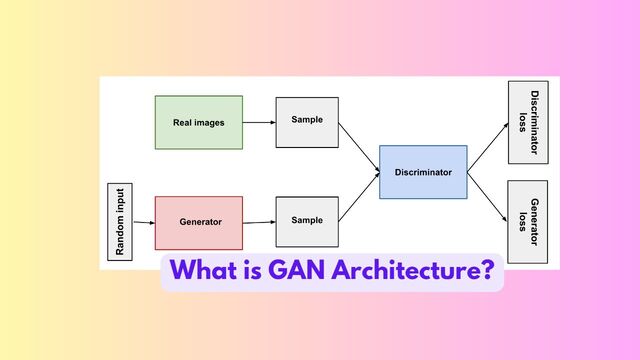
A GAN (generative adversarial network) is two neural networks that train against each other. Ian Goodfellow and co-authors introduced this in 2014. One network is the generator. The other is the discriminator. Together they can make images, video, or audio that look like real data.
If you want a one-page start on this blog, see Start Here. For a shorter intro, see What is GAN?. For how GANs sit next to LLMs and transformers, see LLMs, GANs, and Transformers.
GAN diagram#
This is the loop. Noise goes in. A fake sample comes out. The discriminator compares it to real data and scores real or fake. That score updates both networks.
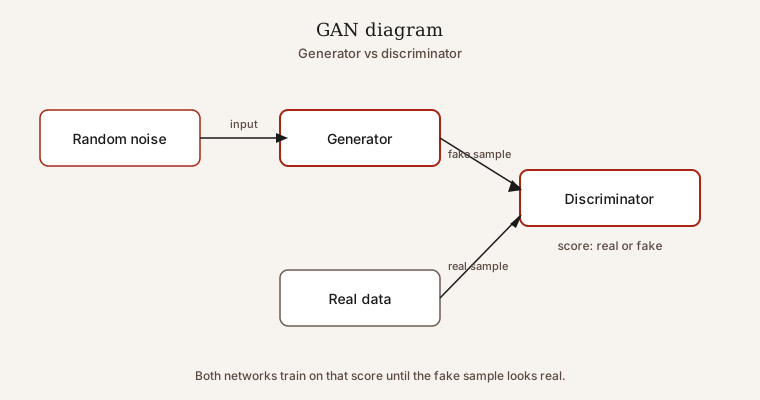
flowchart TD
  noise[Random noise] --> G[Generator]
  G -->|Fake sample| D[Discriminator]
  real[Real data] --> D
  D -->|Score: real or fake| train[Training signal]
  train -->|Update generator| G
  train -->|Update discriminator| D
Generator. It takes random noise and builds a sample. At first the sample is poor. After many rounds it looks more like the training data.
Discriminator. It sees real samples from a dataset and fake samples from the generator. It learns to say which is which.
They train together. The generator tries to fool the discriminator. The discriminator tries not to be fooled. The loop stops being useful when the fake sample is hard to tell from the real one.
GANs are used for image synthesis, style transfer, and text-to-image work. The tables below list common papers and what each variant does.
GAN Paper Summary#
| # | GAN | Date | Architecture Type | Research Organization | Paper | Author Name |
|---|---|---|---|---|---|---|
| 1 | AAE Paper | 2016 | GAN | University of Montreal | Adversarial Autoencoder | Alireza Makhzani et al. |
| 2 | cGANs Paper | 2014 | GAN | University of Montreal | Conditional GAN | Mehdi Mirza and Simon Osindero |
| 3 | CycleGAN Paper | 2017 | GAN | University of California, Berkeley | Cycle-Consistent GAN | Jun-Yan Zhu et al. |
| 4 | DCGAN Paper | 2015 | GAN | OpenAI | Deep Convolutional GAN | Alec Radford et al. |
| 5 | DiscoGAN Paper | 2017 | GAN | Seoul National University | DiscoGAN | Taeksoo Kim et al. |
| 6 | EGAN Paper | 2018 | GAN | The Chinese University of Hong Kong | Energy-Based GAN | Zhaoxin Li et al. |
| 7 | GAN Paper | 2014 | GAN | University of Montreal | Generative Adversarial Network | Ian Goodfellow et al. |
| 8 | IsGAN Paper | 2017 | GAN | Carnegie Mellon University | Improved-Synthesis GAN | Zhiting Hu et al. |
| 9 | Large Scale GAN Paper | 2018 | GAN | University of Edinburgh | Large Scale GAN Training for High Fidelity Natural Image Synthesis | Andrew Brock et al. |
| 10 | LSGAN Paper | 2017 | GAN | University of California, Berkeley | Least Squares GAN | Xudong Mao et al. |
| 11 | PGAN Paper | 2017 | GAN | NVIDIA | Progressive Growing of GANs | Tero Karras et al. |
| 12 | pixelRNN Paper | 2016 | GAN | Google DeepMind | Pixel Recurrent Neural Networks | Aaron van den Oord et al. |
| 13 | StackGAN Paper | 2017 | GAN | Carnegie Mellon University | StackGAN | Han Zhang et al. |
| 14 | StyleGAN Paper | 2019 | GAN | NVIDIA | StyleGAN | Tero Karras et al. |
| 15 | text-to-image Paper | 2016 | GAN | University of Michigan | Generative Adversarial Text-to-Image Synthesis | Scott Reed et al. |
| 16 | WGAN Paper | 2017 | GAN | New York University | Wasserstein GAN | Martin Arjovsky et al. |
GAN Capabilities#
| # | GAN | Objective | Summary | NLP Tasks | CV Tasks |
|---|---|---|---|---|---|
| 1 | AAE | Adversarial Autoencoder | A type of autoencoder that combines generative and discriminative models through an adversarial process. | - | Image Generation |
| 2 | cGANs | Conditional Generative Adversarial Networks | A generative model that can generate samples conditioned on specific input conditions or labels. | - | Image Generation, Image-to-Image Translation |
| 3 | CycleGAN | Cycle-Consistent Generative Adversarial Network | A model for image-to-image translation that learns mappings between two domains without paired training data. | - | Image-to-Image Translation |
| 4 | DCGAN | Deep Convolutional Generative Adversarial Network | A deep convolutional neural network architecture for training generative models using GANs. | - | Image Generation |
| 5 | DiscoGAN | Discover Cross-Domain Relations with GANs | A GAN-based model that learns to map images between different domains without paired training data. | - | Image-to-Image Translation |
| 6 | EGAN | Energy-Based Generative Adversarial Network | A generative model that assigns an energy score to each sample and generates samples with low energy. | - | Image Generation |
| 7 | GAN | Generative Adversarial Network | A framework that consists of a generator and a discriminator network that compete in a two-player min-max game. | - | Image Generation |
| 8 | IsGAN | Improved Wasserstein GAN | A variation of the Wasserstein GAN that improves stability and convergence during training. | - | Image Generation |
| 9 | Large Scale GAN | Large Scale Generative Adversarial Network | GAN models that are designed for generating high-resolution and complex images. | - | Image Generation |
| 10 | LSGAN | Least Squares Generative Adversarial Network | A GAN variant that uses least squares loss functions to improve the training stability and reduce mode collapse. | - | Image Generation |
| 11 | PGAN | Progressive Growing of GANs | A training technique for GANs that gradually increases the size of generated images during training. | - | Image Generation |
| 12 | pixelRNN | Pixel Recurrent Neural Network | A generative model that generates images pixel by pixel using recurrent neural networks. | - | Image Generation |
| 13 | StackGAN | Stack Generative Adversarial Networks | A model that generates high-resolution images in a two-step process, first generating low-resolution images and then refining them. | - | Image Generation |
| 14 | StyleGAN | Style-Based Generative Adversarial Network | A GAN architecture that uses a learned latent space to control the style and appearance of generated images. | - | Image Generation |
| 15 | text-to-image | Text-to-Image Synthesis | Models that generate images from textual descriptions or captions. | Text Generation, Image Generation | Image Generation |
| 16 | WGAN | Wasserstein Generative Adversarial Network | A GAN variant that uses Wasserstein distance as a loss function to improve training stability. | - | Image Generation |
Hashtags#
#GAN #GANArchitecture #GenerativeAI #DeepLearning #NeuralNetworks #ComputerVision #StyleGAN #DCGAN #MachineLearning #DasarpAI
Comments: