
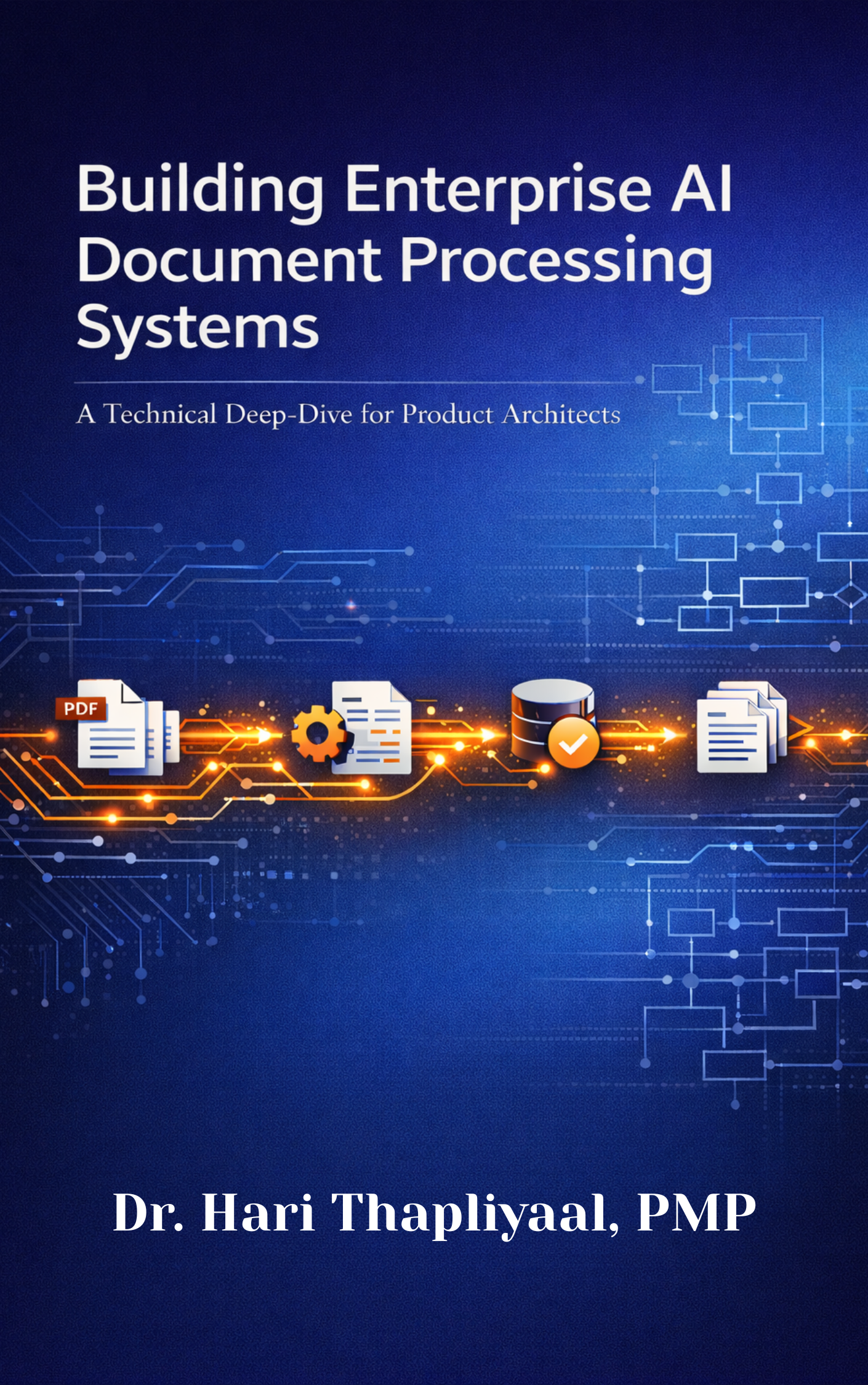
Book: Building Enterprise AI Document Processing System#
A Technical Deep-Dive for Product Architects
Kindle Read/Buy Link - India
Kindle Read/Buy Link - US
Kindle Read/Buy Link - UK
This book is a practical, architecture-minded guide to enterprise AI document processing systems: how organizations turn heterogeneous documents—PDFs, scans, forms, email, and more—into reliable, governable, and cost-aware automation. It is written for product architects, platform owners, and technical leaders who must connect business outcomes to real system design, not just slide decks or proof-of-concept notebooks.
What you will find inside#
- From intake to insight: ingestion, normalization, quality checks, and how failure modes show up in production.
- Structure and understanding: document layout, chunking strategies, metadata, and when “simple” pipelines beat over-engineered stacks.
- Intelligent extraction and Q&A patterns: where retrieval-augmented generation, summarization, and traditional extraction each earn their place—and where they do not.
- Trust, risk, and compliance by design: provenance, human-in-the-loop, audit trails, and alignment with common enterprise expectations.
- Operating the system: performance, cost, observability, and iteration loops so a pilot can grow into a durable product.
Whether you are rationalizing a vendor tool, building on cloud services, or charting a multi-year document-AI program, the aim is the same: clarity in trade-offs, honest limits of models, and a path to value that survives contact with real enterprise workload.
The 700+ pages book is organized into 10 parts with 29 numbered chapters. Part X adds reference materials (an alphabetical index and a glossary), not additional numbered chapters.
Part I: Foundation & Architecture (Chapters 1–6)#
Core principles, patterns, and architectural choices that every later layer depends on: why naive approaches break at scale, a multi-stage pipeline (cost and performance), modular monolith with event-driven and clean-architecture leanings, service boundaries, document-type abstraction, a shared core SDK, and single-source configuration.
- Chapter 1: The Challenge — Why traditional approaches fail at scale and what enterprise document processing really requires
- Chapter 2: The Complete Document Processing Pipeline Architecture — Multi-stage pipeline: in the system described, on the order of 90%+ lower cost and 5–10× better performance than an unstructured baseline
- Chapter 3: Architecture Decision-Making and Service-First Pattern — Comparing options; modular monolith, event orientation, and a service-first layout for independently evolvable services
- Chapter 4: Document Type Abstraction Framework — Factory-style patterns and naming conventions that limit churn when new document types appear
- Chapter 5: Core SDK Pattern — Central utilities shared by all services to remove duplication
- Chapter 6: Configuration Management — One environment-aware configuration model across the system
Part II: Database & Data Management (Chapters 7–9)#
Data persistence that matches a service-first architecture: consistent schema and code, and dependable patterns for enterprise-scale document data.
- Chapter 7: Database Architecture Patterns — Centralized DB management, connection pooling, and schema organization
- Chapter 8: Data Model Consistency — Pydantic models aligned with the database; validation and type safety
- Chapter 9: Master Data Patterns — Unified master-data service, standard CRUD, and how the frontend plugs in
Part III: Performance & Scalability (Chapters 10–14)#
Processing large document volumes: parallelism, long-lived ML workers, query shape, caching, and scaling out.
- Chapter 10: Parallel Processing Patterns —
ThreadPoolExecutorversusasyncio.gather, worker count guidance, and a worked example (for example, ~270s → ~45s in one path described in the book) - Chapter 11: Persistent Worker Architecture — Long-lived workers so models stay warm; example improvement on the order of 5.7× in the case study discussed
- Chapter 12: Database Query Optimization — Batching, fixing N+1 access, and reusing connections
- Chapter 13: Caching and State Management — In-memory cache design, progress tracking, and state sync
- Chapter 14: Horizontal Scaling Architecture — Multi-machine setup, capacity planning, and a 10,000 documents/day–class framing for scale
Part IV: Field Extraction System (Chapters 15–19)#
Turning raw document text into structured, validated fields: prompts, multiple LLM providers, modalities, and schemas.
- Chapter 15: Field Extraction Architecture Overview — End-to-end path: prompt → model → parse → validate → persist
- Chapter 16: Multi-Provider LLM Client Architecture — One client surface across major cloud and model vendors
- Chapter 17: Prompt Engineering and Management — Templates, schema-aware construction, and line-level references
- Chapter 18: Multi-Modal Extraction (Text-First, Image Fallback) — When to use text versus vision, including DPI and layout trade-offs
- Chapter 19: Schema-Based Validation Framework — YAML- or registry-driven schemas, type checks, and business rules
Part V: Machine Learning Integration (Chapters 20–22)#
Embeddings, model lifecycle, and cost discipline behind classification and extraction.
- Chapter 20: Embedding Service Architecture — Centralized embeddings (including domain-tuned options such as FinBERT for finance)
- Chapter 21: ML Model Management — AutoGluon, versioning, and safe deployment patterns
- Chapter 22: LLM Cost Management and Optimization — Cost accounting, token monitoring, and budget guardrails
Part VI: Analytics & Entity Discovery (Chapters 23–25)#
Making extractions useful: analytics surfaces, traceability, and automating master-data population.
- Chapter 23: Analytics Dashboard System Architecture — 14+ dashboard areas (e.g. capital call, reconciliation, tax, portfolio), shared theming, and near real-time updates
- Chapter 24: Drill-Down System — From aggregate metrics to document, page, and line for auditability
- Chapter 25: Entity Discovery and Master Data Auto-Population — Using AI to suggest or fill master-data records from extracted text
Part VII: Frontend Architecture (Chapters 26–27)#
UIs that fit the same APIs and operations patterns as the backend.
- Chapter 26: Frontend-Backend Integration — API clients, TypeScript safety, errors, and live updates
- Chapter 27: UI Component Patterns — Master screens, modals, tables, theming, and long-running job progress in the UI
Part VIII: AI-Assisted Development (Chapter 28)#
How the book (and the system) were co-developed with AI tools, without giving up architecture and domain judgment.
- Chapter 28: AI-Assisted Development Patterns — When AI is appropriate (structure, refactors, boilerplate) versus when it is not (subtle domain rules), plus validation habits and lessons learned
Part IX: Sources & Attribution (Chapter 29)#
Ethical citation and a path to deeper reading.
- Chapter 29: Sources & Further Reading — Per-chapter references, general resources, repository notes, and acknowledgments
Part X: Reference Materials (Index and glossary)#
Not numbered as chapters; supports navigation and shared vocabulary.
- Index — Key terms, patterns, document types, stack items, and metrics, with chapter pointers
- Glossary — Definitions with context and chapter references

Comments: