
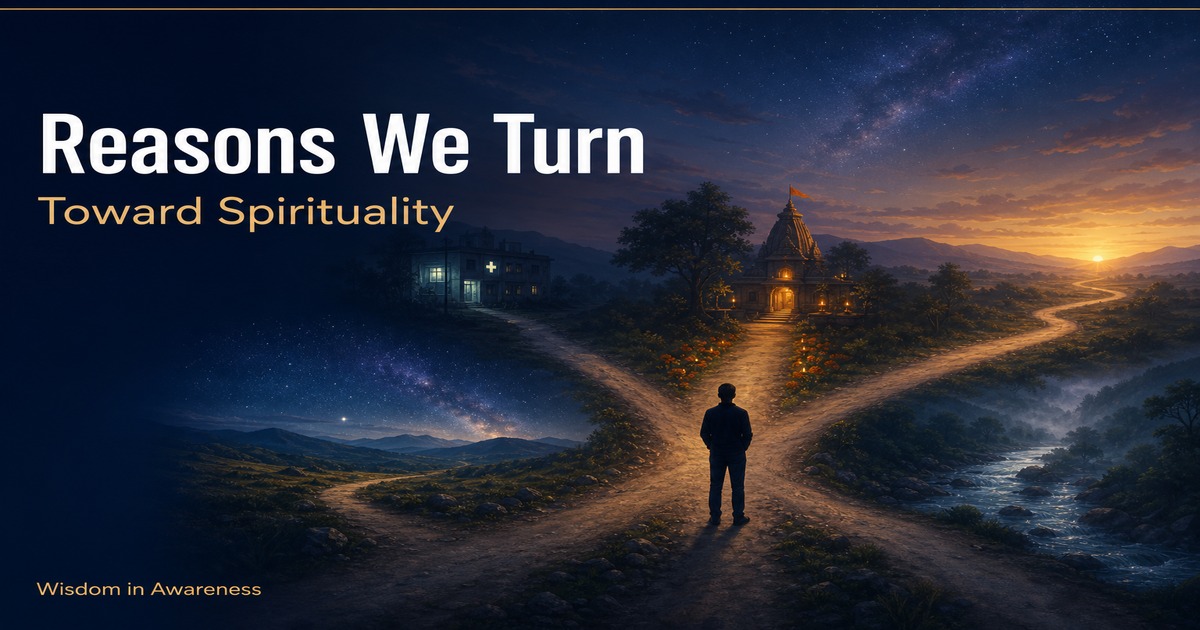
Different Reasons People Turn Toward Spirituality — From Suffering to Truth#
Human beings do not turn toward spirituality for the same reason. Some are pushed by suffering, some by love, some by fear, some by curiosity, and some by an intense longing to know the truth of existence itself.
For one person, spirituality begins in a hospital room. For another, it begins after the death of a loved one. For someone else, it may begin in deep devotion toward a deity, in philosophical inquiry, or in the silent wonder produced by the stars, nature, or the mystery of consciousness.
This diversity is important to understand because spirituality is often presented as if everybody is seeking the same thing. They are not.
Some seek peace.
Some seek healing.
Some seek emotional support.
Some seek meaning.
Some seek transformation.
Some seek power, clarity, or success.
And a rare few seek Truth itself — that which remains beyond changing experiences, beliefs, emotions, body, and mind.
None of these starting points are “wrong.” Human beings begin wherever they are, with whatever life has given them. Spirituality often evolves gradually. Fear may become inquiry. Attachment may become devotion. Suffering may become wisdom.
What matters is not merely where one begins, but whether the journey deepens.
Two Dimensions of Spiritual Journey#
Almost every spiritual journey can be understood through two dimensions:
- Initial Trigger — what starts the movement toward spirituality.
- Highest Spiritual Expression — what the person eventually realizes, embodies, or seeks.
These two are often very different.
A person may begin with grief and end in wisdom.
Another may begin with attachment and end in devotion.
Another may begin with intellectual curiosity and end in direct inquiry into consciousness itself.
This distinction helps us understand both ordinary people and great spiritual personalities more deeply.
Different Starting Points That Lead People Toward Spirituality#
| Starting Point | Inner Human Experience | Possible Spiritual Direction |
|---|---|---|
| Suffering and pain | Illness, grief, insecurity, emotional collapse | Healing, surrender, liberation seeking |
| Fear of death and impermanence | Mortality, uncertainty, aging | Existential inquiry |
| Attachment and relationships | Love, heartbreak, longing | Devotion and Bhakti |
| Curiosity and intellectual inquiry | Desire to understand reality | Philosophy and self-inquiry |
| Wonder and awe | Beauty, mystery, cosmos | Contemplation |
| Search for meaning | Emptiness despite success | Purpose and inner maturity |
| Desire for self-transformation | Discipline, ethics, self-mastery | Yoga and spiritual practice |
| Mystical experiences | Deep meditation, visions, altered states | Direct spiritual seeking |
| Social suffering and compassion | Sensitivity toward injustice and suffering | Service and Dharma |
| Desire for success or stability | Stress, ambition, uncertainty | Practical spirituality |
| Cultural and family influence | Tradition and inherited beliefs | Religious participation |
| Devotional attraction | Emotional connection with deity or Guru | Bhakti and surrender |
| Rational doubt and skepticism | Need for verification | Experiential spirituality |
| Search for Truth | “What is ultimately real?” | Self-realization and liberation |
These categories are not rigid. A person may move through many of them during life. Spirituality is often a process of maturation.
Spirituality Born from Suffering and Fear#
For many people, spirituality begins when ordinary life stops feeling stable.
A serious illness, financial collapse, anxiety, emotional breakdown, family conflict, betrayal, loneliness, or the death of a loved one can deeply shake human certainty. The person suddenly realizes that control over life is limited.
This is one reason why suffering has historically become one of the most powerful gateways to spirituality.
Many people first pray sincerely only when they feel helpless.
A person going through severe health issues may begin asking:
- Why is this happening?
- What is the meaning of suffering?
- Is life only this body?
- What remains when everything changes?
This existential shock is also visible in the life of Gautama Buddha. Seeing old age, sickness, and death shattered the illusion of permanent worldly happiness. His journey began not from abstract philosophy, but from direct confrontation with impermanence and suffering.
Suffering often breaks the unconscious assumption that worldly life alone can provide lasting security. What begins as pain relief may eventually become a deeper search for freedom and understanding.
Spirituality Born from Attachment, Love, and Relationships#
Not all spirituality begins from suffering alone. Sometimes it begins from intense emotional attachment.
The life of Tulsidas is a famous example. Tradition says he was deeply attached to his wife. Her sharp words — questioning why such intensity could not be directed toward Rama — became a turning point in his life. Human attachment transformed into divine devotion.
Similarly, Mirabai developed deep devotional love toward Krishna from childhood. What began as emotional attraction toward a Krishna murti gradually became complete surrender and Bhakti.
This reveals something psychologically profound:
Spirituality does not always begin from purity or detachment. Sometimes it begins from ordinary human emotions redirected toward something deeper.
Human love, longing, attachment, and emotional intensity can evolve into devotion, surrender, and transcendence.
Spirituality Born from Curiosity and Intellectual Inquiry#
Some people are not driven primarily by emotional pain or devotion. They are driven by questions.
What is reality?
What is consciousness?
How does the universe function?
What is time?
What is existence?
Such seekers may initially appear philosophical or scientific rather than spiritual.
Many great scientists carried a deep sense of wonder about existence. Albert Einstein often spoke about awe toward the mysterious order of the cosmos. Isaac Newton spent enormous effort not only on physics but also on theology and alchemy.
Similarly, Swami Vivekananda approached spirituality with rational inquiry and skepticism. He did not want blind belief. His famous question — “Have you seen God?” — reflects the temperament of someone seeking verification rather than inherited faith.
Science investigates the external universe. Spiritual inquiry eventually asks another question:
Who is the knower experiencing this universe?
Some seek to know reality through matter, mathematics, and observation. Others ultimately turn inward toward consciousness itself.
Spirituality Born from Devotion and Mystical Longing#
For some individuals, spirituality is not intellectual at all. It is relational, emotional, and experiential.
Ramakrishna represents this category deeply. His longing for direct experience of the Divine Mother was so intense that spirituality for him was not merely doctrine or ritual — it was living experience.
Similarly, Guru Nanak’s path began in devotional song and remembrance of the Divine Name, which deepened into complete surrender and living intimacy with the One.
For such personalities, spirituality becomes:
- surrender,
- love,
- mystical absorption,
- compassion,
- and direct inner experience.
Their relationship with the Divine is not theoretical. It becomes existentially real.
Spirituality Born from Search for Meaning and Transformation#
Modern life has created another powerful doorway toward spirituality: inner emptiness despite external success.
A person may achieve:
- career success,
- wealth,
- status,
- social recognition,
and still feel psychologically restless.
Many businesspeople, professionals, leaders, and ambitious individuals begin spirituality seeking:
- mental peace,
- emotional balance,
- clarity,
- stress reduction,
- discipline,
- productivity,
- or better decision-making.
Initially, spirituality may be practical.
But over time, some begin realizing that external achievement alone cannot answer deeper human questions. Success may improve comfort, but it does not automatically resolve loneliness, fear, confusion, or existential dissatisfaction.
This leads many toward self-transformation:
- yoga,
- meditation,
- ethical living,
- mindfulness,
- self-observation,
- and inner discipline.
Spirituality Born from Compassion and Social Sensitivity#
Some people turn toward spirituality not because of their own suffering, but because they become deeply sensitive to the suffering of others.
Social inequality, injustice, exploitation, violence, and human pain awaken compassion.
Spirituality then expresses itself through:
- service,
- ethical living,
- social reform,
- education,
- protection of dignity,
- and compassionate action.
This dimension is visible in figures like Basavanna and Ramanuja. Basavanna, in the twelfth-century bhakti movement, linked devotion with dignity of labor and a sharp challenge to caste pride and social cruelty. Ramanuja, in the Vaishnava tradition, is remembered not only for philosophical depth but for insisting that the path of God must be open to ordinary seekers—not reserved for a privileged few. In both cases, spirituality did not remain private; it became reform, inclusion, and care for human dignity.
In such cases, spirituality becomes Dharma in action.
Spirituality Born from Wonder and Awe#
Not every spiritual journey begins in pain.
Sometimes spirituality begins in silence, beauty, and wonder.
A person looking at the night sky, listening to profound music, observing nature, contemplating mathematics, or reflecting on consciousness may experience deep awe.
This wonder can gradually become contemplation.
The human mind begins asking:
- Why does anything exist at all?
- Why is the universe intelligible?
- Why does consciousness exist?
- What is this mysterious experience of being alive?
Wonder itself can become meditation.
The Highest Spiritual Goal — Search for Truth#
All spiritual motivations discussed above are meaningful and human.
People begin where they are:
- in suffering,
- in love,
- in confusion,
- in curiosity,
- in devotion,
- in fear,
- in wonder,
- or in longing for transformation.
But spiritual traditions across the world repeatedly point toward a deeper possibility:
the search for Truth itself.
Not merely temporary relief.
Not merely emotional comfort.
Not merely success or mystical experience.
But:
- What is ultimately real?
- Who am I beyond body and mind?
- What changes and what does not?
- What is consciousness?
- What is death?
- Is there something beyond perception and thought?
Few begin spirituality with this highest question. Most begin with immediate human concerns. Yet sincere seeking can gradually mature into deeper understanding—as with Gautama Buddha, already discussed above: princely comfort, then the four sights, then a path that did not stop at relief but pressed toward liberation and the nature of reality.
Some temperaments, however, seem oriented toward Truth from the start—not mainly to escape pain, win comfort, or fill an inner lack.
Nachiketa in the Katha Upanishad is a classic example. He goes to Yama and asks what survives death. He is not bargaining for worldly gain; he refuses pleasant distractions and keeps returning to one question: what is ultimately real?
Adi Shankaracharya presents a different picture in traditional biography. His father Shivaguru is said to have died while the boy was still very young—hagiographies often place this in early childhood, though details vary across sources. His mother Aryamba raised him in modest circumstances and taught him the Vedas. Household loss and hardship were real, but the accounts do not mainly portray him as a grief-driven seeker. What stands out is precocious mastery of scripture, an unusual pull toward the Upanishads, and an early resolve toward renunciation and Brahman—inquiry into what is real—rather than a life that began in the hunt for relief, success, or emotional consolation.
Figures like these matter because their inquiry was not limited to better living. It extended toward the nature of reality itself.
Perhaps spirituality truly deepens the moment a person becomes willing to ask honestly:
What is true beyond my fears, desires, beliefs, emotions, and perceptions?
And perhaps that question itself marks the beginning of wisdom.
Hari Om Tat Sat
Yours Truly Hari

Comments: