
Laws of Existence: Understand, Align, and Harness#
Wisdom is understanding the laws of existence. Skill is aligning our actions with those laws. Success is harnessing their power without wasted struggle.
None of the laws below was given to humans. None was revealed to humans.
People paid attention. They watched what is outside: nature, society, and the market. They watched what is inside: the dance of the mind, and its restlessness. Thoughts move. Wants rise. Fear does not sit still.
Over a long time, wise people discovered some of these laws, invented some, and drafted some. They did this for the well-being of humans.
Different kinds of laws#
| Type | How it came | Examples |
|---|---|---|
| Natural laws | Discovered by watching nature | Gravity, heat, electricity |
| Mathematical laws | Invented by reasoning about number, shape, and chance | Algebra, geometry, probability |
| Legal laws | Drafted by people who govern | Constitution, criminal law, taxation |
| Economic laws | Discovered by watching markets | Supply and demand, diminishing returns |
| Cultural laws | Invented and kept through tradition | Marriage, mourning, celebrations |
| Social laws | Invented as shared expectations of conduct | Respect, reciprocity, etiquette |
| Moral laws | Discovered by watching harm, care, and the restless mind | Honesty, justice, compassion |
| Religious laws | Drafted by people, then kept as scripture and duty | Commandments, religious duties |
| Organizational laws | Drafted inside institutions | Policies, procedures, responsibilities |
| Personal laws | Drafted by a person for their own life | Habits, commitments, personal principles |
The rows overlap. A moral demand can become a legal rule. A religious duty can become a social expectation. The work behind them is still human work.
Diminishing returns is a plain market pattern. After a point, each extra unit of effort adds less than the one before it.
What people watched#
Outside. They watched nature: falling bodies, heat, storms, crops, and disease. They watched society: how people live together, care for children, quarrel, and answer harm. They watched the market: what people trade, what grows scarce, and what a price does when many people want the same thing.
Inside. They watched the mind. It dances. It wants, fears, remembers, and plans. It does not sit still. That restlessness is not a small private fact. Moral laws, religious duties, and personal rules come from watching it, and from watching the harm it can do.
No outside power handed them a finished list. Attention came first. The law came after.
Discovered, invented, or drafted#
Discovered. The pattern was already in the world. People watched until they could say it in a sentence others could test. A stone falls. When a useful thing grows scarce and many people want it, the price rises. The event was there before the sentence. The law is the sentence. People discovered it. They did not receive it.
Invented. People made a tool that was not lying in the field as a finished statement. Algebra, geometry, and probability let people state number, shape, and chance exactly. A form of marriage, a way of mourning, and a feast let people share a life. People invented these so life could be counted, built, and lived together.
Drafted. People wrote a rule on purpose. A constitution, a tax, a company policy, a personal promise. The words are human words. When a drafted law stops serving human well-being, people can draft a better one.
Religious laws belong with drafted laws. People watched birth, death, fear, hope, and the restless mind. They wrote commandments and duties. Later communities kept those writings as scripture and treated them as sacred. The respect can be real. The writing was still human work. It was not a finished law revealed from outside human life.
Three jobs a law can do#
- Describe. What happens? Natural laws and economic patterns say how a system behaves. If a careful test disagrees, the statement is wrong. Change the statement. You cannot vote a stone into staying in the air.
- Prescribe. What should people do? Legal, cultural, social, moral, and religious rules guide conduct. People can break them. Sometimes they should, when the rule harms human well-being.
- Follow from starting rules. What follows if we accept these starting rules? A mathematical statement is true inside the system people built. Change the starting rules, and a different result can follow.
Understanding is a kind of power#
No one revealed the laws of gravity, electricity, or heat. People discovered the patterns by watching, testing, and reasoning.
Once the pattern was clear, people could use it.
People did not cancel gravity to build aircraft. They learned how falling and lift work, and they built machines that fly.
People did not cancel a river to make electricity. They learned how moving water behaves, and they put that movement to work.
The same holds for human systems.
If you understand a legal system, you can protect your rights. If you understand a market, you can see how wealth is made and lost. If you understand social and cultural expectations, you can build relationships. If you understand your own mind, you can build discipline and some peace.
Knowledge of a system’s laws increases what you can do inside that system.
Alignment is not blind obedience#
You want to cross a river.
You can fight the current and wear yourself out. Or you can learn the flow, the depth, and the direction, and use that knowledge to reach the other side.
You have not given up your aim. You have matched your action to the river as it is.
A sailor cannot order the wind. A sailor can set the sails and still choose the port.
That is alignment.
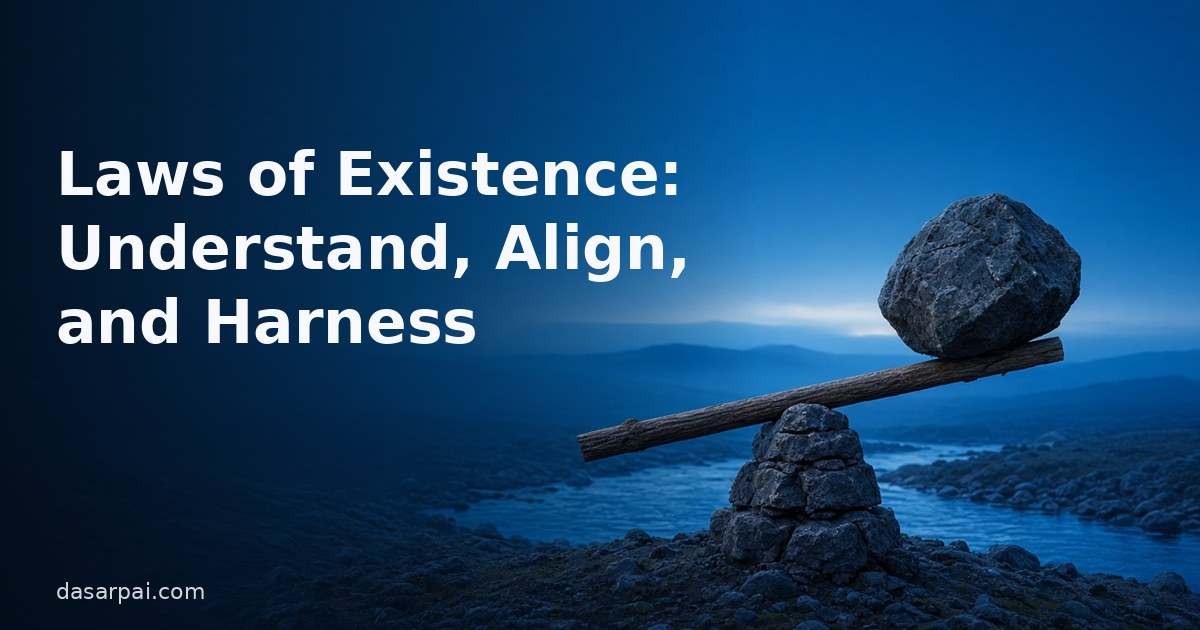
You are working toward a goal. If your actions line up with these laws, you are not alone in that work. Part of the force comes from the law itself. The law works as a lever. A lever is a simple bar: a small push at the right place moves a heavy weight. Your effort stays yours. The law supplies the rest.
Without that understanding, even a small piece of work becomes a struggle. You push against the way the thing already moves. The whole load stays on you.
The lever adds force to the goal you already have. A person who sees the system clearly gets more of that force. A greedy person who sees it clearly gets more of it too. Intelligence makes the lever longer. The choice of which weight to move belongs to a higher guide. Dharma sits above these laws.
It does not mean you accept every rule. A drafted law can be unjust. A custom can grow stale. An institution can start to serve itself. Understanding a system is also what lets you change it.
Alignment means this: learn the laws of a system before you decide to work inside it, or to change it.
Dharma sits above the other laws#
Indian thought uses the word dharma for conduct that holds life together. It includes duty, fairness, and care. Dharma is not one more revealed law above the list. The other laws sit below it. People discovered those laws, invented them, or drafted them so life could go better. Dharma is the higher guide you use when a lower law harms people, when two laws conflict, or when your wish and someone else’s well-being split. Wise people came to it by watching what holds a life together and what tears it apart.
Follow a law, and you gain some force. Refuse an unjust law, and you may face danger: loss, punishment, prison. That gain is real. That danger is real. Both are small next to the force you gain when you understand dharma. A lower law helps one task. Dharma tells you which task is worth that help, and which danger is worth facing. That is the larger lever.
Science shows this kind of order. A careful test sometimes disagrees with a law of physics. Scientists do not throw away mathematics. They ask whether some condition was left out or read wrongly. Friction, heat, or a force they did not measure can make a true pattern look false. The physics is not yet fully understood. Mathematics still guides the search.
A statute, a custom, or your own reading of a situation can fail in that same way. Obedience may be rewarded. Refusal may be punished. Those facts do not settle the question. Keep dharma as the guide, and ask which condition the lower law has missed. The missed condition is often who pays, who cannot speak, or a harm that arrives later.
The judgment still moves. Three things move it.
Intelligence. A sharper mind sees more paths. It also tells a better story about why its own path is right. The story can fool the person who tells it.
Moral values. People grow up inside different lists of right and wrong. A family, a culture, or a religion drafted each list. One list can call an act a duty. Another list can call the same act harm. The feeling of being moral often means only this: the act matches the list I already have.
Greed. Greed shrinks well-being to my gain, and to gain soon. Then it borrows the words of duty. I earned this. My people come first. The rule allows it. The wish stays the same. The name changes to dharma.
The lever makes all three more serious. The same alignment that helps a careful aim also gives force to a selfish one. A greedy person who understands the laws is harder to stop, and harder to correct, because the work succeeds.
Dharma takes care of this by a test that sits outside the feeling of being right.
Name the goal in one sentence. Name the law you are lining up with. Name who gains and who pays, including people who cannot push back. Then ask three questions.
Would I still call this right if I could not hide it, and if I were no more clever than the people who pay? If the answer changes, intelligence was wearing the name of dharma.
Does this hold life together for the people the act touches, or only for my group and the list I inherited? If it holds life together only for my group, that moral value is too narrow.
If the personal gain were taken away, would I still do this and still call it duty? If the duty disappears with the gain, the judgment was greed.
When the answers stay the same, the aim can use the lever. When they change, leave the lever unused. The law will help a bad aim just as readily as a good one.
The law itself may be unjust.
A government may write a law that harms a group of people, or that denies them basic dignity.
You can obey and avoid punishment. You can resist and risk prison or worse. A sharp mind sees the punishment and calls obedience wisdom. Greed calls safety a duty. Ask who pays if people like you all obey. If a group loses basic dignity, the safe act fails the test.
You may find a gap in the law.
You may know a legal system so well that you see a gap. You can take a gain through that gap while other people pay the cost. The act can remain legal. You can become rich or powerful. This is the lever in a greedy hand. Intelligence found the gap. A moral list may even praise the cleverness. Take the gain away. If the duty vanishes with it, do not pull.
Legality is not morality. Obedience is not dharma. Cleverness is not wisdom.
Dharma judges the aim, not only the method. Sometimes it says: follow this law. Sometimes it says: resist this law, even at a personal cost. Sometimes it says: leave the gap unused, even when using it would be legal and profitable.
Wisdom is not only knowing how to gain from a system. It is knowing when to cooperate, when to resist, and when to stop yourself.
Wisdom, skill, and success#
One line holds the work:
Understand → Align → Harness → Achieve
- Understand. Learn the laws of the systems you live in. People discovered them, invented them, or drafted them by paying attention.
- Align. Line the action up with the laws, then run the dharma test. Cleverness, an inherited moral list, and greed can each rename a wish as duty.
- Harness. Use the added force only when that test still says yes. The lever moves the aim you have. It does not correct the aim.
- Achieve. Reach the aim with as little wasted struggle as you can.
Less wasted struggle does not mean less effort. It does not mean you avoid every conflict. Resistance to an unjust law can be the right action.
It means you do not struggle only because you do not yet know how the thing works. Without that knowledge, even a small task stays heavy. Nothing else helps you lift it. With it, the law works as a lever.
You live inside nature, society, culture, institutions, and your own mind. Each has laws. Wise people found them, made them, or wrote them so human life could go better.
Wisdom is understanding the laws of existence.
Skill is aligning our actions with those laws.
Success is harnessing their power without wasted struggle.
A lower law is a small lever. The danger of refusing an unjust law is small next to the lever of dharma. That larger lever is yours when you understand dharma. Dharma asks whether the success you want is worthy of the life it will shape.
Hari Om Tat Sat
Yours Truly Hari
Hashtags#
#LawsOfLife #HumanWellBeing #NaturalLaws #MoralLaws #Dharma #Wisdom #Society #Mind #Justice #SelfDiscipline #Philosophy

Comments: