Advaita Vedanta and Hans Peter Durr#
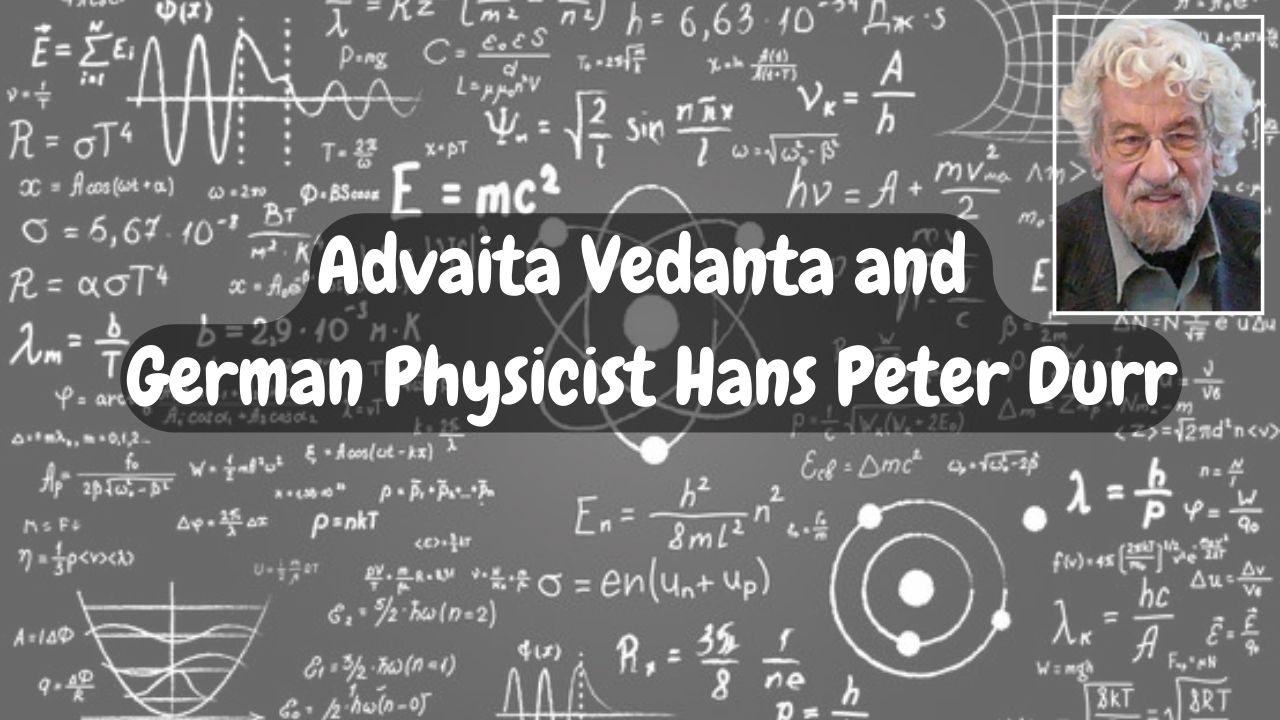
Hans-Peter Dürr (7 October 1929 – 18 May 2014), a renowned German physicist, had deep insights into the philosophical parallels between modern physics and ancient spiritual wisdom, particularly Vedanta. While Dürr did not explicitly write a comprehensive work focused solely on Vedanta, in his numerous interviews, lectures, and writings, he often discussed how the findings of quantum physics aligned with many ideas found in Vedanta and other Eastern philosophies.
From 1958 until 1976 he was a research associate of Werner Heisenberg, specializing in nuclear physics, quantum physics, elementary particles and gravitation epistemology and philosophy. He was Heisenberg’s closest ally in their attempts to develop a unified field theory of elementary particles. In 1962 he habilitated at the Ludwig Maximilian University in Munich. The same year he was a guest professor in Berkeley, California and Madras, India.
Until 1997 he was professor of physics at the Ludwig Maximilian University in Munich. Between 1978 and 1997 he was executive Director of the Max Planck Institute for Physics (Werner-Heisenberg-Institute) and Max Planck Institute for Astrophysics in Munich several times.
Here are a few key ideas that Dürr highlighted in relation to Vedanta:
1. Non-Duality and Interconnectedness#
Dürr frequently spoke about the non-dual nature of reality, which closely mirrors the Vedantic concept of Advaita (non-duality). He argued that at the quantum level, the universe is not composed of separate, isolated entities but is fundamentally interconnected. This unity of all things aligns with the Vedantic view that all of reality is an expression of a single underlying consciousness, known as Brahman.
He remarked:
- “Matter as we know it does not exist. All that exists is a web of relationships. In the Vedanta, this is called non-duality.”
This echoes the core Vedantic teaching that the division we perceive in the world (e.g., between self and other) is illusory, a product of limited perception, and that everything is connected in the ultimate reality.
2. Consciousness as Fundamental#
In Vedanta, consciousness is the foundational reality—everything else is seen as a manifestation or transformation of this consciousness. Dürr, influenced by his studies in quantum mechanics, proposed that matter is not the primary substance of the universe but rather that information, energy, or consciousness might be more fundamental than the physical world we perceive.
He once said:
- “What we have called matter is energy, whose vibration has been so lowered as to be perceptible to the senses. There is no matter.”
This statement resonates with Vedanta, where the material world is seen as a limited, lower-frequency manifestation of pure consciousness.
3. Maya and the Illusion of Matter#
Dürr expressed that what we perceive as solid, tangible matter is, at the quantum level, a kind of illusion. This is very similar to the Vedantic concept of Maya, which suggests that the world we experience through our senses is an illusion that hides the true nature of reality.
He suggested that:
- “Reality is not made out of things; it is made out of relations.”
In Vedanta, the world of forms and objects is seen as a temporary, ever-changing manifestation, while the underlying reality (Brahman) is constant, eternal, and formless.
4. The Observer and the Observed#
One of Dürr’s key discussions revolved around the role of the observer in quantum physics. He explained that at the quantum level, the act of observation affects the system being observed, blurring the line between subject and object. This is similar to Vedanta’s teaching that the separation between the observer and the observed is illusory because everything, including the observer, is part of the same ultimate reality.
In quantum mechanics, the duality between the observer and the observed becomes less clear, and this philosophical view ties closely to the Vedantic idea that everything, including the self, is part of one unified existence.
5. Integration of Science and Spirituality#
Dürr was an advocate for a holistic worldview that integrates science with spirituality. He believed that the scientific discoveries of the 20th century, particularly in quantum physics, were converging with the timeless insights found in spiritual traditions like Vedanta.
He emphasized:
- “The spirit is primary, and matter is derived from it.”
This reflects Vedanta’s view that the physical world is secondary to consciousness and that ultimate knowledge comes from transcending the material perspective to recognize the oneness of existence.
Summary#
Hans-Peter Dürr saw a profound convergence between quantum physics and Vedanta. He argued that both perspectives point to a reality that is interconnected, non-dual, and founded on something far more fundamental than physical matter—possibly consciousness itself. His work is often interpreted as a bridge between the scientific understanding of the universe and ancient spiritual insights, especially those found in Vedanta.
Also in this series: Quantum Physics and Vedanta; deeper questions with ChatGPT. Next: Zero, Point, Śūnya, and the Many Faces of Nothing (Part 5).
Hari Om Tat Sat
Yours Truly Hari
Comments: