
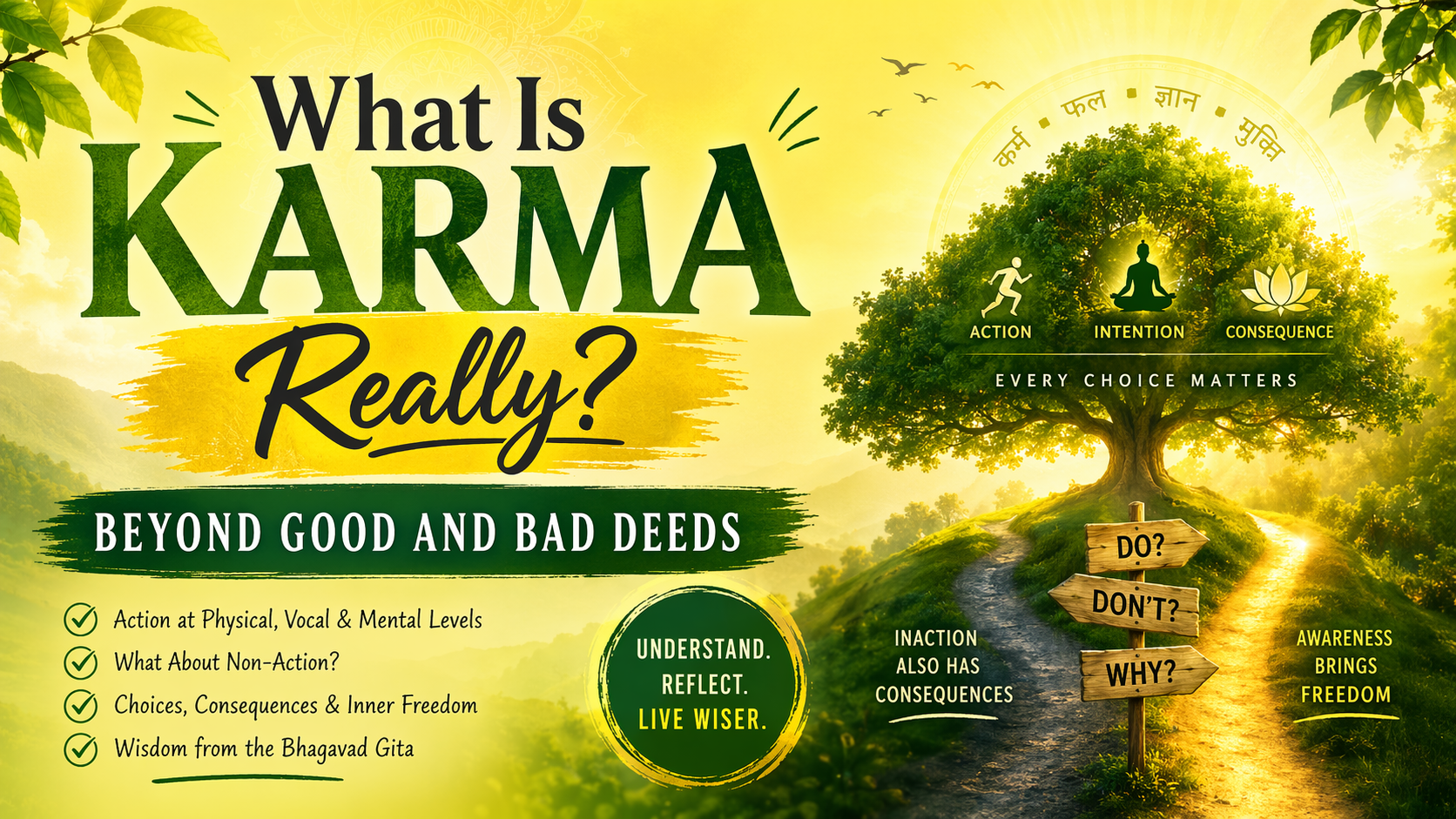
What Is Karma Really? Beyond Good and Bad Deeds#
Understanding Karma as Physical, Verbal, and Mental Action — and Asking Whether Non-Action Is Also Karma#
People use the word karma very casually.
“It is my karma.”
“He is suffering because of bad karma.”
“Do good karma and good things will happen.”
“This is fate.”
The word travels quickly through conversation, but very rarely do we stop and ask: what exactly are we talking about?
Is karma just reward and punishment?
Is it destiny?
Is it moral accounting?
Is it divine justice?
Is it fate from a previous life?
Or is it something much more immediate, much more intimate, and much more difficult than all these simplified ideas?
The trouble begins the moment we reduce karma to a slogan.
Karma is not a casual label to paste on pleasure and pain. It is not merely a way to explain why things happened. It is not only a consolation after suffering, nor a moral weapon to judge others. If we want to understand karma seriously, we must be willing to slow down and look at life more carefully.
Because karma is not only about what happens to us.
It is about action.
It is about consequence.
It is about omission.
It is about ignorance.
It is about response.
And perhaps most importantly, it is about the subtle ways in which a human being participates in the unfolding of life.
Karma Begins With Action#
At its root, karma means action.
That itself is already enough to correct much confusion.
Karma is not first some mysterious cosmic punishment waiting in the sky. It begins with action, with doing, with movement through life. But the moment we say this, another question appears. What counts as action?
If I lift a stone, that is obviously action.
If I speak, that is action.
If I think, desire, resent, imagine, judge, fear, or intend—are these also action?
Tradition answers clearly: yes.
Human beings act at different levels. We act through the body, through speech, and through mind.
A hand may strike or protect.
Speech may heal or wound.
Thought may bless or poison.
So karma is not limited to what is visible.
The body performs karma.
The tongue performs karma.
The mind performs karma.
This alone is enough to deepen the conversation. Most of us think of action only in physical terms. But a human being is not merely a moving body. A sentence can shape a life. A thought can shape a destiny. A hidden resentment can alter the texture of a relationship for years. A trust can open one future. A suspicion can close another.
Thus karma is already subtler than ordinary speech suggests.
And Then the Real Difficulty Begins#
The moment we understand karma as action, an even more difficult question emerges:
Is non-action also karma?
At first this sounds contradictory. If karma means action, how can non-action be karma? But life itself does not allow us to remain with easy definitions. Again and again, experience forces this question upon us.
We cook. That is karma.
But if we do not cook and simply sit waiting for someone else to cook for us, is that outside karma?
If no one cooks and hunger follows, what produced that result?
If someone cooked badly and others remained hungry or became unwell, whose karma is involved there?
We feed someone. That is karma.
But if a needy person stands before us and we do not feed them, does that absence have no consequence?
And if in feeding others we neglect our own legitimate need and remain hungry, what kind of karma is that? Service? Sacrifice? Imbalance? Confusion?
We trust someone. Is that karma? Certainly. Trust shapes vulnerability, closeness, risk, dependence, and future consequence.
Then what about not trusting someone? That too does not remain empty. Distrust protects in one case and wounds in another. It may save us from betrayal or imprison us in isolation. So both trust and distrust enter the field of karma.
We read and acquire knowledge. That reading is karma.
But what if we read and become more confused? Then reading has still borne fruit, though not the fruit we hoped for.
And if we do not read and therefore do not get confused, is that clarity? Or is it merely untouched ignorance? Absence of confusion is not always wisdom.
We meditate and become focused. That is one fruit.
We meditate and become tranquil. That is another fruit.
The outer action may look similar, but the fruit is different. The same seat, the same posture, the same duration—yet not the same result. Why? Because action is not merely outer form. Intention, maturity, preparation, state of mind, method, and inner receptivity all shape the fruit.
A child grows up separated from biological parents and believes that the people raising him are his real parents. Years later, by accident or inquiry, he discovers otherwise. By what karma did this knowledge come? Through another’s speech? Through his own search? Through hidden causes? Through circumstance? Through destiny? And once that knowledge arrives, the struggle between love, gratitude, identity, blood, memory, and belonging—what kind of karma is that? Past consequence? Present mental action? Both?
These are not merely intellectual puzzles. They arise from life itself. And they show why karma is not a shallow topic.
Even the Wise Are Confused#
The Bhagavad Gita does not pretend that karma is easy to understand. It says openly:
किं कर्म किमकर्मेति कवयोऽप्यत्र मोहिता: । तत्ते कर्म प्रवक्ष्यामि यज्ज्ञात्वा मोक्ष्यसेऽशुभात् ॥4.16॥
“What is karma? What is akarma? Even the wise are confused here.”
This is a striking admission. Even thoughtful people become confused about action and non-action. That itself should make us careful. If we are honest, much of our casual talk about karma is far too confident.
We see an event and instantly label it.
We see suffering and assign blame.
We see pleasure and call it good karma.
We see pain and call it bad karma.
But life does not reveal its meanings so quickly.
What looks beneficial today may prove harmful tomorrow.
What feels painful today may later become purifying.
What seems like kindness may be enabling weakness.
What seems harsh may be the beginning of truth.
What appears as success may hollow the mind.
What appears as loss may mature the heart.
So when we speak of good karma and bad karma, we must do so with humility. The quality of karma is not always obvious at the time of doing, not doing, or acting in ignorance. Often it becomes clearer only when the fruit unfolds before us.
Ignorance Does Not Cancel Consequence#
This is one of the most important points in any serious inquiry into karma.
In social and legal life, intention matters greatly. It should. There is a meaningful difference between deliberate cruelty and accidental harm. But in the larger order of reality, ignorance does not suspend consequence.
If I do not know fire burns, fire still burns.
If I do not know what damages the body, the body still suffers.
If I do not know how attachment binds the mind, the mind still gets bound.
If I do not inquire into confusion, confusion may continue.
Reality does not pause because I did not understand.
This is why ignorance cannot be treated as bliss in the karmic order. We may be unaware, unprepared, or uninformed, and yet results still arise. We may not know what we are setting in motion, but motion does not stop on account of our unawareness.
So karma is not only about what we knowingly choose. It is also about the consequences that arise from what we fail to see, fail to understand, fail to do, postpone, neglect, or leave unattended.
That does not mean every absence is karmically profound. But it does mean that omission, confusion, passivity, avoidance, and neglect can become karmically significant when they enter the chain of consequence.
The Litmus Test of Karma: Phala#
A useful way to approach karma is through phala, fruit or result.
If something participates in consequence, it belongs to the field of karma.
This gives us a deeper lens.
Action has fruit.
Non-action too has fruit.
Speech has fruit.
Silence has fruit.
Trust has fruit.
Distrust has fruit.
Reading has fruit.
Refusing to read has fruit.
Meditation has fruit.
Neglect has fruit.
Ignorance has fruit.
But the fruit is not always of the same kind.
Some actions bear immediate fruit.
Some bear delayed fruit.
Some delight first and damage later.
Some disturb first and clarify later.
Some omissions create suffering.
Some omissions prevent harm.
Some truths liberate.
Some truths first break the illusion before they free the mind.
So karma is not merely visible action. It is the broader field of causally significant participation in life.
That is why, in a deeper Vedantic sense, both action and non-action can be spoken of as karma. Not because stillness itself is action, but because what we call non-action often still enters the stream of consequence.
Good and Bad Are Not So Simple#
We often think the universe should come with moral labels already attached. But human life does not work that way.
At one stage of life, a thing appears good. Later it appears harmful. At one age, a certain ambition looks noble. Later it reveals itself as bondage. At one moment, refusal looks selfish. Later it is seen as wisdom. At one time, obedience looks virtuous. Later it appears as fear.
So when we ask, “Is this good karma or bad karma?” we must be aware that the answer is not always available at the moment of doing.
This does not mean there is no difference between wholesome and harmful action. It means that our perception of that difference is often clouded. Desire clouds it. Fear clouds it. Ego clouds it. Habit clouds it. Social conditioning clouds it. Short-term gain clouds it. Emotional hunger clouds it.
A person may act seeking pleasure and generate suffering.
A person may endure difficulty and move toward freedom.
A person may avoid confusion by avoiding inquiry.
Another may pass through confusion into clarity.
That is why karma cannot be understood only through moral vocabulary. It must be understood through lived unfolding.
Six Kinds of Karma#
These six are not merely labels. They show that karma is not one flat category. Some karma sustains life daily. Some arises only when an occasion comes. Some is driven by desire. Some is transformed by non-attachment. Some must never be done. Some becomes necessary only after error. Seen this way, karma is not just “good” or “bad”; it is a whole field of responsibility, motive, omission, consequence, and inner growth. Traditional and Gita-based sources together support exactly this layered understanding.
1. Nitya Karma (नित्य) — Daily Obligatory Karma
These are duties that should be done regularly as part of an ordered life. Traditional examples include daily disciplines such as sandhyā, svādhyāya, and other obligatory observances; in a broader modern rendering, this can include daily prayer, caring for one’s body, basic truthfulness, gratitude, and responsible conduct toward those who depend on us. Traditional discussions often say the main point of nitya karma is not some flashy reward, but prevention of decline through neglect; non-performance brings pratyavāya, the negative effect of omission.
Simple example: preparing food for your family every day, or caring daily for an elderly parent.
If you do it:
Short run: order, stability, reduced guilt, smoother life.
Long run: discipline, inner steadiness, trust from others, gradual purification of mind.
If you do not do it:
Short run: disorder, inconvenience, hunger, strain, avoidable disturbance.
Long run: negligence becomes character, relationships weaken, omission accumulates as inner dullness and outer disorder. Traditional teaching treats this non-performance itself as consequential.
2. Naimittika Karma (नैमित्तक) — Occasion-Based Karma
These are actions required by a particular occasion, event, or trigger. Traditional examples include rites connected with birth, death, annual remembrance, or remedial observances when a particular situation arises. In a broader reading, these are duties that are not daily but become binding when the moment calls for them.
Simple example: showing up when a parent is hospitalized, helping at a funeral, standing by a friend in crisis, or doing what is needed when a child faces a turning point in life.
If you do it:
Short run: relief, appropriateness, moral clarity, support where needed.
Long run: trust, gratitude, maturity, deepening of responsibility and relational dharma.
If you do not do it:
Short run: regret, hurt, abandonment, missed duty.
Long run: broken trust, unresolved guilt, weakening of family and social bonds. Traditional sources treat failure in such occasion-bound duty as spiritually harmful, even if the occasion itself was temporary.
3. Kāmya Karma (काम्य) — Desire-Driven Karma
These are actions done for obtaining a specific result. Traditional examples include rituals for progeny, rain, heaven, or other desired outcomes. In everyday life, this includes effort for promotion, money, status, success, pleasure, security, recognition, or some future gain. Kāmya karma is not automatically evil; it is simply fruit-oriented karma.
Simple example: studying to clear an exam, working overtime for a promotion, doing a vrata or puja for a specific wish, building a business for wealth.
If you do it:
Short run: motivation, direction, effort, possible achievement.
Long run: if governed by wisdom, it can produce useful worldly results; if governed by craving, it can deepen attachment, anxiety, comparison, and dependence on outcomes. The Gita repeatedly warns that attachment to fruit entangles.
If you do not do it:
Short run: you may avoid stress, competition, and strain.
Long run: you may also miss legitimate growth, skill, livelihood, or fulfilled responsibility. So non-performance here is not always “good” or “bad”; it depends on whether the desire was shallow, noble, necessary, or binding. That is exactly why karma is subtle.
4. Niṣkāma Karma (निष्काम) — Action Without Selfish Attachment to Fruit
This is the Gita’s great refinement of karma. Here the action may outwardly look similar to other actions, but inwardly it is done without possessiveness, egoic claim, or selfish hunger for a specific result. The Gita’s emphasis is clear: act, but do not become a slave to the fruit; perform what ought to be done without clinging, and let action become a means of purification rather than bondage.
Simple example: teaching sincerely without obsessing over praise, caring for society without publicity hunger, doing one’s duty in office without making one’s identity depend entirely on promotion, feeding a hungry person without calculating recognition.
If you do it:
Short run: less agitation, less ego fever, more clarity in work.
Long run: peace, purification of mind, reduced bondage to success and failure, fitness for deeper knowledge. The Gita explicitly links unattached action with peace and self-purification.
If you do not do it:
Short run: the mind remains caught in “What will I get?”
Long run: attachment, disappointment, pride, fear, comparison, and repeated entanglement in karmaphala.
5. Niṣiddha Karma (निसिद्ध)— Forbidden or Harmful Karma
These are actions one should not do. Traditional examples include falsehood, homicide, promiscuity, intoxication, and other acts detrimental to ethical and spiritual life. In a modern ethical rendering, this includes cruelty, exploitation, abuse, deceit, corruption, and deliberately destructive conduct.
Simple example: cheating someone in business, lying to break trust, humiliating a dependent person, exploiting the weak, knowingly spreading harm.
If you do it:
Short run: immediate gain, pleasure, relief, revenge, or advantage may appear.
Long run: loss of trust, inner coarsening, fear, fragmentation, guilt, social damage, and spiritual obstruction. Traditional sources explicitly treat niṣiddha karma as destructive to higher progress.
If you do not do it:
Short run: you may have to sacrifice convenience, pleasure, or profit.
Long run: you protect integrity, reduce inner damage, and preserve the conditions necessary for a sane and dharmic life.
6. Prāyaścitta Karma (प्रायश्चित) — Corrective or Atoning Karma
These are actions taken to reduce, repair, or neutralize the effects of wrong action. Traditional sources describe prāyaścitta as austerity, firm resolve, and corrective effort after harmful deeds. In modern life, it can include apology, restitution, confession, disciplined self-correction, repair of damage, and sincere change of conduct.
Simple example: admitting you lied, making amends, repaying what you took, caring for someone you harmed, voluntarily accepting discipline to correct yourself.
If you do it:
Short run: discomfort, humility, loss of ego-defensiveness.
Long run: reduced burden, moral repair, softened consequences, purification, restored trust where possible. Traditional teaching sees prāyaścitta as a way of reducing the severity of wrong karma’s effects.
If you do not do it:
Short run: temporary comfort, denial, protection of image.
Long run: unresolved guilt, hardened ego, damaged relationships, and continued suffering through unaddressed consequences.
The Gita’s Radical Shift#
One of the most quoted teachings on karma is from the Gita:
कर्मण्येवाधिकारस्ते मा फलेषु कदाचन । मा कर्मफलहेतुर्भूर्मा ते सङ्गोऽस्त्वकर्मणि ॥2.47॥
This verse is often paraphrased poorly, as though it teaches indifference to results. It does not. Results matter. Consequences matter. Responsibility matters.
What it challenges is the ego’s obsession with total ownership of outcomes.
Do your work.
Do it well.
Do it with intelligence.
Do it with care.
But do not imagine that the fruit is yours to command absolutely.
The world is larger than your intention. Countless forces participate in every result. To act well is in your hands. To control the total unfolding is not.
And just as importantly, do not hide in inaction. Do not become attached to not doing. Paralysis is not purity. Withdrawal is not always wisdom. Refusal to act can also bind.
This is why karma yoga is such a profound teaching. It is not passivity. It is not fatalism. It is disciplined action without slavery to result.
When the Fruit Arrives, Another Karma Begins#
There is another subtle point, often missed.
When the fruit of karma arrives, our response to that fruit becomes fresh karma.
This is where life regains its openness.
Suppose pain comes. What now?
We may face it.
We may manage it.
We may deny it.
We may blame others.
We may play victim.
We may become wiser.
We may become bitter.
We may avoid responsibility.
We may grow inwardly.
That response is not outside karma. It is karma.
So life is not a fixed prison built only from the past. Every moment of receiving karmaphala is also a moment of new karmic possibility. The result that has arrived may not be in our control now. But our present stance toward it still matters deeply.
This insight saves the doctrine of karma from fatalism.
Karma does not mean helplessness.
Karma does not mean we are only punished by the past.
Karma means that life is continuously shaped by action, consequence, and response.
What About Self-Knowledge?#
At this point a deeper question naturally arises.
Is the highest knowledge—Ātma-jñānam, knowledge of the Self—the result of karma? Is liberation produced by action? Is self-inquiry karma? Is meditation karma? Is grace karma? Is destiny karma?
A careful answer requires subtlety.
Listening, inquiry, reflection, meditation, self-discipline, ethical living, and purification of mind—all these certainly belong to the field of karma. They prepare. They refine. They remove obstacles. They make the mind fit for truth.
But Self-knowledge, in the highest sense, is not produced in the same way that cooking produces food or labor produces wages. The Self is not a new object manufactured by action. Rather, ignorance is removed and what was always true stands revealed.
So action matters. Inquiry matters. Meditation matters. Grace matters. Ripeness matters. But the final recognition of the Self is not merely another worldly product created by karma. Karma may prepare the ground. Knowledge dawns when obscuration weakens.
This is why some actions do not merely produce external results. Some actions purify the mind. Some deepen bondage. Some prepare the possibility of freedom.
A More Honest Way to Live#
What then does it mean to live with awareness of karma?
It means not reducing life to simplistic formulas.
It means not dismissing suffering with “that is their karma.”
It means not using karma as an excuse for passivity.
It means not assuming that whatever feels pleasant is good.
It means not assuming that ignorance protects us from consequence.
It means examining what we do, what we do not do, and what our omissions are creating.
It means asking, before and after action:
What am I setting in motion?
What is driving this—clarity, fear, duty, greed, compassion, vanity, confusion?
If I do not act, what follows?
If I act, what follows?
If I do not understand, what still follows?
And when the fruit arrives, who am I becoming in the way I receive it?
This is a more serious and more transformative engagement with karma than the shallow language of “good vibes” and “bad karma.”
Karma in the Bhagavad Gita: Action, Attachment, and Freedom#
The Bhagavad Gita does not discuss karma in a shallow moralistic way. It does not reduce karma to a simple formula of “do good, get good” or “do bad, get bad.” Instead, it examines karma through several deep questions: What is action? What is inaction? Who is the doer? Why do actions bind? How can action purify rather than imprison? And how can one live fully in the world without becoming inwardly entangled? Chapters 3, 4, and 5 are especially important for this inquiry. (Holy Bhagavad Gita)
1. Your scope is action, not command over fruit
कर्मण्येवाधिकारस्ते मा फलेषु कदाचन । मा कर्मफलहेतुर्भूर्मा ते सङ्गोऽस्त्वकर्मणि ॥ Bhagavad Gita 2.47 ॥
This verse does not teach carelessness about results. It teaches humility about control. We have a choice in action, effort, discipline, and intention, but not absolute command over outcomes. Results arise from many factors beyond the individual actor. Therefore, one should act responsibly, but neither cling to the fruit nor escape into inaction.
2. Freedom begins when attachment to fruit weakens
कर्मजं बुद्धियुक्ता हि फलं त्यक्त्वा मनीषिणः । जन्मबन्धविनिर्मुक्ताः पदं गच्छन्त्यनामयम् ॥ Bhagavad Gita 2.51 ॥
The wise are not freed merely by outward action, but by a transformed relationship to action. When action is performed with steadiness of understanding and without bondage to result, it no longer tightens the cycle of inner dependence and suffering in the same way. The Gita’s emphasis is not passivity, but freedom from compulsive fruit-hunger.
3. Karma Yoga requires mastery of the senses, not withdrawal alone
यस्त्विन्द्रियाणि मनसा नियम्यारभतेऽर्जुन ।
कर्मेन्द्रियैः कर्मयोगमसक्तः स विशिष्यते ॥ Bhagavad Gita 3.7 ॥
The Gita does not praise outer inactivity combined with inner restlessness. It praises the one who disciplines the senses through the mind and acts without attachment. This is important to understand that karma is not merely physical movement; the mind and senses are integral to the quality of karma.
4. Karma is linked to the larger order of life
अन्नाद्भवन्ति भूतानि पर्जन्यादन्नसम्भवः ।
यज्ञाद्भवति पर्जन्यो यज्ञः कर्मसमुद्भवः ॥ Bhagavad Gita 3.14 ॥
This verse expands karma beyond the private individual.
Action is woven into a larger reciprocal order. Human life depends on nourishment, nourishment depends on natural cycles, and those cycles are linked to yajña—right participation in the larger order. Here karma is not mere personal ambition; it is also contribution to a sustaining cosmic and social rhythm.
5. Duty should be done without attachment
तस्मादसक्तः सततं कार्यं कर्म समाचर । असक्तो ह्याचरन्कर्म परमाप्नोति पूरुषः ॥ Bhagavad Gita 3.19 ॥
One should do what ought to be done, but without inward attachment. It shows that the issue is not merely whether one acts, but how one acts. The same outward work can bind one person and purify another depending on attachment.
6. Ego creates the illusion “I alone am the doer”
प्रकृतेः क्रियमाणानि गुणैः कर्माणि सर्वशः । अहङ्कारविमूढात्मा कर्ताहमिति मन्यते ॥ Bhagavad Gita 3.27 ॥
This verse is crucial if you want philosophical depth. The Gita warns that the ego-deluded mind imagines itself to be the sole independent doer. But action unfolds through a much larger field—nature, conditioning, the guṇas, circumstance, body, mind, senses, and prior causes. This does not deny responsibility; rather, it dissolves arrogant doership.
7. Renunciation and Karma Yoga both matter, but Karma Yoga is preferred for most
सन्न्यासः कर्मयोगश्च नि:श्रेयसकरावुभौ । तयोस्तु कर्मसन्न्यासात्कर्मयोगो विशिष्यते ॥ Bhagavad Gita 5.2 ॥
The Gita does not romanticize abandonment of action. It acknowledges both renunciation and Karma Yoga, yet clearly privileges Karma Yoga for most seekers. Why? Because inward freedom while acting is harder, subtler, and more transformative than merely stepping away from work externally.
8. The yogi acts through body, mind, intellect, and senses for purification
कायेन मनसा बुद्ध्या केवलैरिन्द्रियैरपि ।
योगिनः कर्म कुर्वन्ति सङ्गं त्यक्त्वात्मशुद्धये ॥ Bhagavad Gita 5.11 ॥
Karma operates through body, speech, mind, senses, and intellect. The yogi does not stop acting; the yogi acts without attachment, and action becomes a means of self-purification.
9. Attachment to fruit entangles; surrender of fruit brings peace
युक्तः कर्मफलं त्यक्त्वा शान्तिमाप्नोति नैष्ठिकीम् । अयुक्तः कामकारेण फले सक्तो निबध्यते ॥ Bhagavad Gita 5.12 ॥
The difference is not always in outward work, but in inner alignment. The attached person works from craving and becomes bound. The integrated person relinquishes fruit-obsession and finds peace.
Conclusion#
Karma is often presented as a neat moral law: do good, receive good; do bad, receive bad. But real life resists such reduction.
In its root sense, karma means action. Yet in lived philosophical inquiry, karma cannot be confined to visible action alone. Human life is shaped not only by what we do, but also by what we do not do, what we fail to understand, what we postpone, what we neglect, and how we respond when consequences unfold before us.
That is why non-action too can be karmically significant.
That is why ignorance does not cancel consequence.
That is why fruit matters.
That is why response matters.
And that is why the inquiry into karma is really an inquiry into participation.
Not: “What will happen to me?”
But: “What am I setting in motion now?”
Through body.
Through speech.
Through mind.
Through omission.
Through response.
Perhaps that is where the real study of karma begins.
References#
- Sadhana Panchakam (PDF)
- Advaita Vedanta — Kramakrishna unit 4
- Gita Supersite — BG 18.2 (Devanagari)
- Gita Supersite — BG 4.17 (Devanagari)
- Gita Supersite — BG 5.13 (Devanagari)
- Bhagavad Gita 2.47 — Holy Bhagavad Gita
- Bhagavad Gita 2.51 — Holy Bhagavad Gita
- Bhagavad Gita — Chapter 3 (Karm Yog)
- Bhagavad Gita 3.7 — Holy Bhagavad Gita
- Bhagavad Gita 3.14 — Holy Bhagavad Gita
- Bhagavad Gita 3.19 — Holy Bhagavad Gita
- Bhagavad Gita 3.27 — Holy Bhagavad Gita
- Bhagavad Gita 5.2 — Holy Bhagavad Gita
- Bhagavad Gita 5.11 — Holy Bhagavad Gita
- Bhagavad Gita 5.12 — Holy Bhagavad Gita
- Nitya, Kāmya, Naimittika and Niṣiddha Karma — Wisdom Library

Comments: